America’s First Historian
Gouverneur Morris’s Observations on the American Revolution (Part 1)
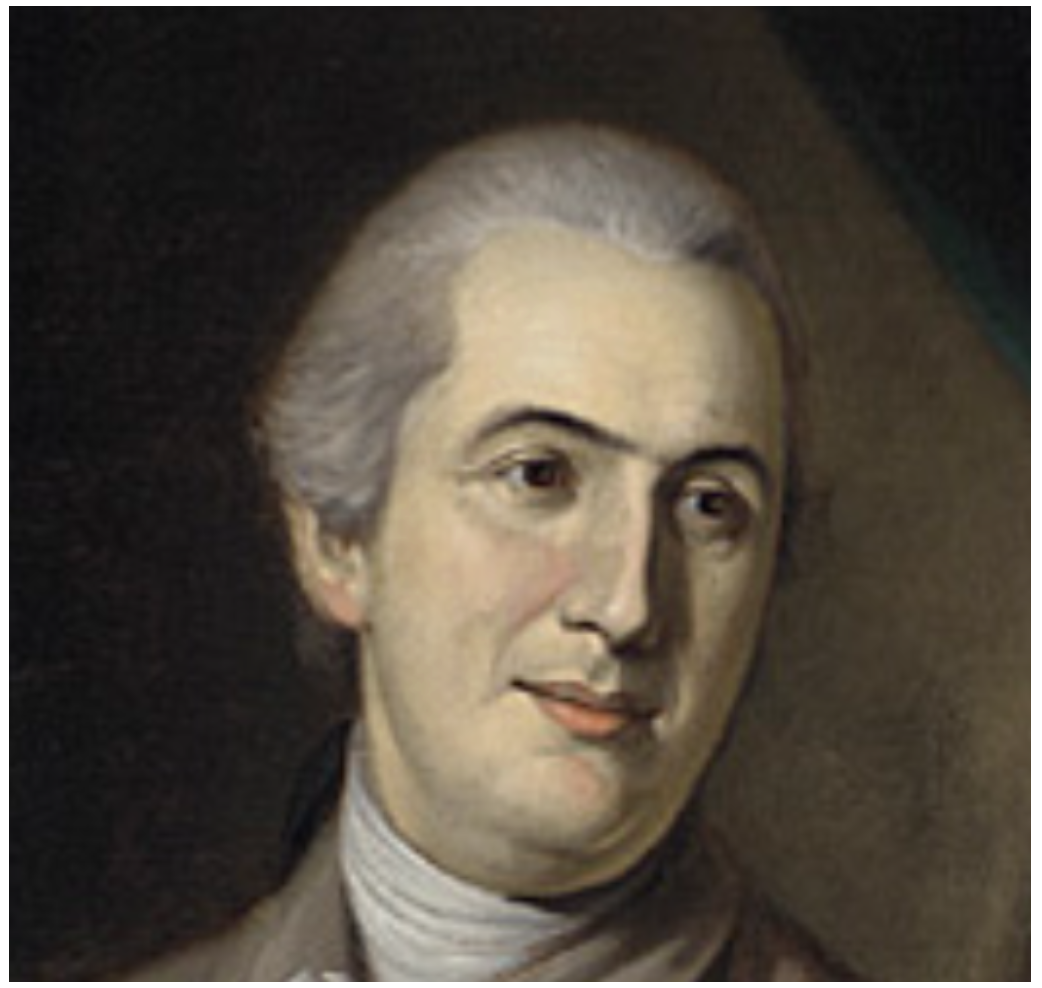
Gouverneur Morris is widely recognized by historians as the “penman of the Constitution.” In 1787 Morris famously drafted the Preamble and the final draft of the Constitution. But what else did he write? While largely forgotten today, Congress in 1779 called upon Morris to draft an official history of the American Revolution. Published mid-way through the war, Morris’s Observations on the American Revolution (“Observations”) was an effort to combat British propaganda, solidify support for the war effort, and allow the American public to “look over the ground they had trodden.” As argued below, Gouverneur Morris deserves to be recognized the first American[1] historian post-independence from Britain. Indeed, Morris appears to have been the first author to use the phrase “the American Revolution”[2] in print.[3]
The first history of the American Revolution is generally understood to be David Ramsay’s History of the Revolution in South Carolina published in 1785 and his History of the American Revolution published in 1787. Mercy Otis Warren, another early historian of the American Revolution, published her three-volume History of the Rise, Progress, and Termination of the American Revolution in 1805. Published in 1779, Gouverneur Morris’s Observations arguably qualifies as the first history of the Revolutionary War. In hindsight it should not be a surprise that Morris was selected for this task by his peers as his was “the pen most trusted” by Congress.[4]
Morris’s Observations was written as momentum was shifting to the Americans following the French decision to join the war after the Battle of Saratoga. To be sure, Morris was not attempting to write an impartial historical account of the war. Nevertheless, Morris’s Observations reached back into colonial history to provide an overview of the underlying colonial grievances which gave rise to the war. As such, Morris was writing contemporary history intended for an international audience struggling to understand and justify the war effort on both sides of the Atlantic.[5] While Thomas Paine’s Common Sense is better known, Morris’s Observations arguably had a comparable impact with British audiences when it was reprinted in 1780.[6]
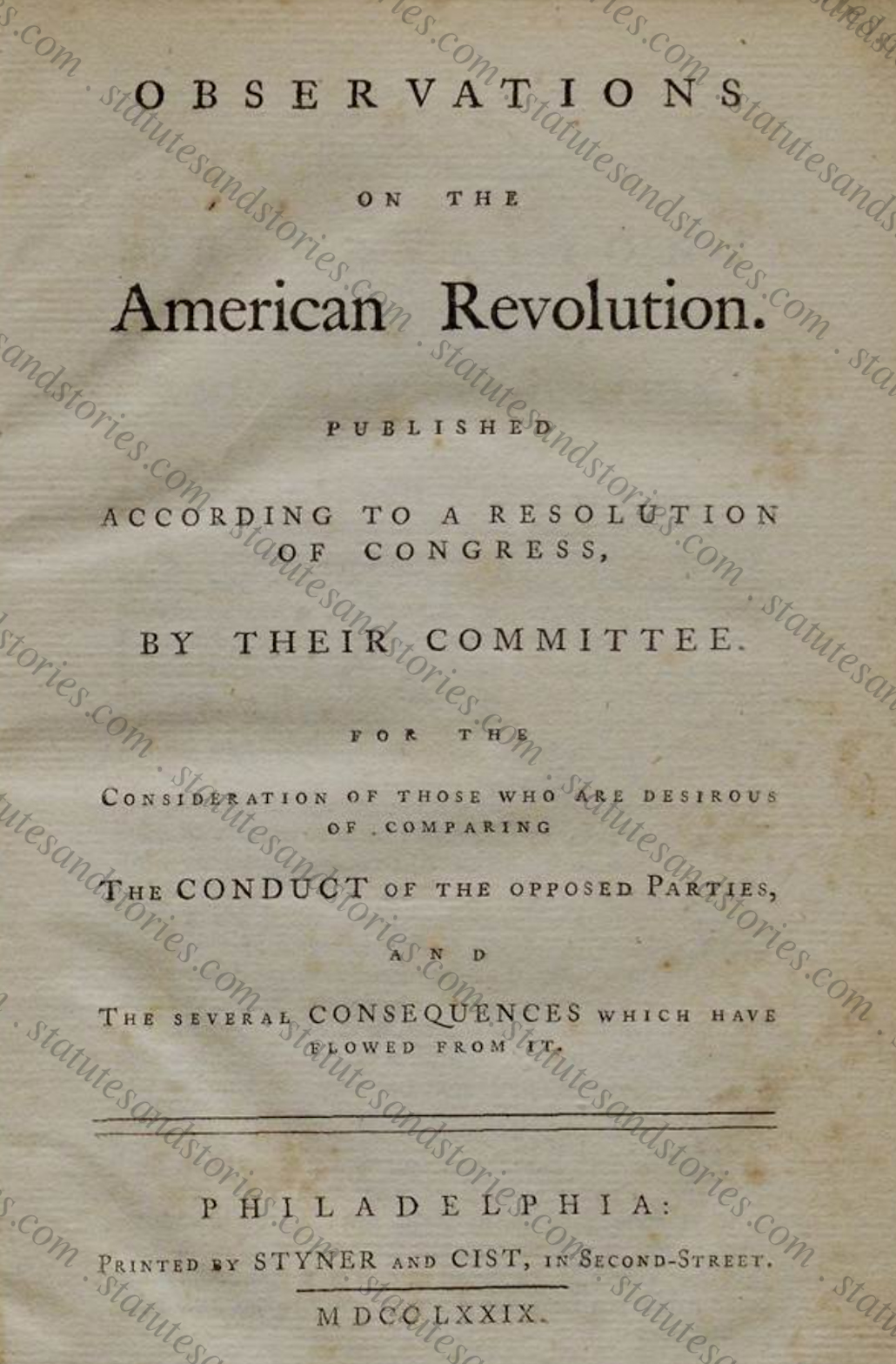
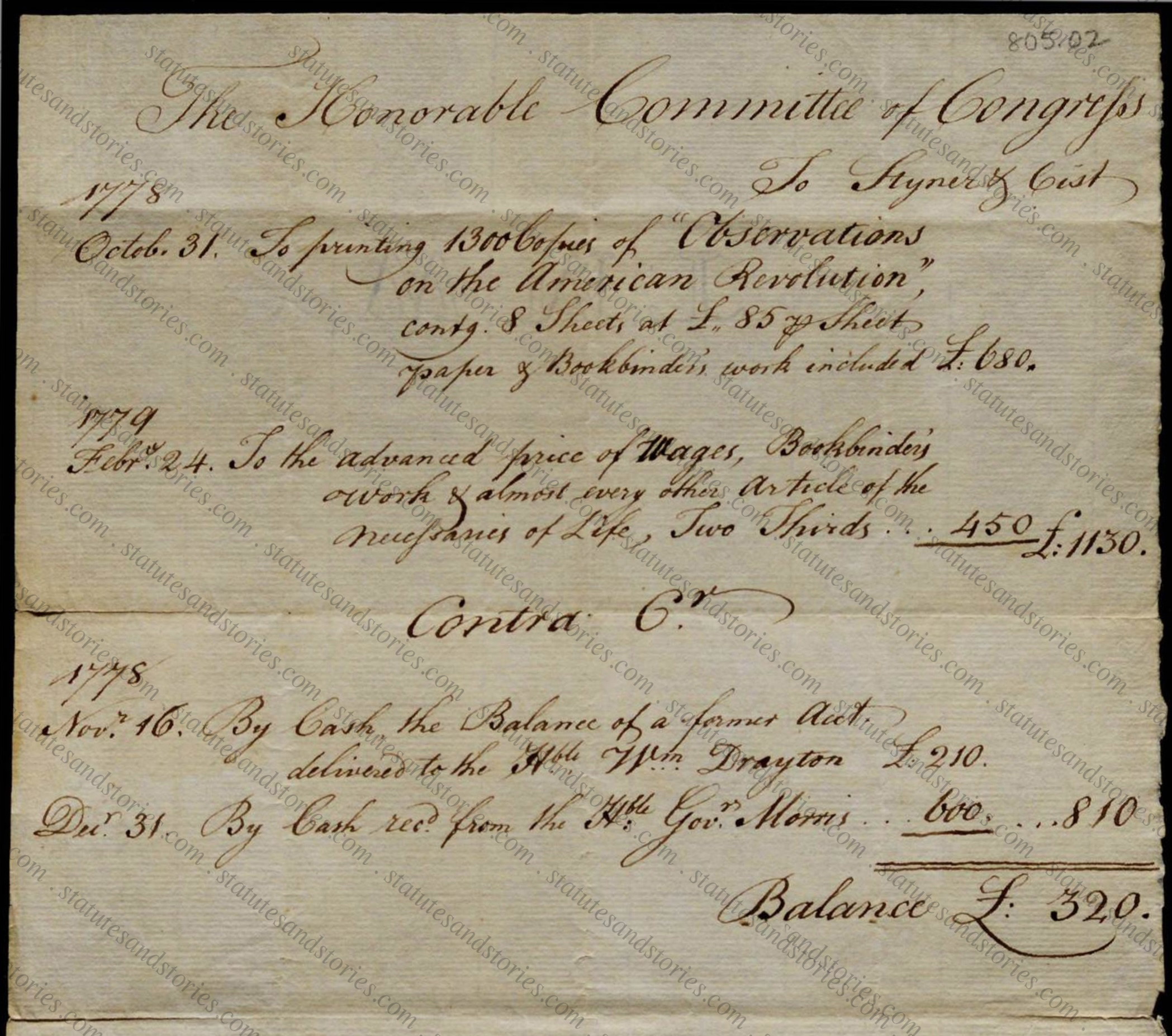
Remarkably, Gouverneur Morris wrote Observations while serving as an active member of the Continental Congress. In fact, a cash strapped Congress voted to pay[7] for the publication of Morris’s Observations, making it nothing less than the only “official” history of the war. Morris’s Observations is not only noteworthy for its early timing but also its official pedigree, having been written “according to a resolution of Congress.”[8] Congress was willing to dedicate scarce wartime funds for this project based on the recognition that America was waging both a defensive campaign against the British military and a public relations war with the British Carlisle Commission.
This blog post is the first of a two-part series arguing that Gouverneur Morris has a rightful claim to be recognized as the first historian of the United States, as such. Part 1 begins by introducing Morris’s long overlooked work. Part 1 makes the case that Morris was the ideal choice to draft the first history of the American Revolution, as the “foremost publicist” of Congress.[9] During his time in Congress Morris was called upon to draft “almost if not all the publications of Congress of any importance,” particularly those involving diplomatic relations.[10]
Part 2 (pending) continues a detailed analysis of the contents of Morris’s Observations. Short on details of specific battles, the work is less of a military history and more of a diplomatic and political history of the war. Morris’ Observations includes a discussion of the adoption of the Stamp Act in 1765, its repeal in 1766, the Townsend Acts[11] of 1767, the Continental Association in 1774, various pamphlets and addresses to the inhabitants of colonial America and petitions to the King prior to independence, the Olive Branch Petition[12] in 1775, the accompanying Address to People of Great-Britain, various Congressional resolutions, and the Declaration of Independence.[13] The work also reprints the back and forth war of words between Congress and the Carlisle Commission in 1778, which was largely Morris’s handiwork.[14]
Part 2 (pending) also addresses the historiography of the America Revolution, comparing Morris’s Observations with subsequent histories of the Revolution. While Morris does not appear to have coined the phrase “the American Revolution,” he was seemingly the first to use it in print. Part 2 concludes with a discussion of the historical significance of Morris’ Observations and his vision for postwar America.
Congress understood the importance of Observations, printing 1,3000 copies of the 122-page pamphlet for distribution around the country.[15] The 3,000 word monograph was printed in Philadelphia using soft cover bindings. Today the work would be described as the equivalent of a Congressional white paper. “The publication was the nearest Congress ever came to issuing an official history of the revolution.”[16] In addition to providing a review of Anglo-American relations, the work was an effort to demonstrate British responsibility for the war, American resolve, and the inevitability of American independence.
Gouverneur Morris and the Continental Congress
Morris’s entry into revolutionary politics began in 1775. Only 23 years old, Morris was elected to New York’s First Provincial Congress shortly after New York learned of the Battle of Lexington and Concord.[17] After serving several terms, Morris would become one of the youngest members of the Second Continental Congress. From these early vantage points, Morris was ideally situated to witness American history in the making.
Morris first met George Washington in June of 1775, the same month that Washington was appointed Commander in Chief of the Continental Army. Morris was a member of the greeting party that welcomed “the rebel Generals,” Washington, Philip Schuyler and Charles Lee to New York City.[18] Morris’s diplomatic skills would be put to good use. In a twist of fate, Washington arrived at New York City on his way to Boston on the same day that Royal Governor William Tryon arrived from London.[19]
Among other assignments, Morris chaired the New York Provincial Congress’ standing Committee of Correspondence[20] and served on its first Committee of Safety.[21] Morris also served on the committee that prepared instructions for New York’s delegates to the Continental Congress, which included Morris’s half brother, Lewis Morris.[22] Along with John Jay and Robert R. Livingston, Morris helped draft the New York Constitution in 1776. He successfully urged that religious freedom be protected, but failed in his attempts to ban slavery.[23]
After the British evacuation of Boston, Washington returned to New York in 1776. Morris worked closely with Washington on a “Secret Committee.” Morris also served on a committee investigating an assassination plot on Washington’s life.[24] In 1776 Morris met the similarly precocious Alexander Hamilton, at the time an artillery captain in the New York militia.[25]
In 1777 Morris was appointed to the Second Continental Congress. At the time, Congress had fled to York, Pennsylvania, after the British captured Philadelphia. When Morris arrived at Congress in January of 1778 his “reputation for a certain genius and eloquence preceded him.”[26] After meeting Gouverneur, Robert Morris recognized his “first rate abilities” and predicted that he “will be immediately useful” to his Congressional colleagues.[27] As described by General Richard Montgomery,“Gouv Morris cuts a figure….a very find young fellow.[28] Egbert Benson, New York’s future attorney general, remarked that Morris comprehended complex financial matters “as it were by intuition.”[29]
On his first day in Congress Morris was appointed to the Committee at Camp to meet with George Washington at Valley Forge.[30] Morris quickly recognized the desperate state of the army, writing to John Jay on February 1, 1778 that the “skeleton of an army presents itself to our eyes in a naked, starving condition, out of health, out of spirits.”[31] Morris would not only form an abiding friendship with Washington, at Valley Forge he also met the Marquis de Lafayette and Alexander Hamilton.
Morris was a workhorse during his service in Congress. He was appointed to and chaired an extraordinary number of critical committees. By the end of 1778, Morris served on sixty-five committees, including the Financial Committee, the Committee on Public Safety, the Committee on Marine Activities, the Committee on Treasury Administration Reorganization, the Medical Committee, the Committee to Provide Instruction to Our Foreign Commissioners, the Clothier General’s Committee, the Committee for Settling Cartel Problems, and the Committee to draw up seals for the Treasury and Navy, to name a few.[32] Morris drafted a manifesto on the injurious treatment American prisoners.[33] His July 1778 report to establish a Treasury Board would subsequently be adopted by Congress, among other reports prepared by Morris.[34] In 1778 Morris became one of the youngest signatories to the Articles of Confederation.
In addition to a “staggering number” of committee assignments, much of Morris’s work
in Congress involved sensitive foreign policy, the American response to the British Carlisle Commission, and budding relations with France. Due to his deep involvement in critical diplomatic matters, Morris’s biographers have recognized that he was effectively serving as “Congress’ foreign secretary.”[35] This experience no doubt proved useful when Morris subsequently complied Observations to tell the American side of the story.
Gouverneur Morris and the Carlisle Commission
In April of 1778 Congress received a letter from General Washington with breaking news from London. With prospects of a possible American alliance with France on the horizon, Parliament was apparently prepared to reconcile with the colonies. If true, Lord North was willing to surrender taxing authority and recognize colonial grievances short of independence.[36]
Britain was seemingly prepared to offer home rule to the war weary Americans. A peace commission to be led by the Earl of Carlisle was being assembled in London to negotiate with Congress. General Washington was alarmed by the pending British proposal. This would have been an offer too good to refuse – if it was 1775. Washington recognized that the “diabolical” scheme was a Trojan Horse “designed to poison the minds of the people…from our cause.” Washington wrote that he expected that the British ploy “will be attacked in every shape, in every part of the Continent.”[37]
After reading Washington’s letter Congress appointed a committee chaired by Morris to study the news from London.[38]On April 22 a report prepared by Morris recommended that independence was no longer negotiable. As framed by Morris, “these United States cannot with propriety, hold any conference or treaty with any commissioners on the part of Great Britain, unless they shall preliminary thereto, either withdraw their fleets and armies, or else, in positive and express terms, acknowledge the independence of the said states.” Congress unanimously approved Morris’s recommendation and ordered it published.[39] Congress thus rejected the British bait on no uncertain terms.[40]
As described by Morris biographers, his report was “tough, realistic, and inspiring.”[41] Morris made clear that there would be no backing down from their great cause “in which all mankind are interested.”[42] Morris explained that America was “united in this arduous contest upon principles of common interest, for the defense of common rights and privileges; which union hath been cemented by common calamities, and by mutual good offices and affection….” The report ended with a call for the states to double down on the war effort with the “most strenuous exertions” in support of the continental troops in the field and that the state militia “may be held in readiness to act as occasion may require.”[43]
John Jay readily recognized Morris’s handiwork. In a letter to Morris Jay suggested that the report “was too strikingly marked with Morris not to be known by his friends to have been produced by his pen.”[44] Henry Laurens, also pleased with Morris’s work, observed that Morris’s report “contains a complete answer to the laborious performances of Lord North and the labors of the blood thirsty Tyron.” On a lighter note, the President of Congress observed to his son that Morris’s report, “will point out to the illustrious Commissioners from White Hall, from whence to take their departure.”[45]
It soon became clear that the Carlisle Peace Commission was a last-ditch effort to pre-empt ratification of the treaties negotiated by America and France.[46] Morris had predicted as much. In a letter to John Jay, Morris also correctly predicted that if in fact a treaty had been signed with the House of Bourbon “a spark hath fallen upon the train which is to fire the world.”[47]
Although Congress had adjourned for the day, on May 2 President Laurens hastily reconvened Congress into special session. The joyful news must have been palpable as the treaties of amity and commerce with France were laid before Congress.[48] Also racing across the Atlantic, however, were the Carlisle commissioners.
Congress was ready for the Carlisle Commission when the formal dispatch from London arrived on June 13. Another three-member committee had been directed to prepare an address to the American public.[49] The “Address of the Congress to the Inhabitants of the United States of America” was drafted by Morris. Designed to warn the public of the danger of the seductive offer from Britain, Congress recommended that ministers of all denominations read Morris’s address in their “respective churches, chapels and other places of worship.”[50]
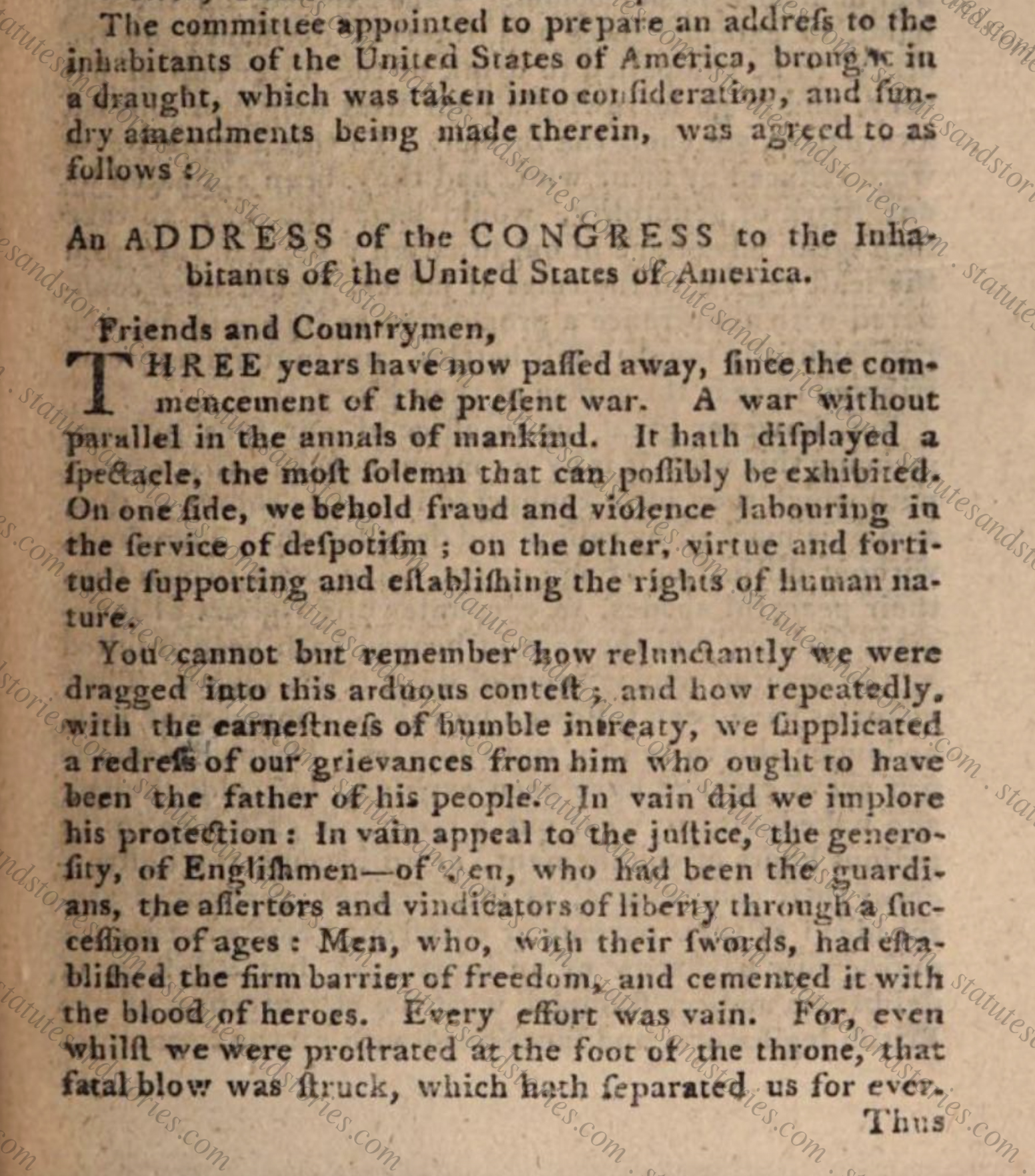
As long as America was not ensnared by “insidious offers of peace” and had the courage to persevere it would prevail. For surely, not even “a shadow of liberty” could be preserved “in a dependent connection with Great Britain.” If America continued the struggle, Morris’s looked to a time soon to arrive “when every man shall sit under his own vine and under his own fig-tree, and there shall be none to make him afraid.”[51] Morris also envisioned the “sweets of a free commerce with every part of the earth” would reimburse America for all its losses. Morris concluded the address with the prayer that “the power and the happiness of these sovereign, free and independent states, founded on the virtue of their citizens, increase, extend and endure.”[52]
Frustrated with Congress’s cool response, the Carlisle Commission sent an open letter challenging Congress’s authority to make treaties under the Articles of Confederation.[53] Rather than debating with the enemy, Congress resolved that “no answer be given” to the Carlisle Commission’s impertinent letter.[54] Congress had the luxury of ignoring the Carlisle Commission, since it knew that their official silence would be joined by the ready pen of Morris.[55]

Over the next several months, writing anonymously as “An American,” Morris engaged in a newspaper war with the Carlisle Commission. For example, Morris taunted: “You have tried fleets and armies and proclamations, and now you threaten us with newspapers.”[56] When the Carlisle Commission appealed directly to public opinion, Morris responded that at least two-thirds of the population were patriots. Observing that “the land of America is against you,” Morris explained that the “principles of your opponents are republican, some indeed aristocratic, the greater part democratic, but all opposed to kings.” Morris further proclaimed that America was “not only vigilant and irascible, but much roused and exasperated” by “the injustice, the treachery, the cruelty of Great Britain.”[57]
Morris and Foreign Policy
The fact that Morris found time to joust with the Carlisle Commission is remarkable given his other responsibilities, which would further expand during the summer of 1778. The value of the new alliance with France immediately became clear on July 29, 1778 when a squadron of French war ships arrived in the Delaware Bay. In addition to troops and supplies, the French fleet also delivered the new French minister plenipotentiary from the Court of Versailles, Conrade Alexandre Gérard. Not surprisingly, Gouverneur Morris was selected to help arrange the protocol for Gérard’s reception as the first foreign diplomat ever received by Congress.[58]
Gérard’s arrival proved to be a seminal moment in the Revolutionary War.[59] On August 6, 1778, the Continental Congress held an elaborate ceremony at the Pennsylvania State House formally welcoming Gérard. After speeches and diplomatic protocols had concluded, Congress adjourned to Philadelphia’s City Tavern for a joyful reception.[60] As reported in diplomatic correspondence back to Paris, twenty-one toasts were raised amid the roar of cannon, including toasts to the King and Queen of France, the perpetuity of the union between France and America, and the success of their combined armies.[61]
In addition to working closely with Gérard, Morris was also selected to prepare the instructions for Benjamin Franklin in Paris. Morris thus developed “the first such directives sent to an American minister in a foreign post.”[62] Morris would later be considered for the influential position of secretary to Franklin in Paris.[63]
Accordingly, Morris’s vantage point in Congress, his specific committee assignments, and his work as the pen of Congress made Morris the perfect choice to draft the first history of the war. As described by another famous historian/politician, Teddy Roosevelt, Morris’s Observations was:
a masterly outline not only of the doings of Congress …but also an account of the causes of the war, of the effort of the Americans to maintain peace, and the chief events that had taken place, as well as a comparison between the contrasting motives of the contestants. . . . The whole was executed with address and ability, manifesting a deep knowledge of the principles and reasons on which the contest was founded, and an ardor and patriotism not surpassed by any writings of the day.[64]
This blog continues in Part 2 (pending) with a deep dive into the contents of Morris’s Observations. Part 2 also addresses the historiography of the American Revolution, comparing Morris’s Observations with subsequent histories of the Revolution. Part 2 will conclude with a discussion of the historical significance of Morris’ Observations and his vision for America after the war.
Endnotes
[1] The first published history of the British colonies was Captain James Smith’s The Generall Historie of Virginia, New-England, and the Summer Isles, published in 1632.
[2] Ilan Rachum, “From ‘American Independence’ to ‘American Revolution,’ ” Journal of American Studies 27, no. 1 (April 1993): 73–81; https://www.jstor.org/stable/40464078. Morris likely drew inspiration from William Henry Drayton, the Chief Justice of South Carolina, who referred to the American Revolution as early as April of 1776 in a charge to a grand jury. https://www.amrevmuseum.org/virtualexhibits/season-of-independence/pages/charlestown-south-carolina-grand-jury-presentments-april-23-1776 Drayton was also a colleague of Morris on the three-member committee charged with responding to the Carlisle Commission. JCC, 10:367.
[3] In a letter to John Adams dated 27 March 1777, William Gordon indicated that he was “collecting materials for an history of the rise progress and successful issue of the American revolution.” https://founders.archives.gov/documents/Adams/06-05-02-0074
Nonetheless, Gordon would not publish his history for another decade. William Gordon, The History of the Rise, Progress, and Establishment, of the Independence of the United States of America, 4 vols. (London, 1788). Accordingly, while Morris did not originate the term “the American Revolution,” he certainly popularized it.
[4] Edmund C. Burnett, Letters of Members of the Continental Congress (Carnegie Institution, 1926), 3:xv.
[5] Shortly after its publication in America, Morris’s Observations were circulating in London. William Howard Adams, Gouverneur Morris: An Independent Life (Yale University Press, 2003), 111. Observations was republished in 1779 by the British periodical The Remembrancer. Morris biographer James Kirschke suggests that the republication of Observations by John Alnon in London was propitiously timed. According to Kirschke, “[i]t is quite possible,” that Observations may have helped swing British public opinion against the war. In fact, Alnon was accused of libeling King George and was imprisoned for two years. James J. Kirschke, Gouverneur Morris: Author, Statesman, and Man of the World (Thomas Dunne Books, 2005), 92.
[6] Kirschke, 92.
[7] Congress authorized payment of $2,986 to Stiner & Cist for printing of 1,300 copies of Observations on April 5, 1779. JCC, 13:421.
[8] The full title of the 122-page work declares that it was “Published According to a Resolution of Congress by their Committee for the Consideration of those who are Desirous of Comparing the Conduct of the Opposed Parties and the Several Consequences which have Flowed from It.”
[9] Max M. Mintz, Gouverneur Morris and the American Revolution (University of Oklahoma Press, 1970), 104.
[10] Gouverneur Morris to Robert Morris, 17 August 1778; LMCC, 3:376-77.
[11] Morris refers to the Townsend Acts as “a statute commonly called the glass, paper and tea act,” as today’s conventional labels and terminology had not yet been agreed upon. Observations at 6.
[12] Observations at 12.
[13] Morris cites the Declaration of Independence as the “DECLARATION by the Representatives of the UNITED STATES of AMERICA, in Congress assembled,” which was the title in the original printed version of the Declaration, but not the engrossed version signed beginning on August 2, 1776.
[14] The Carlisle Peace Commission arrived in America in June of 1778 and did not return to England until December. Frustrated in their efforts to negotiate with Congress, in October the Commission issued an appeal directly to the American people, with a 40-day deadline to accept the King’s offer of pardon. The Observations were thus part and parcel of the Congressional response to the British overtures. Paul H. Smith, Letters of Delegates to Congress (Library of Congress, 1985), 12:xxvii.
[15] JCC, 12:519.
[16] Paul H. Smith, Letters of Delegates to Congress (Library of Congress, 1985), 12:xxvii.
[17] Journals of the Provincial Congress of the State of New York (Albany: Thurlow Weed, 1842), 1:8; Mintz, 48.
[18] JPC, 1:54-55.
[19] Believed to have been the largest ceremonial welcome he had every received, Washington was greeted by eight militia companies and a large crowd as he crossed across the Hudson. According to one newspaper report, the throng included “a greater Number of the principal Inhabitants of this City, than ever appeared here on any Occasion before.” New-York Gazette: and Weekly Mercury, 26 June 1775. British Royal Governor Tryon was kept waiting on his ship in New York harbor. Adams, 52-53; Mintz, 54-55.
[20] JPC, 1:13.
[21] Adams, 54. Sparks, 1:40.
[22] JPC, 1:26.
[23] Adams, xii.
[24] Adams, 68. Mitnz, 60.
[25] Adams, 58,
[26] Adams, 95. Having been born on 31 January 1752, Morris was only in his mid 20s when he was elected to Congress.
[27] Robert Morris had also heard of Gouverneur’s reputation for whimsy, indicating that “I have been told that his only blemish is being a little to whimsical.” Robert Morris to Richard Peters, 25 January 1778. Adams, 304. William Constable, who would also become a close associate and business partner, opined that “our G.M. is a Man of Abilities, but unless intimately acquainted with him you would not be apt to believe that He is also a man of Infinite Industry and strict Attention to his Business.” Adams, 95.
[28] Adams, 49; Mintz, 48. Montgomery would perish leading the invasion of Quebec.
[29] Sparks, 1:39-40.
[30] Mintz, 89.
[31] Mintz, 94.
[32] Adams, 102; Kirschke, 68, 74, 93.
[33] JCC, 10:81.
[34] Meister, 197.
[35] Adams, 102.
[36] Mintz, 101; Adams, 103.
[37] George Washington to Henry Laurens, 18 April 1778.
[38] JCC, 10:367.
[39] JCC, 10:374, 379, 380.
[40] Mintz, 101.
[41] Adams, 103.
[42] JCC, 10:379.
[43] JCC, 10:380.
[44] John Jay to Gouverneur Morris, 20 May 1778. https://founders.archives.gov/documents/Jay/01-01-02-0307
[45] Henry Laurens to John Laurens, 28 April 1778; LMCC, 3:195. The President of Congress, Henry Laurens also told his son that Morris’s report, “will point out to the illustrious Commissioners from White Hall, from whence to take their departure…”
[46] Mintz, 102.
[47] LDC, 9:545.
[48] JCC, 11:418.
[49] JCC, 11:471.
[50] JCC, 11:481.
[51] JCC, 11:481. Micah, 4:4.
[52] JCC, 11:481.
[53] Mintz, 110.
[54] JCC, 702.
[55] Edmund C. Burnett, The Continental Congress (W. W. Norton & Co., 1964), 352.
[56] Mintz, 107.
[57] “An American,” Pennsylvania Packet, 19 September 1778.
[58] Adams, 112; Mintz, 108-9.
[59] In a letter to the Rhode Island Assembly, Rhode Island Congressional Delegate Henry Marchant reported his expectation that the “important day” was “replete with lasting advantages” arising from the American treaty with “so powerful an ally.” Marchant opined that the alliance with France “promises to be as lasting as it is mutually beneficial, generous and noble.” Paul H. Smith, ed., Letters of Delegates to Congress (Washington, DC: Library of Congress, 1983) (hereinafter LDC), 10:431.
[60] Samuel Flagg Bemis, A Short History of American Foreign Policy and Diplomacy (New York: Holt, Reinhart & Winston, 1959), 13; John D. R. Platt, Historical Resource Study: The City Tavern (Philadelphia: Independence National Historical Park, 1973), 140-141.
[61] Edmund Cody Burnett, The Continental Congress (New York: The Macmillan Co., 1941), 349; Edmund C Burnett, ed., Letters of Members of the Continental Congress (Washington, DC: Carnegie Institution, 1926), III:362; Harold Donaldson Eberlein & Cortlandt Van Dyke Hubbard, Diary of Independence Hall (Philadelphia: J. B. Lippincott Co., 1948), 244.
[62] Adams, 112.
[63] Mintz 142. Unfortunately the carriage accident that resulted in amputation of his leg forced Morris to turn down the job.
[64] Theodore Roosevelt, Gouverneur Morris (Houghton, Mifflin & Co., 1898), 88.