Benjamin Franklin Historic Marker Application
Visitors to Philadelphia are well aware of the “Franklin Court,” one of the most beloved historic sites in “America’s Most Historic Square Mile.” The archaeological remains of Benjamin Franklin’s famous home near Third and Market Street are memorialized today as an iconic “ghost reconstruction” and adjoining museum within Independence National Historical Park. The celebrated Franklin Court complex was built as part of America’s Bicentennial in 1976. Yet, it is not immediately evident to visitors that Benjamin Franklin had already retired from his career as a printer when he moved to this location.[1]
A substantially larger percentage of Franklin’s adult life was spent elsewhere.[2] For decades Franklin and his family resided two blocks closer to the Delaware River on Market Street between Front and Second Street. It is time to recognize the largely forgotten location where Franklin and his family lived on the 100 block of Market Street during the formative years of his career as a printer, entrepreneur, philanthropist, inventor and scientist (hereinafter the “Franklin Press” location).
As described below, beginning in 1728 Franklin lived alongside his print shop at several locations on the 100 block of Market Street. The purpose of this narrative summary is to evidence the robust historic record and widespread community support for the pending application for the “Franklin Press” marker (PHMC application PGJS1EQ7GS17).
Edgell and Grace properties on the 100 block of Market Street
Unlike Franklin’s final home at Franklin Court, Franklin never owned the rental properties on the 100 block of Market where he established his printshop and raised his family. Perhaps this is the reason why the “Franklin Press” location has been ignored for so long. Fortunately, however, the Franklin Press location where Franklin lived on the 100 block of Market Street near his printshop from 1728 until 1751 is well documented.[3]
As illustrated by Exhibit 1 below, from his arrival in 1723 at the age of 17, Franklin can be connected to over a dozen different locations in Philadelphia.[4] When he wasn’t living in London or Paris, Franklin made his home in Philadelphia from 1723 to 1790. The only surviving building where Franklin lived is 36 Craven Street in London, now known as the Benjamin Franklin House.[5] While Philadelphia lacks any surviving Franklin residences, the “Franklin Press” location should nonetheless be recognized as the most important site of his long publishing career.
Exhibit 1 (map)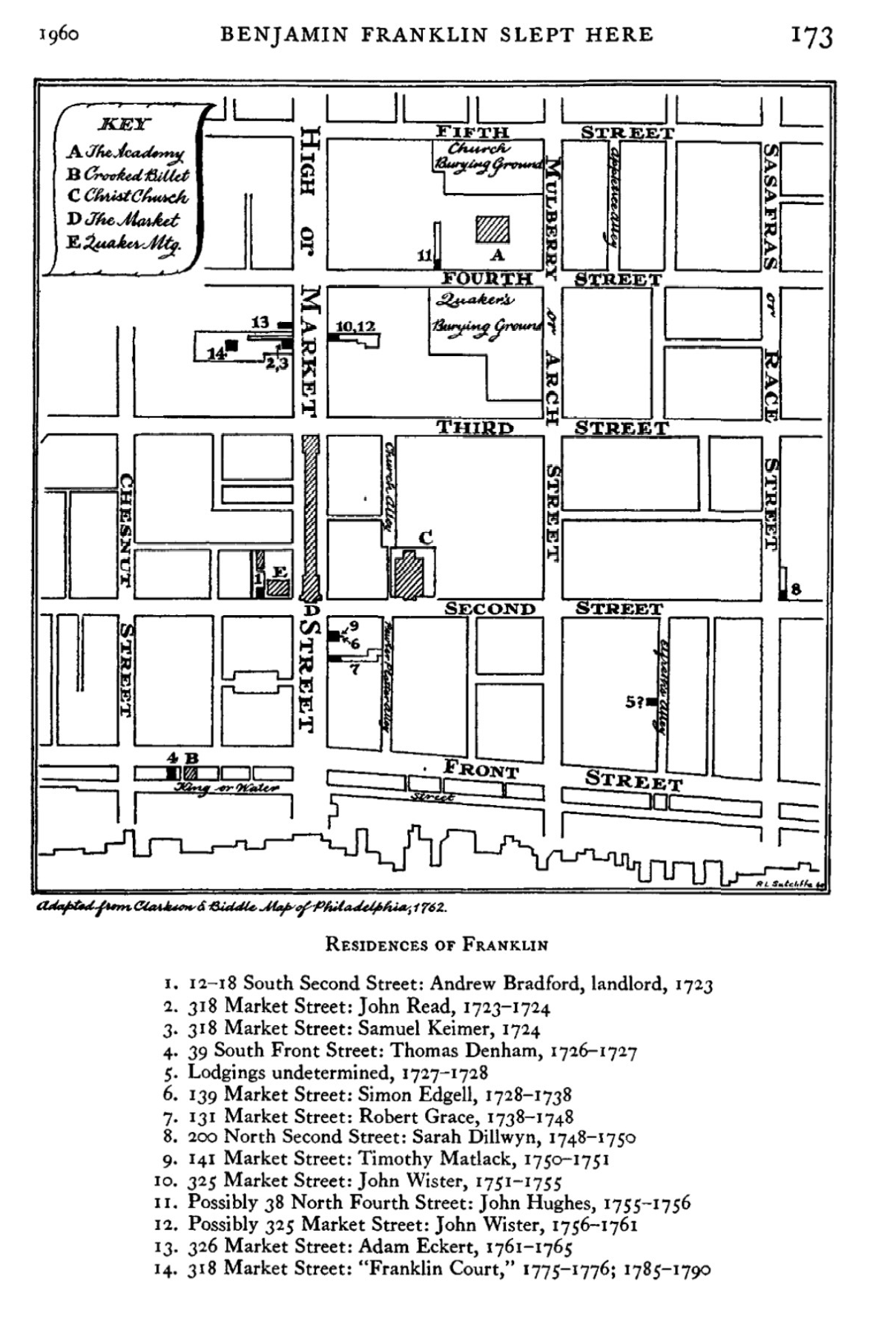 Biographers commonly divide Franklin’s remarkable story into different phases of his life. During his youth and apprenticeship Franklin lived in Boston where he was born, Philadelphia, New Jersey, and London. After learning the printing trade, at the age of 23, Franklin and Hugh Meredith rented a small house from Simon Edgell in June of 1728 at what is now 139 Market Street (the “Edgell property”).[6] At this location, in October of 1729, Franklin and Meredith began publishing what would become the most successful newspaper of its day, the Pennsylvania Gazette.
Franklin remained at 139 Market for a decade until January of 1738 when he relocated a few doors down the block to 131 Market Street.[7] From 1738 to 1748 Franklin lived at and operated his printshop from the 131 Market location owned by Robert Grace (the “Grace property”). It was at these Market Street locations where Franklin prospered as a printer, entrepreneur, inventor and philanthropist. This is the reason why these properties on the 100 block of Market should be recognized by a historic marker honoring Franklin and the “Franklin Press.”
By contrast, during the period when he lived in London from 1757 to 1775 (with a break from 1762-1764) he was the colonial agent for several colonies and primary intermediary between the colonies and Great Britain. During the final period of his life, 1775 through his death in 1790, “Franklin was an elder statesman and diplomat” who lived briefly at the Franklin Court from 1775-1776 and 1785-1790.[8]
Franklin Press chronology and exhibits
Franklin and Meredith worked together for Samuel Keimer, the publisher of The Universal Instructor in all Arts and Sciences: and Pennsylvania Gazette. The two co-workers decided to go into business together in the spring of 1728 when Meredith’s apprenticeship with Keimer expired. The two partners began renting the Edgell property (139 Market)[9] in June 1728. They ordered a press and type from London with the financial backing of Meredith’s father.[10]
At the 139 Market location Franklin wrote his first Busy-Body column which was printed in the American Weekly Mercury.[11] Franklin also published one of his most important early works, A Modest Enquiry into the Nature and Necessity of a Paper Currency at the Edgell property.[12] In July of 1729 Franklin and Meredith acquired Keimer’s struggling newspaper and press. Beginning on 2 October 1729 Franklin and Meredith began publishing the newly renamed Pennsylvania Gazette. As described by Franklin, they purchased Keimer’s operation “for a trifle.” Franklin later observed that “[i]t prov’d in a few years extremely profitable to me.”[13]
Pictured below is Keimer’s masthead (Exhibit 2), along with the first edition of the newly acquired paper by Franklin and Meredith (Exhibit 3). At the bottom of the 2 October 1729 Gazette (Exhibit 4), Franklin and Meredith identified themselves as the new owners, operating at the “New Printing-Office near the Market.”[14] For the balance of his career, Franklin would continue to cite this location of his printing office, as evidenced by the imprint at the bottom of the 24 October 1765 Gazette (Exhibits 5 & 6).
Exhibit 2 (Pennsylvania Gazette masthead, published by Samuel Keimer, 7 July 1729)
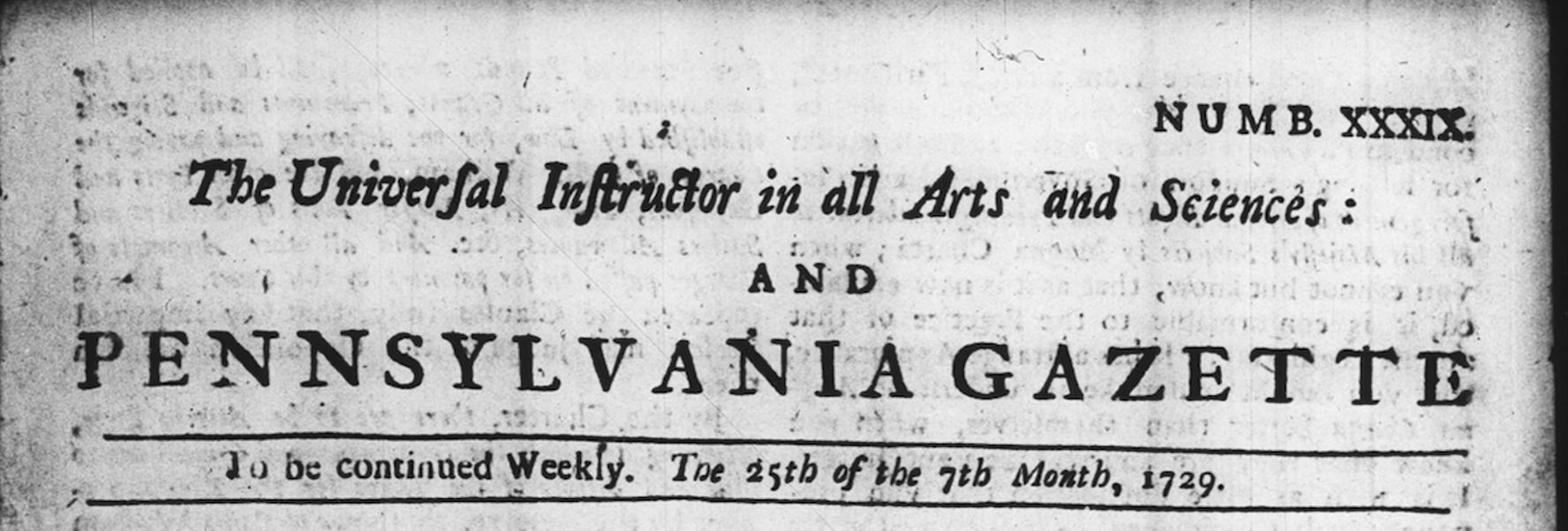
Exhibit 3 (Pennsylvania Gazette masthead, published by Franklin, 2 October 1729)
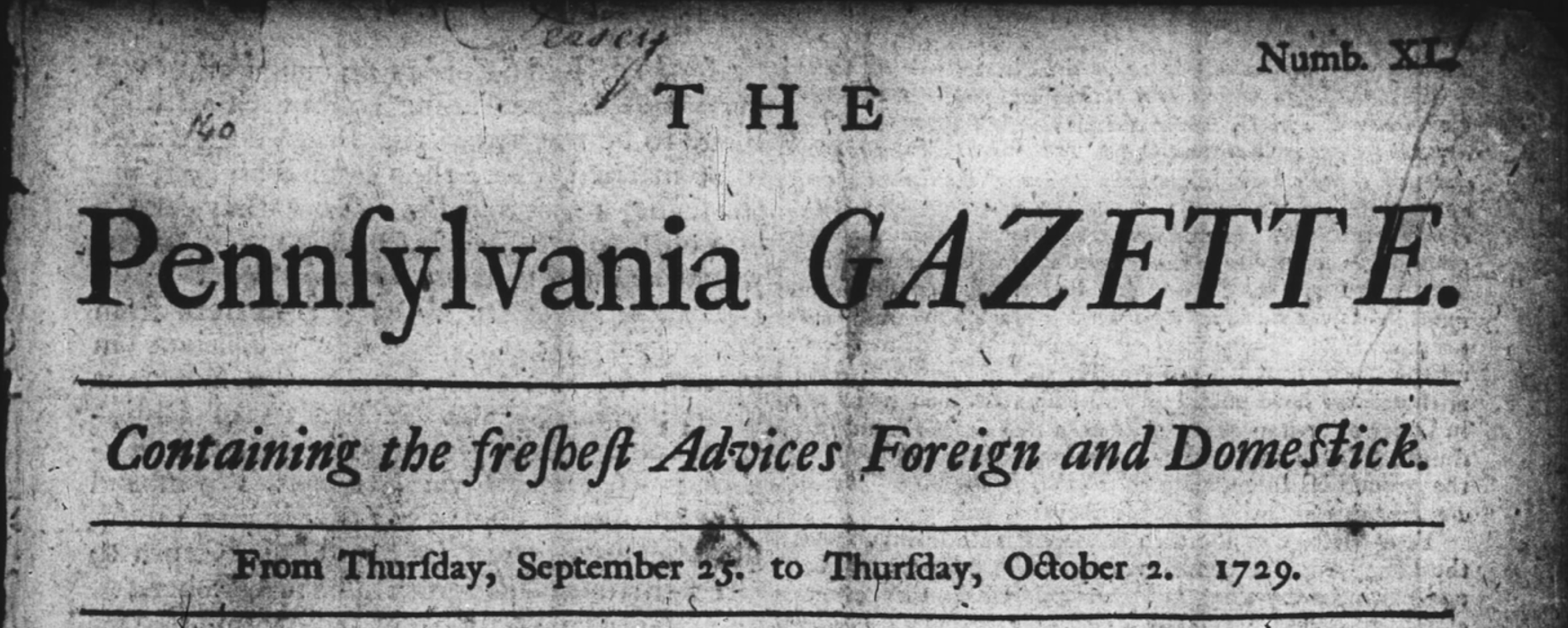
Exhibit 4 (Franklin’s imprint on 2 October 1729)

Exhibit 5 (Pennsylvania Gazette masthead, 24 October 1765)
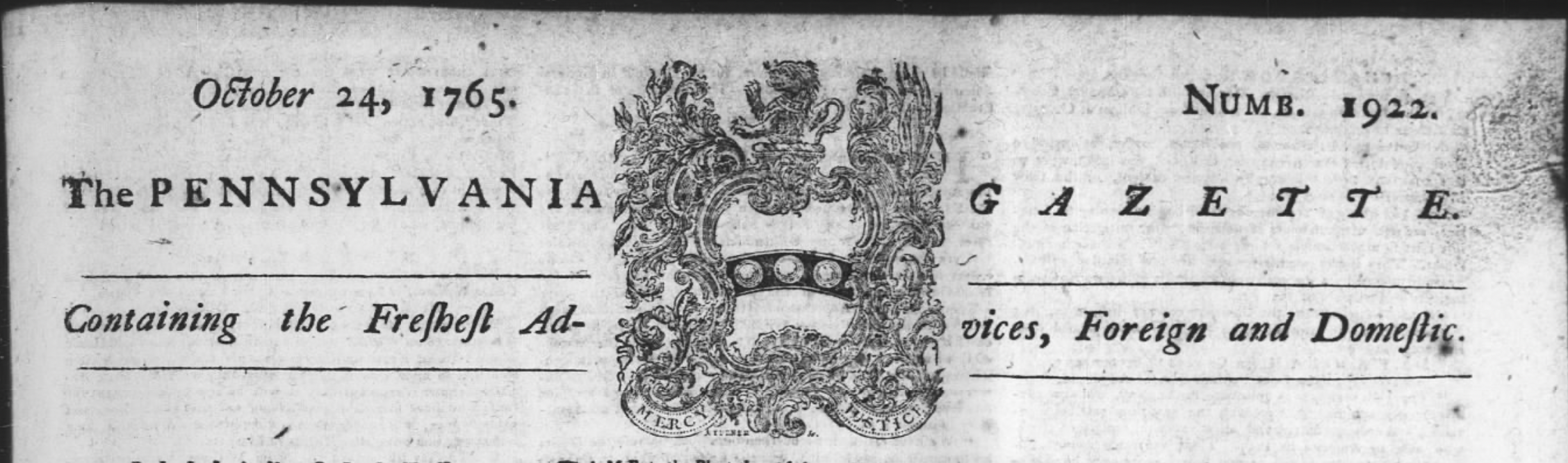
Exhibit 6 (Franklin & Hall imprint, 24 October 1765)

Although Franklin was proudly hard working, driven and thrifty, Meredith was “no compositor, a poor pressman and seldom sober.”[15] Franklin and Meredith dissolved their partnership in April of 1730, with Franklin assuming all unpaid debts.[16] During Franklin’s decades of operation of the Pennsylvania Gazette, the paper featured his pseudonymous writings including his celebrated “Join, or Die” political cartoon.
Franklin also raised his family at the 139 Market location. Franklin’s son, William, was born in 1730.[17] Franklin married Deborah Read in September of 1730. Their son, Francis (Franky) Folger, was born in October of 1732. In January of 1733 Franklin published his first edition of Poor Richard’s Almanack. Written by Franklin using his Richard Saunders penname, the annual almanac would become enormously successful with new editions until 1757.[18] Franklin operated his printshop and the Gazette at the Edgell property for over a decade.
Among other notable accomplishments while living at the 139 Market Street location, Franklin organized his Junto in 1727,[19] helped establish the Library Company in 1731, published the first German-language newspaper in America in 1732,[20] and co-founded the Union Fire Company in 1736.[21] Franklin also became the postmaster of Philadelphia in October of 1737 while living at the 139 Market Street address.[22] Exhibit 7, a notification published by Franklin in the Gazette, announced that “the Post-Office of Philadelphia is now kept at B. Franklin’s in Market-Street.”
Exhibit 7 (Notice published in PA Gazette on 27 October 1737)

Additional evidence of Franklin’s residence in the 139 Market Street property owned by Edgell are ledger entries for house repairs incurred by Franklin. As the house was originally built circa 1717, the need for periodic maintenance is not surprising. For example, over the years Franklin charged Edgell for approximately a dozen repairs, including repairs to the plaster, yard gate, and the stairs.[23] Exhibit 8 illustrates repairs to the Edgell home recorded in Franklin’s Ledger A from the early 1730s.
Exhibit 8 (Franklin ledger entries)


In January of 1739 Franklin and his family “removed from the House he lately dwelt in, four Doors nearer the River, on the same side of the Street.”[24] Pictured below as Exhibit 9 is the notification that Franklin and his printing office relocated to what would now be the 131 Market Street address owned by Robert Grace. Franklin would live at the Grace property until January of 1748.
Exhibit 9 (Notice of Franklin’s move to 131 Market Street, PA Gazette, 11 January 1739)
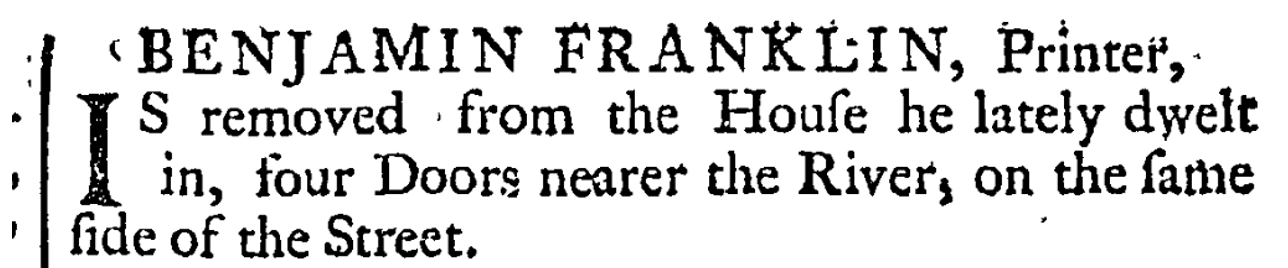
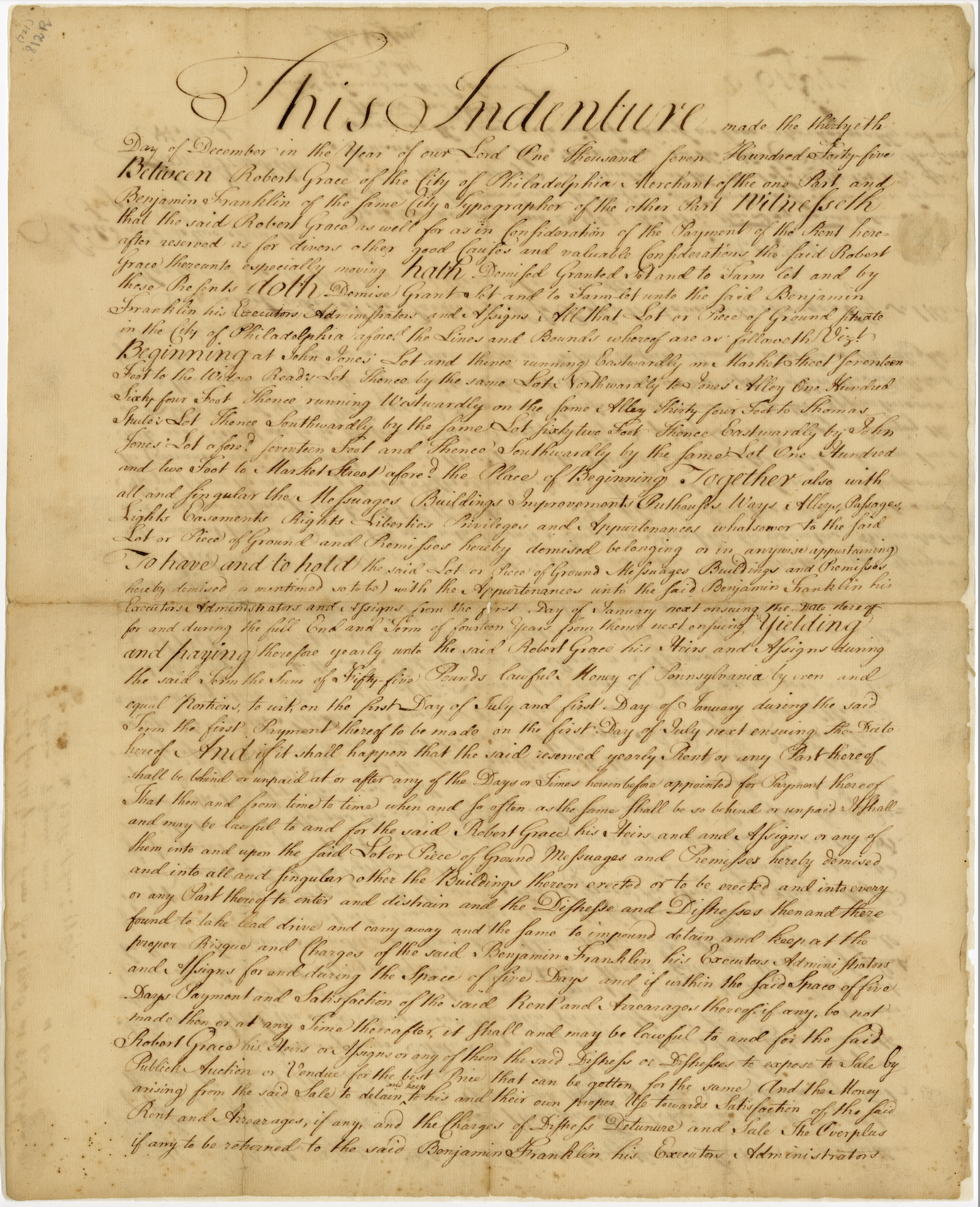
Exhibit 10 is the “indenture” between Franklin and Grace, whereby Franklin leased the 131 Market Street property for more than a decade.[25] StatutesandStories.com thanks Sarah Horowitz, the Curator of Rare Books and Manuscripts at Haverford College, for providing high resolution images of the beautifully preserved manuscript. The lease described the Grace property as follows:
[the lot, with all buildings and other improvements thereon] Beginning at John Jones’s lot on the north side of Market St., running eastward 17 ft. to the Widow Read’s lot, then northward 164 ft. to Jones Alley, westward 34 ft. to Thomas Shute’s lot, southward 62 ft., then eastward by John Jones’s lot 17 ft., and then southward 102 ft. to Market St. Franklin is to pay £55 lawful money of Pennsylvania annually, in equal installments on July 1 and January 1, with a right to Grace to enter and distrain in case of default…
It is also useful to note that the Grace property bordered Jones Alley, which was also known as Pewter Platter Alley (located between Second and Third Streets).[26] Today the alley is Church Street.
Exhibit 10 (Lease for Grace house at 131 Market)
Property description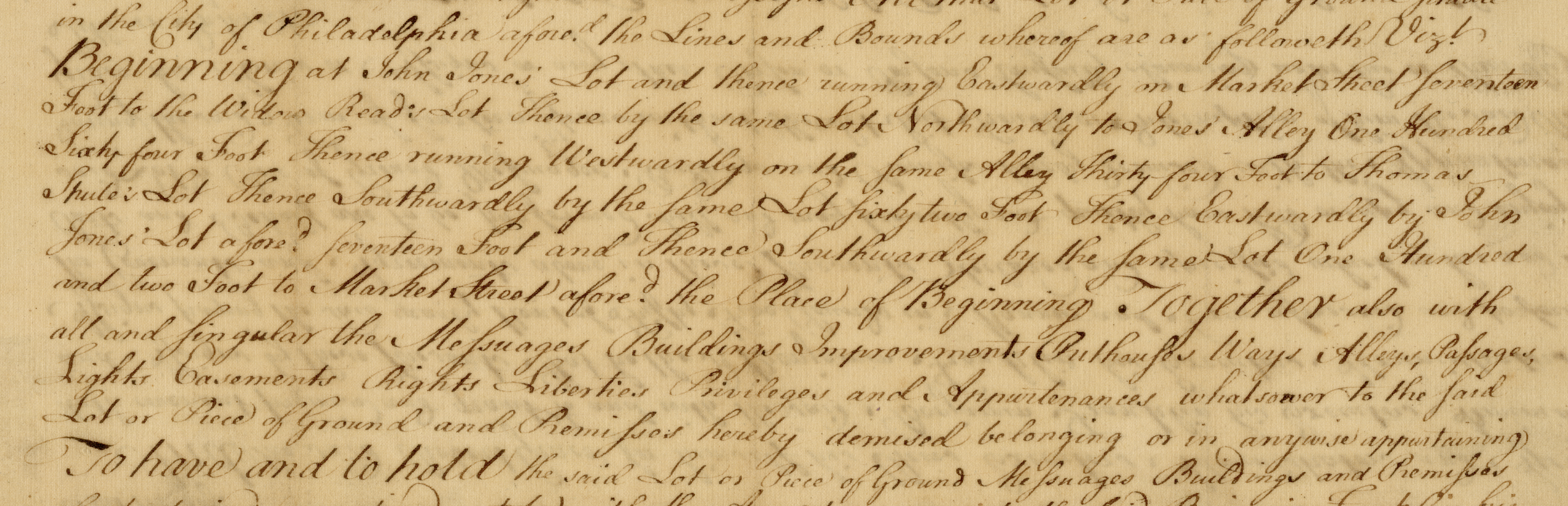
Daughter Sarah (Sally) Franklin was born in September 1743 and resided here. Franklin’s accomplishments while living in the Grace property on 131 Market Street, included:
- Publishing sermons of the Reverend George Whitefield, a leader in the First Great Awakening religious revival
- Inventing the Franklin fireplace, a metal stove designed by Franklin to more efficiently radiate heat
- Founding the American Philosophical Society in 1743 (described in Franklin’s “Proposal for Promoting Useful Knowledge Among the British Plantations in America”)
- Conducting scientific research into electricity beginning in 1745
- Publishing his pamphlet, Plain Truth, in 1747 which contained the first political cartoon.[27]
The Grace property located at 131 Market (and 120-122 Church Street) was considerably larger than the Edgell property. It allowed Franklin to separate his home from his printing office and offered more space for the post office. Scholars have speculated that the additional cost of heating the Grace property may have contributed to Franklin’s invention of his new fireplace.[28]
At the age of 42 Franklin was successful enough that he decided in 1748 to retire from the day-to-day operation of his press. Forming a partnership with David Hall in January of 1748 Hall acquired the printing shop in exchange for half of the profits. Franklin moved to a quieter location from 1748-1750,[29] but briefly returned to the 100 block of Market Street from 1750-1751.[30]
As described by Franklin in a letter written in 1748, he “put my Printing house under the Care of my Partner David Hall, absolutely left off Bookselling, and remov’d to a more quiet Part of the Town, where I am settling my old Accounts and hope soon to be quite a Master of my own Time, and no longer (as the Song has it) at every one’s Call but my own.”[31] In his autobiography he reflected that his partnership with Hall “continued eighteen years, successfully for us both.”[32]
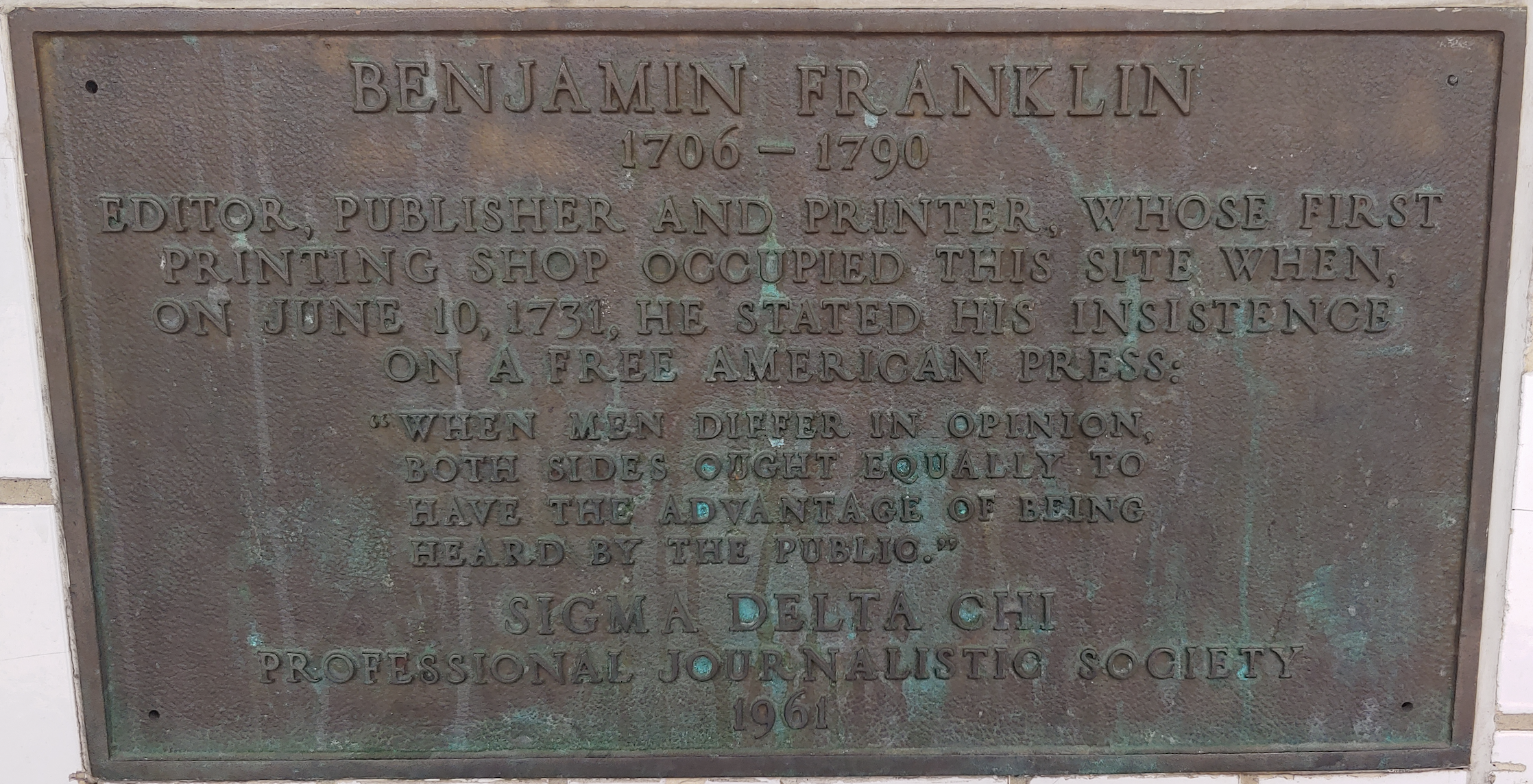
During his extended residence at the 100 block of Market Street, Franklin established the “largest and most influential of the early American printing networks.” Franklin helped facilitate the spread of newspapers published by his former employees. Franklin’s printing network represented one of Franklin’s “major contributions to American journalism,” which “helped lay the foundation for an increasingly free press.”[33] In 1961, the journalism society Sigma Delta Chi installed a marker at the proposed site of the Franklin Press marker to honor his contributions as an editor, publisher and printer. Unfortunately, the marker pictured below as Exhibit 11 has gone missing.
Exhibit 11 (missing marker by Sigma Delta Chi)
141 Market Street home
After briefly retiring to the Dillwyn property from 1748-1750,[34] Franklin returned to the 100 block of Market from 1750-1751. Historians have speculated that after living for decades on Market Street, the Franklins likely missed their old neighborhood and friends.[35] During the period that he lived at 141 Market, “Franklin continued the experiments he had begun in the Grace house, developing his theories on electricity and the cause and effects of lightning.”[36]
While renting from Timothy Matlack at 141 Market Street, Franklin’s other activities included:
- Formulated plans for an office to insure houses against fire
- Developed plans for a provincial hospital
- Assisted with the founding of the University of Pennsylvania
- Assisted with the founding of the Pennsylvania Hospital.[37]
Although Franklin’s “Proposals Relating to the Education of Youth,” were published in 1749 when Franklin lived north of Market Street, it is clear that he assisted with his founding role while living at the 141 Market Street location. For example, Franklin helped organize 24 university trustees who purchased a building in 1751.[38] Franklin also sketched out and published his ideas for “Philadelphia Academy” in 1750 and 1751.[39] In other words, even in retirement Franklin used his press on the 100 block of Market Street to spread his visionary ideas which remain his legacy today.


Conclusion
Benjamin Franklin is a signature figure in the history of Philadelphia. Franklin also has a lasting legacy in American and world history. Since 1792, when the first public monument to Franklin was commissioned, he has been repeatedly recognized with public art and other memorials.[40] For example, the Benjamin Franklin bridge opened in 1926, the year of the Sesquicentennial (America’s 150th birthday). The Benjamin Franklin Parkway is an iconic mile-long boulevard stretching from City Hall to the Philadelphia Museum of Art which is modeled after Paris’ Champs-Élysé. The 20-foot marble Franklin statue and Benjamin Franklin National Memorial were dedicated at the Franklin Institute in 1976.[41] Yet, no marker mentions Franklin’s printing press, his longstanding residence, or his visionary and charitable activities on the 100 block of Market Street.
As described above, Franklin only moved to his final Franklin Court home in 1775, after retiring from active involvement as a publisher. The proposed Franklin Press marker application should not be viewed, however, as detracting in any way from the significance of Franklin Court. Franklin’s public career as the president (governor) of Pennsylvania, delegate to the Continental Congress and member of the Constitutional Convention occurred while living at Franklin Court. Nevertheless, Franklin’s private career and formative years as a printer, author, philanthropist, businessman, inventor and scientist occurred at the Franklin Press location. Accordingly, the Franklin Press is deserving of a separate marker which is well timed to honor Franklin for America’s 250th birthday.
Respectfully submitted,
List of signatories
W. B. Allen, PhD (Michigan State University Emeritus Dean and Professor)
J. Jackson Barlow, PhD (Director, Program in Philosophy, Politics, and Economics, Juniata College)
Jonathan Burton (Director of Development, Independence Historical Trust)
Carol Berkin, PhD (Presidential Professor of History Emeritus at Baruch College and The Graduate Center, City University of New York; Editor, History Now)
Kenneth R. Bowling, PhD (Co-editor, Documentary History of the First Federal Congress; Adjunct Professor, Department of History, George Washington University)
Andrew H. Browning, PhD (author of The Panic of 1819, Schools for Statesmen, and Rescuing the Republic)
Richard Brookhiser (historian, biographer, journalist)
Joyce E. Chaplin, PhD (James Duncan Phillips Professor of Early American History Harvard University; author of The Franklin Stove: An Unintended American Revolution)
Jeffrey A. Cohen, PhD (Bryn Mawr College)
Footnotes
[1] Penny Balkin Bach, Public Art in Philadelphia (Temple University Press, Philadelphia, 1992), 241; Venturi, Rauch and Scott Brown, Ghost Structures, Association for Public Art: https://www.associationforpublicart.org/artwork/ghost-structures/
[2] Franklin only lived for approximately seven years at his Franklin Court home (318 Market Street) from 1775-1776 and 1785-1790. Claude-Anne Lopez, Benjamin Franklin’s ‘Good House’: The Story of Franklin Court (Washington, D.C.: U.S. Dept of Interior, 1981), p.7.
https://pubs.nps.gov/eTIC/HOSP-INDU/INDE_391_134848_0001_of_0068.pdf
He lived at nearby locations on the 300 block of Market Street from 1723-1724 (2 buildings across from 318 Market, owned by John Read and Samuel Keimer), 1751-1755 (possibly 325 Market, owned by John Wister), 1756-1761 (326 Market owned by John Wister), and 1761-1765 (326 Market owned by Adam Eckert). Hannah Benner Roach, “Benjamin Franklin Slept Here,” The Pennsylvania Magazine of History and Biography, vol. 84, no. 2, pp. 127-174, 173 (April 1960). https://www.jstor.org/stable/20089285
[3] Roach, 173.
[4] Franklin resided overseas for approximately 27 years. He lived in London from 1724-1726, 1757-1762, 1764-1775. During and after the Revolutionary War he lived in Paris from 1776 to 1785. https://www.pbs.org/kenburns/benjamin-franklin/benjamin-franklin-life-timeline
[5] Simon Worrall, “Ben Franklin Slept Here,” Smithsonian Magazine (March 2006). https://www.smithsonianmag.com/travel/ben-franklin-slept-here-112338695/
[6] Roach, 139, 173. According to Franklin, “We found a house near the market, and took it.” Franklin paid rent of £24 a year for the Edgell property beginning in 1728. Benjamin Franklin, The Autobiography of Benjamin Franklin & Selections from His Other Writings (Modern Library Edition, 1950), 87.
[7] Roach, 139.
[8] Carla Mulford, ed., The Cambridge Companion to Benjamin Franklin (Cambridge University Press, 2008), 6
[9] Edgell had acquired the 139 Market Street property from merchant Richard Hill. Benner Roach, 139, citing Deed Book F-1, 162: Dec. 31, 1717. While not particularly large (19 x 39 feet), the house was located in a prime retail location in the town, on the north side of High Street, several doors to the east of Second Street, near the entrance to the market stalls.
[10] Roach, 139.
[11] The Mercury was printed by Andrew Bradford, the first American newspaper printed outside of Boston. Roach, 140. Franklin’s first Busy-Body column appeared in the Mercury on 4 February 1729.
[12] Roach, 140.
[13] Franklin Autobiography, 71.
[14] On the first page of the 2 October 1729 paper, Franklin and Meredith summarized their plans for their new paper. For example, they assured the public that they would make the Gazette
“as agreeable and useful an Entertainment as the Nature of the Thing will allow.”
[15] Franklin Autobiography, 71.
[16] Roach, 141.
[17] William’s exact date of birth is unknown, as is the identity of his mother.
[18] In 1758 Franklin printed a compilation of Richard’s most memorable wisdom as The Way to Wealth.
[19] The mutual improvement society also served as a philosophy club which discussed moral, political, and scientific issues and sought to apply their lessons to their personal lives and community. Philip Dray, Stealing God’s Thunder (Random House, 2005) 26.
[20] Although it was short lived, Die Philadelphische Zeitung, was also the first foreign-language newspaper published in America.
https://www.neh.gov/humanities/2014/novemberdecember/curio/ben-franklins-german-language-newspaper
[21] The Fire Company was the first fire department of its kind in Philadelphia composed of volunteers.
[22] https://www.pbs.org/kenburns/benjamin-franklin/benjamin-franklin-life-timeline
[23] Benjamin Franklin’s Ledger A&B 1730-1740, APS #B F85 f6 5, [р. 339] “[р.] 164 [account of] Simon Edgell D[ebto]r.” Roach, 142.
[24] Pennsylvania Gazette, 11 January 1738.
[25] The original lease between Franklin and Grace does not appear to have survived. Exhibit 10 evidences the renewal of the lease in 1745. According to the editors of the Franklin papers the property was located on the “north side of Market Street, between Front and Second, facing the Jersey Market.” https://founders.archives.gov/documents/Franklin/01-03-02-0022
[26] James G. Barnwell, “Some of the Alleys, Courts and Inns of Philadelphia, 1767-1790,” The Pennsylvania Magazine of History and Biography, vol. 37, No. 1 (1913), pp. 107-116. https://www.jstor.org/stable/20085630
[27] Peter Charles Hoffer, When Benjamin Franklin Met the Reverend Whitefield: Enlightenment, Revival, and the Power of the Printed Word (Johns Hopkins University Press, 2011)(beginning in 1739 Franklin and Whitefield began collaborating and formed a lifelong friendship); Page Talbott, ed., Benjamin Franklin: In Seach of a Better World (Yale University Press, 2005), 31.
[28] Roach, 146.
[29] Franklin rented a house owned by Sarah Dillwyn on the northwest corner of Second and Race (also known as Sassafras Street) until 1750. From 1750-1751 Franklin returned to the 100 block of Market Streeting, renting a building owned by Timothy Matlock at 141 Market. Roach, 173.
[30] Roach, 173.
[31] https://founders.archives.gov/documents/Franklin/01-03-02-0133
[32] When the partnership expired in 1766, Hall carried on the business with a new partner as Hall and Sellers. https://founders.archives.gov/documents/Franklin/01-02-02-0106
[33] Ralph Frasca, Benjamin Franklin’s Printing Network: Disseminating Virtue in Early America (University of Missouri Press, 2006) 2, 5.
[34] Sarah Dilwyn’s home was located on the northwest corner of Second and Race (also known as Sassafras Street).
[35] Roach, 154.
[36] Roach, 156-157.
[37] https://www.pennmedicine.org/locations/pennsylvania-hospital
[38] https://www.upenn.edu/about/history
[39] https://archives.upenn.edu/exhibits/penn-history/18th-century/
[40] Penny Balkin Bach, Public Art in Philadelphia (Temple University Press, Philadelphia, 1992), 21-22.
[41] https://fi.edu/en/exhibits-and-experiences/benjamin-franklin-memorial