Uncovering the Antifederalists and correcting the record at the National Constitution Center (NCC)

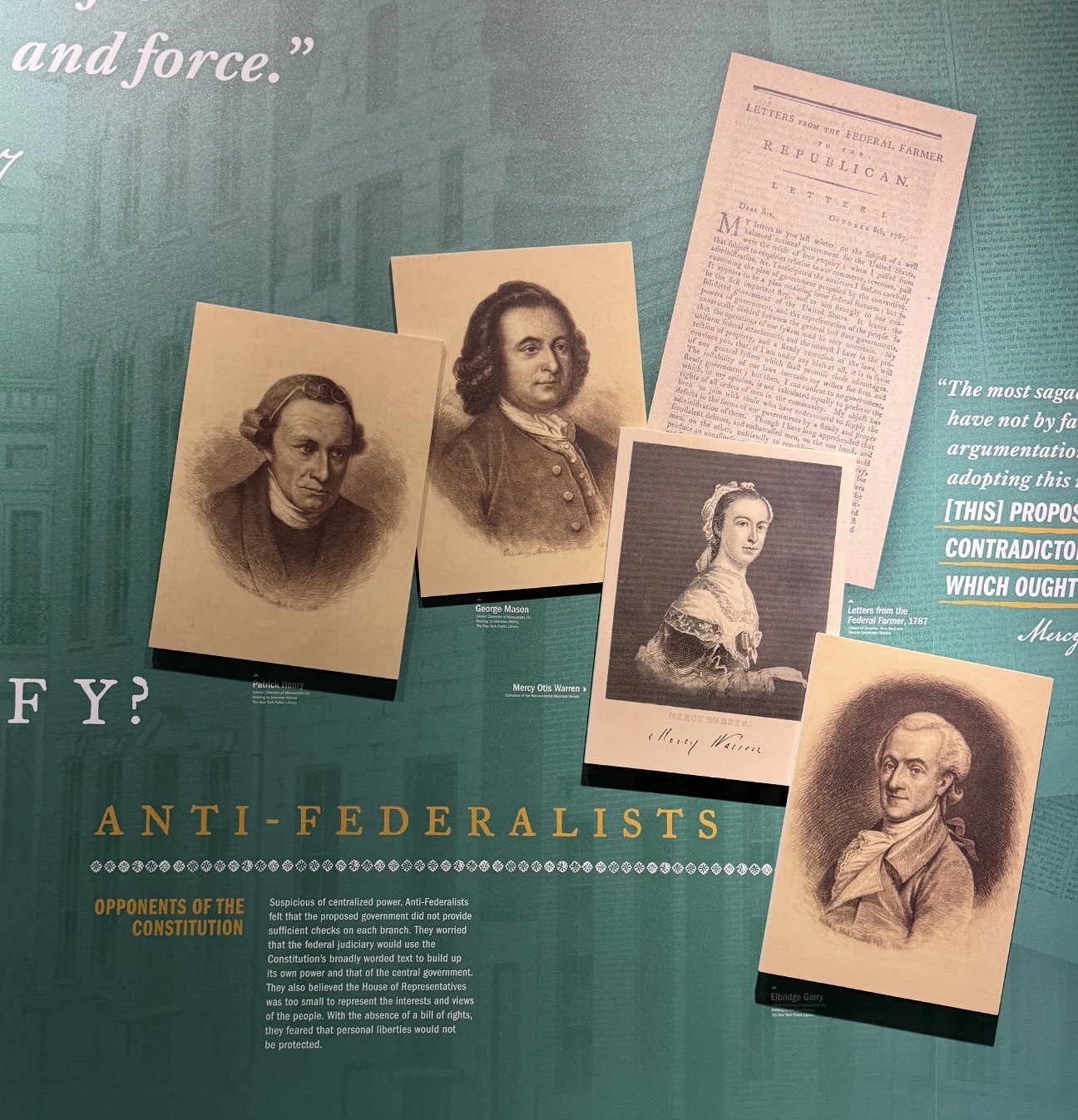
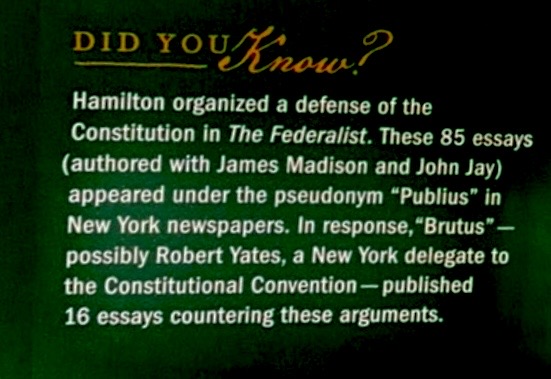
The National Constitution Center (NCC) installed its new permanent exhibit earlier this year. StatutesandStories.com is pleased to report that the new exhibit, America’s Founding, recognizes that Gouverneur Morris, Alexander Hamilton, and Elbridge Gerry boarded with Miss Dalley during the summer of 1787. Yet work remains to be done, as the NCC does not identify the Federal Farmer and incorrectly suggests that Robert Yates may have been Brutus.
Pictured below is the NCC’s prior exhibit which erroneously suggested that James Wilson was responsible for the final draft of the Preamble.

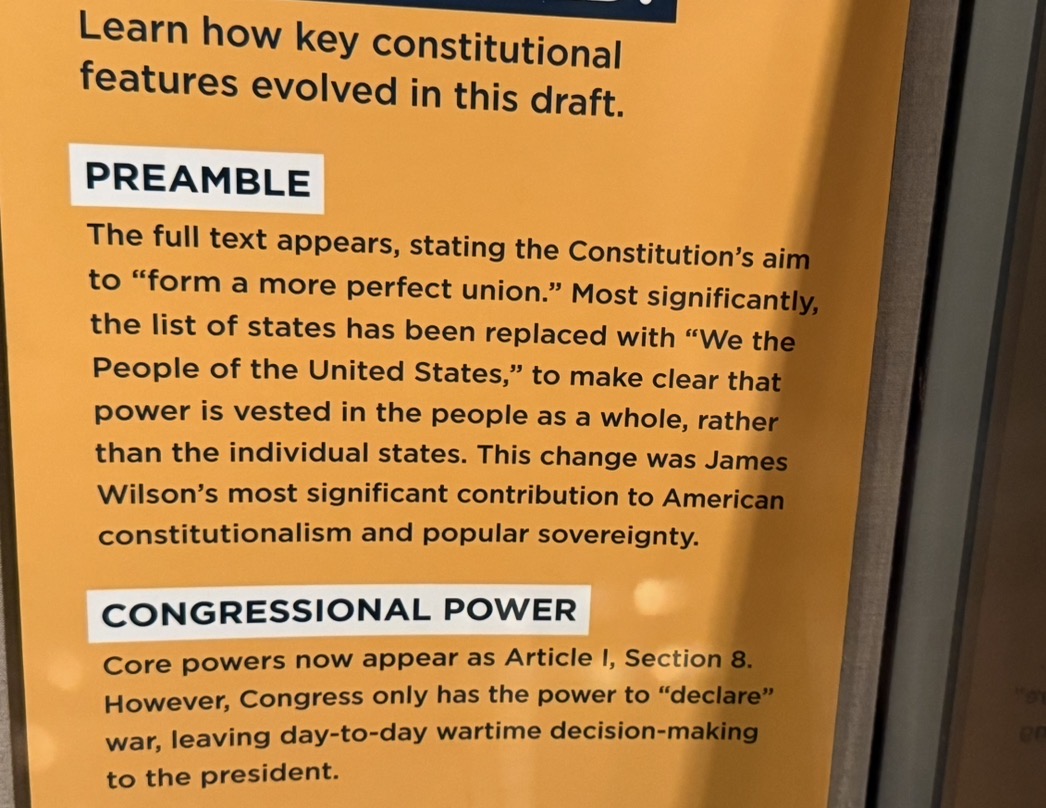
Copied below are images from the NCC’s new exhibit which accurately reflects Gouverneur Morris’s authorship of the soaring text of the Preamble. Among other things, in September of 1787 Morris and the Committee of Style revised James Wilson’s August draft from the Committee of Detail to recognize that the Constitution was established by “We the People of the United States” rather than We the People of the states, which were listed from north to south.


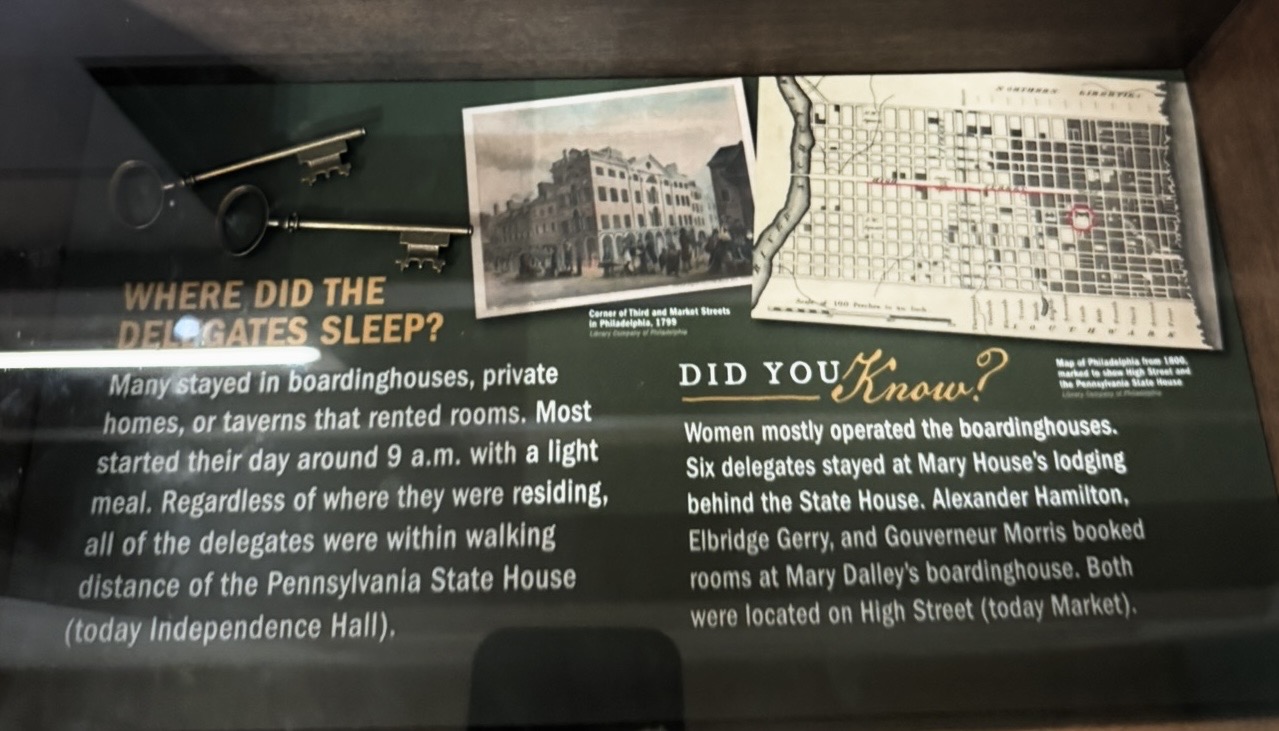
Professor John Kaminski and I are working with the staff at the NCC to update their exhibit regarding the attribution of the two most important Antifederalists, the Federal Farmer and Brutus. Based on years of archival research, we now know that Elbridge Gerry was the Federal Farmer and Melancton Smith was Brutus.
Copied below is a panel submission to the Organization of American Historians (OAH) for its 2027 conference to discuss our attribution research.
Brutus and the Federal Farmer: Pseudonymous Essays More Consequential than The Federalist during the Ratification Debate
The Federal Farmer and Brutus were two of the most important Antifederalist essayists during the ratification debates in 1787 – 1788. In many respects, The Federalist papers reflect a public dialogue between Publius and these two leading Antifederalists. For nearly 200 years historians assumed that Richard Henry Lee was the Federal Farmer until Gordon S. Wood convincingly argued otherwise in 1974, but without offering an alternative author. Two decades later John P. Kaminski floated the thesis that Elbridge Gerry was the Federal Farmer. Recently uncovered evidence supports Gerry’s attribution. Why does this matter?
With Gerry confirmed as the Federal Farmer the field is cleared to recognize Melancton Smith as Brutus. Indeed, additional Melancton Smith manuscripts recently uncovered in Albany confirm Smith’s authorship of Brutus. These “new” sources have come to light at a time when there is growing appreciation for the arguments espoused by the Antifederalists.
For decades, on very little evidence, historians assumed that Robert Yates was Brutus. In 2009, Michael P. Zuckert and Derek A. Webb identified the “Melancton Smith circle” around New York Governor George Clinton. While the identity of Brutus has been disputed for decades, historians widely agree that Brutus was “the most formidable antagonist of the immortal Publius.” When Alexander Hamilton decided to write The Federalist series in the fall of 1787 he was responding to the opening letters of Brutus. Madison described Brutus as a “new Combatant” who “strikes at the foundation” of the proposed Constitution “with considerable address & plausibility.”
During the summer of 1788 the New York ratification convention witnessed a clash of titans. For six weeks Alexander Hamilton, squared off against his “chief interlocutor,” Melancton Smith. In a newly uncovered speech, Smith, the self-proclaimed Antifederalist manager of the New York convention, explained his fateful decision to support ratification with recommendatory amendments. After five weeks of debate, Smith pivoted to join forces with Hamilton and the Federalists. In so doing, Smith provides an example of a profile in courage, acting in the national interest at great personal cost.
The debate in the New York ratification convention was arguably the hardest fought struggle in any of the state ratification conventions. In addition to being the longest lasting, the New York convention produced the largest number of proposed amendments. New York was also the only state to formally propose a second constitutional convention. The New York ratification convention thus became one of “the finest examples of political debate in American history.” With Gerry and Smith identified as the Federal Farmer and Brutus, they now deserve to be elevated to the top echelon of the founding generation.
Yet on the date of this submission, the permanent exhibit at the National Constitution Center still attributes Brutus to Robert Yates and does not attempt to identify the Federal Farmer. Indeed, well respected historical institutions, research libraries and scholars are all over the map, offering conflicting attributions. Far too many still attribute Richard Henry Lee as the Farmer, despite Gordon Wood’s seminal work over 50 years ago.
Program abstract
Federal Farmer and Brutus were two of the most important Antifederalist essayists during the debate over ratifying the Constitution. For nearly 200 years historians assumed that Richard Henry Lee was Federal Farmer until Gordon S. Wood convincingly argued otherwise. Two decades later John P. Kaminski posited that Elbridge Gerry was Federal Farmer. Recently uncovered evidence supports Gerry’s attribution. With Gerry confirmed as Federal Farmer the field is cleared to recognize Melancton Smith as Brutus. Indeed, additional Smith manuscripts recently uncovered in Albany confirm Smith’s authorship. These “new” sources have come to light at a time when there is growing appreciation for the work of the Antifederalists.
Additional Information:
Late last year, fourteen pages of Melancton Smith’s personal notes of the debates in the New York ratification convention in Poughkeepsie were transcribed and published for the first time in the Documentary History of the Ratification of the Constitution (the “DHRC”). Smith’s convention notes had been held in private hands after being sold at auction by Sotheby’s in 2017. The DHRC, consisting of 47 volumes, is word searchable. This treasure trove of material, including Smith’s newly discovered speech of July 23, 1788, tells the story of arguably the most consequential constitutional debate in world history. In 2027, perhaps it is time to see what we can learn from the Antifederalists.
Pictured below is the current exhibit at the NCC which recognizes the important role played by the Antifederalists, including Brutus and the Federal Farmer. We look forward to working with NCC staff to update the attributions of these leading Antifederalists.