Founding Pseudonyms
The Sixteen Pen Names used by Delegates to the Constitutional Convention (with published correspondence and speeches leading into the state ratification conventions)
Adam Levinson, Esq., in collaboration with John P. Kaminski, PhD
(Draft under construction)

The use of pseudonyms was ubiquitous in early American history.[1] The most “prolific and profound” issue following the Revolutionary War was the debate over the ratification of the Constitution.[2] Beginning in September of 1787 thousands of pseudonyms were used as Americans decided whether their government would be established based on “reflection and choice, or whether they are forever destined to depend for their political constitutions on accident and force.”[3]
As far as can be determined, the pseudonyms used by the delegates to the Constitutional Convention (otherwise known as the “framers”)[4] have never been compiled into a single comprehensive list. The purpose of this blog post is to make available a readily accessible table of pseudonyms used by the framers of the Constitution during the ratification debates.[5] It is hoped that this list will enable readers to track the publicly expressed opinions of the framers during the critical ten months when the nation undertook the monumental task of ratifying the most successful constitution in the history of the world.[6] Writing from his diplomatic post in London, John Adams described the ratification struggle as “the greatest single effort of national deliberation that the world has ever seen.”[7]
Despite the general practice of anonymity, the opinions of several of the framers were directly reported in the press without pseudonyms. Accordingly, this blog post also compiles the public correspondence and speeches of the framers leading to their respective state ratification conventions in 1787 and 1788. To be sure, this blog builds on the work of generations of historians who have recognized the importance of the subject matter. For example, after decades of work by John P. Kaminski and the editors of the Documentary History of the Ratification of the Constitution and the Bill of Rights (“DHRC”), the forty-seven volumes of this seminal collection are now available online and are word searchable.[8]
Of the fifty-five delegates who attended the Constitutional Convention, only thirty-nine signed the Constitution. As demonstrated by the first table below, sixteen framers wrote pseudonymously during the ratification campaign. Of these sixteen delegates who used pen names, twelve were Federalists and four were Antifederalists. Several are believed to have written under multiple pen names during the ratification campaign (Alexander Hamilton, Elbridge Gerry, Roger Sherman and Rufus King). Where the identity of the author is not settled, a question mark is indicated in the table beside the pseudonym attributed to the delegate.
Yet, not all delegates exclusively used anonymous pseudonyms. As indicated by a second chart of public correspondence and objections, eleven famous delegate letters/essays were also widely reported in the press. Of these eleven communications, eight were written by the three delegates who refused to sign the Constitution on September 17 (Randolph, Mason and Gerry). Another three letters/essays[9] were written by delegates who departed the Convention early, after the Great Compromise (Yates, Lansing and Martin). It should be no surprise that these six delegates felt the need to publicly express their position, as they likely wanted to justify their dissent.
George Washington’s 17 September 1787 letter as the President of the Convention was unique. It was specifically authorized by his fellow delegates before they departed Philadelphia. The famous “Cover Letter” transmitted the Constitution to the Confederation Congress meeting in New York City for formal distribution to the states. While Washington’s Cover Letter reflected the official view of the Constitutional Convention that ratification was “indispensable” and the “most ardent wish” of the framers, a second private letter by George Washington was widely printed without his authorization beginning in December of 1787. As several of these letters were circulated privately before being published, two sets of dates are included in the tables, the date of the underlying letter along with the subsequent first printing date.

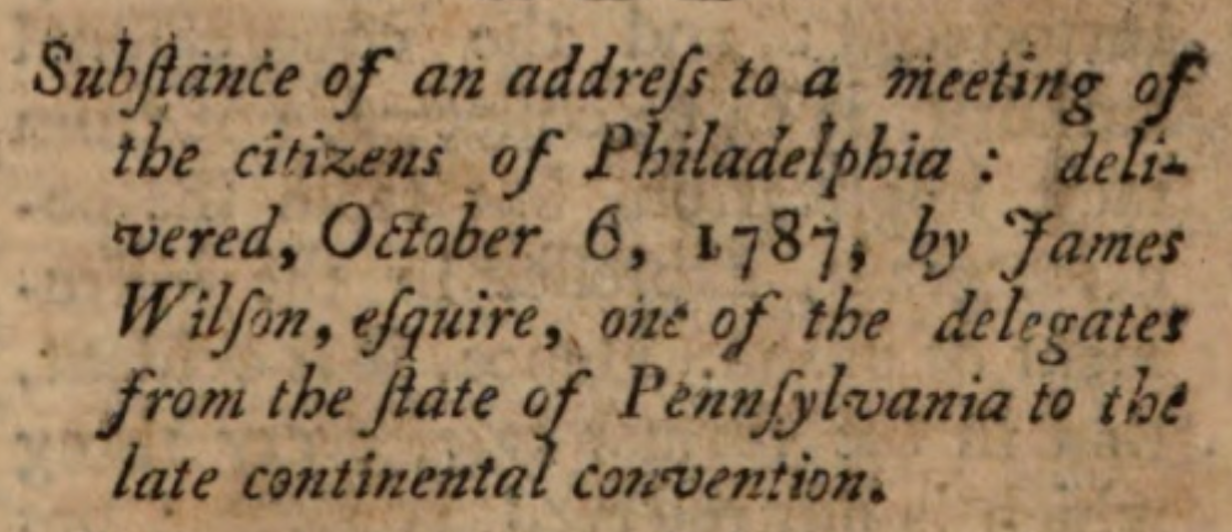
As illustrated in the third table below, six delegate speeches were also widely published in the press prior to the state ratification conventions. Perhaps the most famous of the delegate speeches was Benjamin Franklin’s final remarks at the Constitutional Convention on 17 September. Another critically important speech was James Wilson’s “Speech at the State House Yard” in Philadelphia on 6 October 1787, the first example of a delegate publicly advocating on behalf of the Constitution.[10]
The published speeches by James McHenry and Luther Martin were delivered at the Maryland House of Delegates on 29 November 1787, at a meeting requested to provide information before the vote to call for the Maryland ratification convention. Similarly, the published speeches by Charles Cotesworth Pinckney and Charles Pinckney occurred during the three-day debate at the South Carolina House of Representatives prior to authorizing the South Carolina ratification convention. North Carolina delegate Hugh Williamson’s speech of 8 November 1787 is comparable to James Wilson’s speech, as both were publicly delivered, unofficially, by Federalists to large crowds outside of official proceedings.
Attentive readers might ask why the following table includes the Antifederalist Federal Farmer but omits other critical Antifederalist essays, including Brutus, Cato and Centinel. The quick answer is that these widely respected pseudonymous essays were not written by delegates to the Constitutional Convention. A second follow-up post Founding Pseudonyms – Part II (pending) will discuss the most important pseudonymous essays by the “other founders,” who participated in the ratification debates but were not framers of the Constitution in Philadelphia. Likewise, the tables below purposely exclude key speeches by delegates at the state ratification conventions, which may be the subject of another future post.[11]
The three following tables are an effort to collect all publicly available statements by the framers of the Constitution before the voting began in the state ratification conventions. In other words, what information was communicated to the public by the framers prior to the ratification conventions? The answer is set forth below, for the first time in one place, in three easily accessible tables, along with citations to the DHRC.[12] In sum, sixteen delegates used pseudonyms during ratification (29% of the fifty-five Convention delegates).
Pseudonymous Essays by Convention Delegates during the Ratification Debate
|
Author, Party, State |
Pseudonym & number of essays |
Date first published |
|
Alexander Hamilton, Federalist (NY) |
Anonymous letters to New York’s Daily Advertiser dated 21 July and 15 September 1787 preemptively attacking Governor Clinton for reprobating the Convention without reserve[13]; Caesar (2)?[14]; Publius (50 or 51) |
21 July 1787; 15 September 1787; 1 October; 27 October 1787[15] |
|
James Madison, Federalist (VA) |
Publius (29 or 30) |
22 November 1787[16] |
|
Charles Pinckney, Federalist (SC) |
Observations on the Plan of Government Submitted to the Federal Convention (6)[17] |
14 October 1787[18] |
|
George Mason, Antifederalist (VA) |
Cato Uticensis (1)? |
17 October 1787[19] |
|
Oliver Ellsworth, Federalist (CN) |
A Landholder (13) |
5 November 1787[20] |
|
Elbridge Gerry, Antifederalist (MA) |
Federal Farmer (18); A Friend and Customer (1)[21] |
|
|
Roger Sherman, Federalist (CN) |
A Countryman (5); A Citizen of New Haven (1) |
15 November 1787; 7 January 1788 [24] |
|
Rufus King, Federalist (MA) |
Proculus (1)?; A Customer (1) |
|
|
Luther Martin, Antifederalist (MD) |
Genuine Information (12)[27] |
8 February 1788[28] |
|
John Francis Mercer, Antifederalist (MD) |
A Farmer (7)? |
15 February 1788[29] |
|
Daniel of St. Thomas Jenifer, Federalist (MD) |
The Landholder X (1)? |
29 February 1788[30] |
|
Benjamin Franklin, Federalist (PA) |
K (1) |
8 April 1788[31] |
|
John Dickinson, Federalist (DE) |
Fabius (9) |
12 April 1788[32] |
|
Gouverneur Morris, Federalist (PA) |
An American (1) |
23 April 1788[33] |
|
Edmund Randolph, refused to sign Constitution but subsequently supported ratification (VA) |
Republican (1)? |
16 July 1788[34] |
|
Hugh Williamson (NC); Federalist |
A Republican (1)[35] |
17 September 1788[36] |
The following table lists eleven published letters by delegates to the Constitutional Convention which helped frame the public debate over the Constitution. Two of the eleven letters were formal transmission letters, written in September as part of the early public relations campaign by Federalists to promote ratification. For example, the October 25 report by Sherman and Ellsworth concluded by indicating that, “[t]he Convention endeavored to provide for the energy of government on the one hand, and suitable checks on the other hand, to secure the rights of the particular states, and the liberties and properties of the citizens. We wish it may meet the approbation of the several states, and be a means of securing their rights and lengthening out their tranquility.”[37]
Eight of the eleven documents were written by six dissenting delegates who either refused to sign the Constitution or departed Philadelphia prior to September 17. In particular, the objections by Antifederalists George Mason and Elbridge Gerry were no doubt instrumental in the eventual proposal of the Bill of Rights by Congress after ratification.
Public Correspondence/Objections published during Ratification Debate
(several were circulated privately before being published)
|
Author, Party, State |
Description |
Date first published |
|
George Washington, Federalist (VA) |
Constitution’s “Cover Letter” transmitting Constitution to Congress, dated 17 September 1787 |
19 September 1787, Pennsylvania Packet [38] |
|
Roger Sherman & Oliver Ellsworth, Federalists (CN) |
Report of Connecticut Delegates transmitting Constitution to Governor Samuel Huntington, dated 26 September 1787 |
25 October 1787, New Haven Gazette [39] |
|
George Mason, Antifederalist (VA) |
Mason’s Objections to the Constitution, dated 7 October 1787 (sent by Mason to George Washington, but printed without permission by Tobias Lear) |
21 November 1787, Massachusetts Centinel; 22 November 1787, Virginia Journal; 23 November 1787, Virginia Gazette [40]
|
|
Edmund Randolph, Federalist (VA)[41] |
Randolph’s Reasons for Refusing to Sign the Proposed Federal Constitution, dated 10 October 1787 |
27 December 1787 (first published as a pamphlet)[42]
|
|
Elbridge Gerry, Antifederalist (MA) |
Gerry’s Objections to Signing the Constitution, letter to MA Assembly, dated 18 October 1787 |
3 November 1787, Massachusetts Centinel [43] |
|
George Washington, Federalist (VA) |
Washington’s private letter to Charles Carter, dated 14 December 1787 |
27 December 1787, Virginia Herald [44] |
|
Robert Yates and John Lansing, Jr., Antifederalists (NY) |
Yates and Lansing’s Reasons of Dissent, letter to NY Governor Clinton, dated 21 December 1787 |
14 January 1788, New York Journal; New York Daily Advertiser [45] |
|
Elbridge Gerry, Antifederalist (MA) |
Gerry’s Response to Landholder VIII, defending his conduct at the Constitutional Convention, dated 3 January 1788 |
5 January 1788, Massachusetts Centinel [46] |
|
Luther Martin, Antifederalist (MD) |
Luther Martin to the Printer Responding to Landholder VIII and defending Gerry, dated 13 January 1788 |
18 January 1788, Maryland Journal [47] |
|
Luther Martin, Antifederalist (MD) |
Luther Martin’s Address Responding to Landholder X (four essays by Martin) |
18 March 1788 to 4 April 1788, Maryland Journal [48]
|
|
Elbridge Gerry, Antifederalist (MA) |
Elbridge Gerry’s Response to Landholder X, published April 18 |
18 April 1788, Boston American Herald [49] |
The following table lists all six published speeches by delegates to the Constitutional Convention prior to their respective state ratification conventions. Interestingly, only speeches by Antifederalist Luther Martin were printed prior to the state ratification conventions. By contrast, five speeches by Federalists were widely reprinted and available to the public in advance of the ratification conventions.[50] Click here for a blog post describing Wilson’s speech as the “single most important speech in the debate over ratifying the Constitution.”[51] Click here for a blog post describing what are believed to be the five most important speeches during the ratification campaign (including Wilson’s speech and Franklin’s speech, along with three ratification convention speeches by John Hancock, Edmund Randolphi and Melancton Smith).[52]

Published Speeches during Ratification Debate
(not including speeches at state ratification conventions)
|
Author, Party, State |
Description |
Date first published |
|
James Wilson, Federalist (PA) |
Wilson’s famous Speech in the State House Yard, Philadelphia, 6 October 1787 (the first speech by a delegate defending the Constitution) |
9 October 1787, Pennsylvania Herald (widely reprinted in about 40 newspapers) [53]
|
|
Benjamin Franklin, Federalist (PA) |
Franklin’s famous Convention speech of 17 September 1787 |
3 December 1787, Boston Gazette [54]
|
|
James McHenry, Federalist (MD) |
McHenry’s Address to the Maryland House of Delegates, 29 November 1787 (Extract of a Letter from a Member of the House of Delegates, now sitting at Annapolis, to his Friend summarizing McHenry’s speech)[55] |
7 December 1787, Maryland Journal [56] |
|
Luther Martin, Antifederalist (MD) |
Martin’s Address to the Maryland House of Delegates, 29 November 1787, published as Genuine Information in twelve installments |
8 February 1788, Maryland Gazette [57] |
|
Charles Cotesworth Pinckney & Charles Pinckney, Federalists (SC) |
Speeches at the South Carolina House of Representatives during three days of debate (from 16–18 January) prior to calling for a state ratifying convention. [58] |
18 January 1788, Charleston City Gazette [59] |
|
Hugh Williamson, Federalist (NC) |
Williamson’s speech on 8 November 1787 at the Town of Edenton, NC, subsequently published as his “Remarks on a New Form of Government” |
25 February 1788, New York Daily Advertiser [60] |

Brief Historiography of Pseudonyms and Public remarks by the Framers
In the late nineteenth century, historian Paul Leicester Ford began the process of compiling the key pseudonymous essays of the ratification debates. In 1888 Ford assembled fourteen ratification era essays in his Pamphlets on the Constitution of the United States. Ford added another seventeen works with his Essays on the Constitution in 1892.[61] Many of Ford’s attributions were subsequently challenged by historians.[62] Most famously, in 1974 Gordon Wood convincingly demonstrated that the Antifederalist Federal Farmer was not Richard Henry Lee of Virginia.[63] While Wood declined to offer another attribution, he opined that the Federal Farmer was likely a resident of New York or Massachusetts. In 1988 John P. Kaminski floated his thesis that Elbridge Gerry was likely the Federal Farmer.[64] Click here for a link to a multi-part series arguing that Kaminski’s attribution has been proven with recently uncovered sources and new analysis.
In 1911 Yale historian Max Farrand published the three-volume Records of the Federal Convention of 1787. Farrand gathered together all available documentary materials relating to the adoption of the Constitution. At the time, the manuscripts, notes and other records which told the story of drafting of the Constitution were not easily accessible as they were scattered in archives and private collections around the world. Much of the material had never been published. Farrand’s work has since become the authoritative cannon which is regularly cited by generations of historians, biographers and courts.
For the anniversary of the bicentennial of the Constitution in 1987, James Hutson and Leonard Rapport updated Farrand’s work by publishing The Supplement to Max Farrand’s The Records of the Federal Convention. Hutson was the long-serving chief of the Manuscript Division of the Library of Congress. Rapport was a legendary archivist with the National Archives. Their Supplement added an assortment of “new” materials discovered since 1911, including George Washington’s diary, John Lansing’s notes on debates, and hundreds of pages of other primary sources.
Historians have long recognized that the United States Constitution and Bill of Rights were adopted during a remarkably open and democratic ratification process. Although the Antifederalists “lost” the ratification debate in 1788, they are rightly entitled to be counted among the leaders of the “founding” generation. While the Constitution was drafted by the Federalists, arguably “the spirit of American politics has more often been inspired by the Antifederalists.”[65]
Renewed appreciation for the role of the Antifederalists began in earnest in the 1960s. Historians Jackson Turner Main and Forrest McDonald are credited for their focus on Antifederalist scholarship in the early 1960s.[66] Morton Borden published The Anti-Federalist Papers in 1965, a collection of eighty-five Antifederalist essays intended to illustrate Antifederalist responses to each of the eight-five Federalist Papers. While some historians may have considered Borden’s organization of The Anti-Federalist Papers to be “overly contrived,” Borden succeeded in bringing attention and scholarship to overlooked Antifederalist sources. Cecilia M. Kenyon also shined light on the subject in 1965 with her book, The Antifederalists.
In 1981 Herbert J. Storing published seven volumes of Antifederalist materials under the ambitious title, The Complete Anti-Federalist. Starting in 1976, Merrill Jensen, John P. Kaminski and Gaspare J. Saladino began the monumental process of publishing the authoritative Documentary History of the Ratification of the Constitution and the Bill of Rights (DHRC). The preceding charts were largely compiled using the cumulative index of the DHRC.
In addition to Paul Leicester Ford’s early compilations of important pseudonymous essays, other notable listings include Jackson Turner Main’s list of twelve Antifederalist essays in Appendix C of his book. In 1990 Gaspare J. Saladino published a detailed article listing 67 pseudonymous essays by both Federalist and Antifederalists.[67] At the time of Saladino’s article, only eight volumes of the DHRC had been published. When completed, the DHRC now contains several thousand pseudonymous essays and over 70,000 documents.[68]
Additional scholarship about the Federalists and Antifederalists has included the following histories and collections:
- Ralph Louis Ketcham, The Anti-Federalist Papes and Constitutional Convention Debate (Penguin Books, 1986).
- John P. Kaminski and Richard Leffler, Federalists and Antifederalists: The Debate Over the Ratification of the Constitution (Madison House, 1989).
- Bernard Bailyn, The Debate on the Constitution (Library of America, 1993), two volumes.
- Jack N. Rakove, Original Meanings: Politics and Ideas in the Making of the Constitution (New York: Knopf, 1996).
- Saul T. Cornell, The Other Founders: Anti-Federalism and the Dissenting Tradition in America, 1788-1828 (University of North Carolina Press, 1999).
- David J. Siemers, The Antifederalists: Men of Great Faith and Forbearance (Rowman & Littlefield, 2003).
- Michael P. Zuckert & Derek A. Webb, The Anti-Federalist Writings of the Melancton Smith Circle (Liberty Fund, 2009).
- Pauline Maier, Ratification: The People Debate the Constitution, 1787-1788 (Simon & Schuster, 2010).
- Robert J. Allison & Bernard Bailyn, eds., The Essential Debate on the Constitution: Federalist and Antifederalist Speeches and Writings (New York: The Library of America, 2018).
- Michael J. Faber, The Anti-Federalist Constitution: The Development of Dissent in the Ratification Debates (University Press of Kansas, 2019).
Endnotes
[1] During the eighteenth-century political essays were “the principal means of airing ideas and arguments.” Richard B. Bernstein and Kym S. Rice, Are We to be a Nation? (Harvard University Press, 1987), 218. The use of pseudonyms was common in American newspapers until three years into the American Civil War when Union General Joseph Hooker insisted that journalists reveal their identities when writing about the war. Eric Burns, Infamous Scribblers: The Founding Fathers and the Rowdy Beginnings of American Journalism (Public Affairs, 2006), 167.
[2] https://csac.history.wisc.edu/2022/07/22/pseudonyms-and-the-debate-over-the-constitution/
[3] Federalist No. 1.
[4] The term “delegate” is used synonymously with the term “framer” to describe the fifty-five delegates who attended the Constitutional Convention from May through September of 1787.
[5] Of course, many framers used multiple pseudonyms during their life. The table set forth below only focuses on pseudonyms used during the ratification campaign.
[6] The ratification campaign began on 19 September 1787 when the Constitution first appeared in the Pennsylvania Packet. The Constitution crossed the requisite nine state threshold when New Hampshire ratified in June of 1788. The ratification process continued through May of 1790 when Rhode Island became the final state to ratify.
[7] DHRC, 7:1721.
[8] This blog post would not have been possible without the terrific resources of the DHRC, including its multivolume cumulative index.
[9] Due to their length, Luther Martin’s essays publicly responding to Landholder were printed in four installments. DHRC, 11:396.
[10] DHRC, 13:337.
[11] Admittedly, the delegates speeches at the state ratification conventions are too numerous to easily aggregate together given the extensive (and valuable) debates at several of the state conventions. Readers are referred to the DHRC which compiles the transcripts of all the conventions, by state.
[12] It is anticipated that the tables might be useful for future researchers. For example, it may be noteworthy that sitting judges didn’t appear to have written any of the eleven pseudonymous essays. It may also be useful to study the regional diversity and timing of the essays.
[13] While Hamilton’s July 21 letter was anonymous, it was commonly understood at the time that Hamilton was the author. Hamilton publicly acknowledged his authorship of the July 21 letter in a follow-up letter to the Daily Advertiser on 15 September 1787; DHRC, 19:11 and 19:26.
[14] Paul Leicester Ford opined that Alexander Hamilton was Caesar. Jacob E. Cooke and other historians have questioned the attribution. DHRC:19:69.
[15] DHRC, 19:68 (Caesar); DHRC, 19:137 (Publius).
[16] DHRC, 19:137.
[17] Note that Observations was not published pseudonymous as Pinckney was identified as the author. DHRC, 27:12.
[18] DHRC, 27:3. Observations was first published as a pamphlet in New York on 14 October 1787 and was subsequently serialized in South Carolina in six newspaper installments between 29 October and 19 November.
[19] DHRC, 8:4. 8:70.
[20] DHRC, 13:561.
[21] DHRC, 7:1751. Note that A Friend and Customer was Gerry’s public response to Landholder X and as such was not written pseudonymously.
[22] Note that the Federal Farmer was originally written as two pamphlets of 5 and 13 essays, first published on 8 November 1787. The second pamphlet was published on 2 May 1788. Each of the respective essays listed their own purported date, beginning on 8 October 1787.
[23] DHRC, 7:1751.
[24] DHRC, 3:460; DHRC 3:524. Note that the name A Countryman was also used by other authors, Dewitt Clinton and Hugh Hughes.
[25] DHRC, 6:1213, n.5; DHRC, MA Supplement, 255-259.
[26] DHRC, 7:1722; 16:191
[27] DHRC, 11:126. Note that Genuine Information was not an anonymous pseudonym, but rather a collection of speeches given by Luther Martin to the Maryland Assembly in November of 1787, prior to the state’s ratification convention in April of 1788.
[28] DHRC, 11:126.
[29] DHRC, 11:306.
[30] DHRC, 11:342.
[31] DHRC, 17:36.
[32] DHRC, 17:74.
[33] DHRC, 9:746.
[34] DHRC, 10:1754. The publisher of the Virginia Independent Chronicle provided notification on 9 July 1788 that a series of letters addressed to the citizens of Virginia on the subject of the Constitution was forthcoming. If the letters were in fact written by Randolph, their publication date was after the close of the Viriginia ratification campaign. With that said, the Republican letters were published prior to the close of the ratification campaign in New York, North Carolina and Rhode Island.
[35] Note that multiple authors independently used the pseudonym A Republican.
[36] DHRC, 31:563. Note that multiple authors independently used the pseudonym A Republican.
[37] The formal report by Sherman and Ellsworth was written to comply with the technical requirements of Connecticut’s act of May 1787 appointing its delegates to the Convention. Connecticut’s delegates were obligated to report “such Alterations and Provisions” by the Convention to render the Articles of Confederation “adequate to the Exigencies of Government, and the Preservation of the Union.” DHRC, 13:470.
[38] DHRC, 1:305.
[39] DHRC, 13:470.
[40] DHRC, 8:40. Note that Mason is also believed to have sent his objections to Richard Henry Lee on 18 September 1787. Interestingly, there were differences in the Northern printings versus the Southern printings, with northern newspapers omitting Mason’s objection to the passage of navigation acts by a simple majority in Congress. The Virginia Gazette version is similar to the handwritten objections on Mason’s printed copy of the report of the Committee of Style from the Constitutional Convention. DHRC, 8:41.
[41] Randolph initially refused to sign the Constitution, but he eventually supported ratification at the Virginia Ratification Convention.
[42] DHRC, 8:260.
[43] DHRC, 13:548.
[44] DHRC, 8:276.
[45] DHRC, 15:366.
[46] DHRC, 5:622.
[47] DHRC, 15:414.
[48] DHRC, 11:396.
[49] DHRC, 17:172.
[50] Perhaps future researchers will investigate the impact of – and reason for – the lack of published speeches by Antifederalists prior to their state ratification conventions.
[51] https://csac.history.wisc.edu/2020/10/06/single-most-important-speech-in-the-debate-over-ratifying-the-constitution/
[52] https://csac.history.wisc.edu/2025/11/04/the-five-most-important-speeches-during-the-ratification-debates/
[53] DHRC, 13:337.
[54] DHRC, 13:212.
[55] On 23 November 1787 the Maryland House of Delegates voted to request that its Convention delegates attend a meeting of the House on 29 November to provide information about the Convention. Four of the North Carolina’s five Convention delegates attended on 29 November (Daniel Carroll, Daniel of St. Thomas Jenifer, James McHenry, and Luther Martin). Martin’s address to the Maryland House of Delegates was expanded and reorganized into his “Genuine Information,” reprinted in twelve installments in the Maryland Gazette between 28 December 1787 and 8 February 1788.
[56] DHRC, 11:110; DHRC, 11:79, 80(manuscript of McHenry’s speech).
[57] DHRC, 11:126.
[58] All four of its delegates to the Constitutional Convention addressed the South Carolina House of Representatives, with Charles Pinckney and Charles Cotesworth leading the debate. DHRC, 27:88.
[59] The debates were widely re-printed in newspapers and in 55-page pamphlets. DHRC, 27:88
[60] DHRC, 30:10.
[61] Pamphlets on the Constitution of the United States (Brooklyn, 1888); Essays on the Constitution (Brooklyn: Historical Printing Club, 1892).
[62] Critics have asserted that Ford was too quick to assume that pseudonymous essays were written by leading politicians. “More recent scholarship has disproved many of Ford’s attributions.” Bernstein and Rice, Are We to be a Nation, 312 n. 36. For example, Ford attributed the pseudonymous essay, A Steady and Open Republican, to Charles Pinckney. This essay is now believed to have been written by Christopher Gadsden of Charleston. DHRC, 17:387, n 1. Whether or not Ford’s attributions continue to ring true, his 19th century scholarship was ahead of its day. Ford was himself openminded. He initially attributed Brutus to Thomas Treadwell but later identified Robert Yates as Brutus. DHRC, 13:411. It is now believed that Brutus was Melancton Smith. William Jeffrey, Jr., “The Letters of ‘Brutus’ – A Neglected Element in the Ratification Campaign of 1787-88,” 40 University of Cincinnati Law Review 643 (1971).
Newly located manuscripts and further analysis help confirm Jeffrey’s attribution that Brutus was Melancton Smith. https://www.statutesandstories.com/blog_html/confirmed-antifederalist-melancton-smith-was-brutus/
[63] Gordon S. Wood, “The Authorship of the Letters from the Federal Farmer,” WMQ, 3rd ser. 31 (1974), 299–308.
[64] John P. Kaminski, “The Role of Newspapers in New York’s Debate Over the Federal Constitution,” in Stephen L. Schechter and Richard B. Bernstein, eds., New York and the Union (Albany, 1990), 285; DHRC, 12:203.
[65] Saul Cornell refers to the Antifederalists as the “the Other Founders.” Saul Cornell, The Other Founders: Anti-Federalism and the Dissenting Tradition in America, 1788-1828 (University of North Carolina Press, 1999), 1.
[66] Jackson Turner Main, The Antifederalists: Critics of the Constitution, 1781-1788 (Chapel Hill, 1961); Forrest McDonald, “The Anti-Federalists, 1781-1789,” Wisconsin Magazine of History, 46 (1963), 206-214.
[67] Gaspare J. Saladino, “Pseudonyms Used in the Newspaper Debate over the Ratification of the Constitution in the State of New York, September 1787 – July 1788,” in New York and the Union, Stephen L. Schechter & Richard B. Bernstein, ed. (New York State Commission on the Bicentennial, 1990).
[68] https://csac.history.wisc.edu/2022/07/22/pseudonyms-and-the-debate-over-the-constitution/