America’s First Historian
Gouverneur Morris’s Observations on the American Revolution (Part 2)
A temple to freedom

In 1779 a newly released publication made headlines and attracted international attention. The Revolutionary War would continue to be waged for another four years, but the first draft of its history had already been written by Gouverneur Morris. Recognizing the importance of Morris’s work, Observations on the American Revolution (“Observations”), Congress paid for the cost of copies to be distributed around the country.[1] “Published according to a resolution of Congress,” readers were advised that “it was absolutely necessary that every inhabitant of the United States should be possessed of this valuable tract” in order that they might “look over the ground they have trodden during the present conflict.” As discussed below, this work along with Morris’s other scholarly pursuits entitle him to be properly recognized as America’s first post-revolutionary historian.
To promote the 122-page pamphlet, entire passages were reprinted in newspaper advertisements. The following concluding paragraph contains Morris’s bold post-war vision and soaring declaration of American ideals. Notably, Morris’s prose anticipated Emma Lazarus’ famous inscription on the Statue of Liberty[2] which reverberates across American history.

Gouverneur Morris is widely recognized as the “penman of the Constitution.” While his work drafting the Preamble and final draft of the Constitution in 1787 has been cherished for generations, his other contributions to American history are easily overlooked. In 1779 Congress called upon Morris to draft an official history of the American Revolution. Morris’s Observations was an effort to combat British propaganda, rally public support, and survey the history of the first three years of the war.

This blog post is the second in a three-part series arguing that Gouverneur Morris has a rightful claim to be recognized as the first American[3] historian post-independence from Britain. Indeed, Morris appears to have been the first author to use phrase “the American Revolution”[4] in print.[5] While he was not an academic historian who taught or published in a formal university setting, he delivered well-regarded funeral orations for George Washington, Alexander Hamilton and George Clinton.[6] Near the end of his life Morris lectured on a variety of historical topics, including the underlying question of “What is history?”[7] While his detailed diaries were not published during his lifetime, it is clear that he was writing for posterity. In 1804 he became a trustee of Columbia College. It should thus not be surprising that Morris became the second President of the New York Historical Society in 1816.[8]
Part 1 began by introducing Morris’s long overlooked work. Part 1 presented the case that Morris was the ideal choice to draft the first history of the American Revolution, as the “foremost publicist” of Congress.[9] During his time in Congress Morris was called upon to draft “almost if not all the publications of Congress of any importance,” particularly those involving diplomatic relations.[10]
Part 2 below continues with a detailed analysis of the contents of Morris’s Observations. Short on details of specific battles, the work is less of a military history and more of a diplomatic and political history of the war as it was being fought. Morris’ Observations begins with a brief discussion of the establishment of the colonies, the adoption of the Stamp Act in 1765, its repeal in 1766, the Townsend Acts[11] of 1767, and the Continental Association in 1774. Morris also summarizes various addresses to the inhabitants of colonial America and petitions to the King prior to independence, including the Olive Branch Petition[12] in 1775, the accompanying Address to People of Great-Britain, various Congressional resolutions, and of course the Declaration of Independence.[13] Morris also captures the back and forth war of words in 1778 between Congress and the British Carlisle Commission, which was largely Morris’s handiwork.[14] Links will be provided below to several of these historically significant primary sources.
Part 3 (pending) will outline the similarities between Morris’s Observations and the Preamble of the Constitution. Part 3 will also discuss of the historical significance of Morris’ Observations and his vision for America after the war. Yet, Morris did not merely predict American greatness and expansion across the continent. Dating back to his remarkable “Oration on the Necessity for Declaring Independence” in 1776, he also envisioned that America would become an “asylum from oppression” and exalt “the dignity of mankind.”[15] This same humanistic imperative repeats three years later in his Observations, when Morris called for America to become a temple to freedom and an “asylum to mankind” for the “oppressed, the miserable and the poor of every nation and every clime.”
Part 3 will continue with a discussion of the historiography of the America Revolution and a comparison of Morris’s Observations with subsequent histories of the Revolution. It is also appropriate to consider Morris’s history lectures and his involvement as a trustee at Columbia and as an officer of the New-York Historical Society. Part 3 will conclude with a discussion of Morris’s diaries and the work of historian Emilie Mitran, which support the thesis Morris’s fingerprints evidence the work of both a statesman and a historian.
Overview of Morris’ Observations
Congress understood the importance of Observations, printing 1,300 copies of the 122-page pamphlet.[16] Today the 3,000 word monograph would be described as a Congressional white paper. “The publication was the nearest Congress ever came to issuing an official history of the revolution.”[17] In addition to providing a review of Anglo-American relations, Observations was an effort to establish British culpability for the war, demonstrate American resolve, and confirm the inevitability of American independence.
The first history of the American Revolution is generally understood to be David Ramsay’s History of the Revolution in South Carolina published in 1785 and his History of the American Revolution published in 1787. Mercy Owen Warren, another early historian of the American Revolution, published her three-volume History of the Rise, Progress, and Termination of the American Revolution in 1805. Published in 1779, Gouverneur Morris’s Observations predates these works as the first history of the Revolutionary War. In hindsight is should not be a surprise that Morris was selected for this task by his peers as his was “the pen most trusted” by Congress.[18]
These should be no doubt that Morris was engaged in the work of a historian when he wrote Observations. None other than Thomas Paine considered the pamphlet to be a work of historical scholarship. In a full-page review, Paine explicitly described Observations as drawing a “historical connection” between the principal state papers in a “continued chain.”[19] Interestingly, Paine was critical of Morris’s omission of the battles of Trenton and Princeton. While Paine considered his other criticism “immaterial to the history,” Paine was adamant that the addition of a half dozen pages “might have been employed” to better advantage by laying the groundwork for Burgoyne’s defeat at Saratoga.
Morris’s Observations was written as momentum was shifting to the Americans following the French decision to join the war after the Battle of Saratoga. To be sure, Morris was not attempting to write an impartial or detailed historical account of the war. Nevertheless, Morris’s Observations reached back into colonial history to provide an overview of the underlying colonial grievances which gave rise to the conflict. As such, Morris was writing contemporary history intended for an international audience struggling to understand and justify the war effort on both sides of the Atlantic.[20]
Remarkably, Gouverneur Morris wrote Observations while serving as an active member of the Continental Congress. When a cash strapped Congress voted to pay[21] for the publication of Morris’s Observations, it became the only “official” history of the war. Morris’s Observations is not only noteworthy for its early timing but also its official pedigree, having been written “according to a resolution of Congress.”[22] Congress was willing to dedicate scarce wartime funds for this project based on the recognition that America was waging both a defensive campaign against the Britain military and a public relations war with the British Carlisle Commission.
Content of Morris’s Observations
In May of 1780 detailed newspaper advertisements heralded the new publication.[23] As pictured below, the following events would be discussed pertaining to the American Revolution, along with what can be described as Morris’s “clever running commentary” connecting together more than two dozen Congressional resolutions, petitions, declarations and other primary sources:[24]
- The Address of Congress to the Inhabitants of America of October, 1774
- The Nonimportation Agreement of 1774 and the Continental Association
- The letter from Congress to General Gage of October 11, 1774 concerning Massachusetts
- The Resolves of Congress concerning the defense of New York
- The Declaration of Congress setting forth the Causes and Necessity of Taking up Arms, July 6, 1775
- The Petition of Congress to the King of England, July 8, 1775
- The Address of Congress to Inhabitants of Great Britain, July 8, 1775
- The Recommendation of Congress to the Inhabitants of the colonies to erect new governments, May 1776
- The Declaration of Independence, July 1776
- The Resolutions of Congress concerning proposals for Peace with Great Britain
- The Report of the Committee appointed to meet Lord Howe
- Drafts of two bills brought in the British Parliament
- The Report of the Congressional Committee on said bills
- The Address of Congress to the Inhabitants of America, May 8, 1778
- Letters and answers from Lord Howe and General Clinton to Congress
- Letters and answers from the British Commissioners to Congress
- Representation of the British Commissioners concerning the Convention of Saratoga and the Resolution of Congress thereon
- The Letter from General Clinton on the same subject
- The Manifesto and Proclamation by the British Commissioners
- Congress’s reply Manifesto

Copies of Morris’s Observations were also shared among Revolutionary leaders.[25] For example, Richard Henry Lee sent a copy to Thomas Jefferson and John Adams. By letter dated 3 May 1779 Lee described the pamphlet as “containing a collection of the most material congress papers with a few remarks interspersed, in order to shew in one comprehensive view the progress of our glorious revolution, and to rectify some false representations of the British Commissioners.”[26]
Historian Paul Smith describes Observations as “[e]ssentially a review of Anglo-American relations from the Stamp Act through 1778. . . designed above all to demonstrate British responsibility for the war with America and to remind Americans of some of the barbarities and excesses practiced by agents of the king.”[27]
Theodore Roosevelt, apart from his political career, was also an author and historian. Appreciating Morris’s role during and after the Revolutionary War, it is telling that Roosevelt wrote one of the first biographies about Gouverneur Morris.[28] As described by Roosevelt, Morris’s Observations contained “an outline of the causes of the war, the means used by the Americans to avert it, their unavailing efforts to secure a recognition of their rights” along with the chief events that followed. “The whole was executed with address and ability, manifesting a deep knowledge of the principles and reasons on which the contest was founded, and an ardor of patriotism not surpassed in any writings of the day.”[29]
Set forth below are examples of Morris’s handiwork which serve to demonstrate that Morris was writing history the revolutionary generation and for “posterity”[30] Famously, Morris would similarly address the Preamble of the U.S. Constitution “to ourselves and our posterity.” Morris thus recognized that his audience extended from readers in 1779 to “[w]hoever shall read the history of these transactions in a future age.”[31]
Morris began Observations by identifying his two goals:
. . . that the present generation may fully comprehend those two points which posterity indeed will perceive at a single glance, but which it is of importance to the consciences of men to be well informed of now. For certainly it becomes us to know that the contest which hath emancipated our country, originated with our enemies, and hath been by them urged on for the purposes of domination: while on our part every step hath been taken consistent with possible safety to deprecate their vengeance and avert the calamities of war.[32]
Morris next proceeded to offer a “cursory view of the British colonies before the revolution” along with Morris’s introductory “remarks on the circumstance of colonization.” According to Morris, an underlying principle remained true across time: “Men are by nature free,” a right which could never be alienated. If citizens renounced the allegiance and protections of their sovereign they were free to fly from the territories of the state and “erect new independent governments in new countries.” For Morris, the “first adventurers” to America were inspired by freedom when they “framed independent constitutions.” Although different in form, colonial governments were all inspired by and founded upon the “eternal maxim of free governments, that no man can be bound by laws to which he does not consent.”[33]
After these little republics began to flourish in the new world, their weakness required an “ancient trunk” for support. Morris wrote that our ancestors, “seduced by ancient habits” and former friendships and connections naturally turned to the King of England in exchange for “protection in common with all his other subjects.”[34] Yet, for Morris the British colonies “were in fact so many independent states” connected by similar manners, language, civic institutions and commerce. It followed, however, that “this connection could not be permanent” as the interests of Britain and America were “diametrically opposite.”[35]
According to Morris, the French and Indian War was a significant turning point in American history. Morris reasoned that during the course of “the last war” the weight and magnitude of America became visible to Britain. “Great-Britain claimed revenue and dominion. We refused the one, and disputed the other.”[36] Morris continued with a discussion of the history of the Stamp Act of 1765 and the Declaratory Act of 1766. As commonly understood, Morris explained that the Stamp Act was repealed not because it was founded on an erroneous principle, but because colonial protests demonstrated that the continuance thereof would be attended by “consequences greatly detrimental to the commercial interest of Great-Britain.”[37]
Morris also discussed what are now known as the Townshend Acts of 1767 and 1768, which Morris indicated were “commonly called the glafs, paper and tea act, made fifteen months after the repeal of the ftamp act.” Morris also objected to the courts of admiralty and vice admiralty established by Britain to more effectually recover “penalties and forfeitures” inflicted by Parliament. According to Morris, the effect of this “new model” was to “subvert” colonial legislatures and raise revenue from the colonists without their consent, rendering colonial assemblies useless.
Morris cited at length from the “history” set forth by the First Continental Congress in its October 1774 Address to the Inhabitants of the British colonies.[38] In particular, patriots took issue with the replacement of jury trials with admiralty courts where single judges presided, holding their commissions at the pleasure of and totally dependent on the crown for their salaries. [39] In addition to quoting from Congressional communications to the colonies, Morris also quoted from Congress’s October 1774 petition to King George. As described by Morris, “For the redress of these grievances, the Congress of America, instead of flying to arms, which, however justifiable, would not perhaps have been wife, and which certainly ought as much as possible to be avoided, presented a petition to the king….”[40]
Morris carefully laid the predicate for the Boston Tea Party and similar protests in South Carolina, Philadelphia and New York.[41] “A large body of troops and a considerable armament of ships of war” were sent to assist in the collection of money without colonial consent. At a time of peace, “uncontroulable military power” was vested in royal military generals, “not known to the constitutions of these colonies.” Under the pretense of governing the colonies Britain established new dangerous institutions as “could only be expected from incensed masters” collecting tribute or plundering conquered provinces.[42]
Quoting from Congress’s October 1774 Address, Morris explained that after the colonies resolved not to import East India Company tea: “The cargo sent to South Carolina was stored, and not allowed to be sold. Those sent to Philadelphia and New-York were not permitted to be landed. That sent to Boston was destroyed, because Governor Hutchinson would not suffer it to be returned.” Once Britain learned of the destruction of tea in Boston, “the public spirited town . . . was singled out for destruction, and it was determined the province it belongs to should partake of its fate.”[43] As to be expected, Morris also criticized the Quebec Act along with the Intolerable Acts.
The First Continental Congress responded to the Intolerable Acts with a Declaration of Resolves of (also known as the “Declaration of Colonial Rights”) adopted on 14 October 1774. Morris quoted from the Declaration, which set forth colonial objections and restated colonial rights. Congress accompanied its Declaration of Resolves with a Petition to King George on October 26.[44] As detailed by Morris, the colonies professed their loyalty to the King, even if relations with Parliament were rapidly deteriorating.[45]
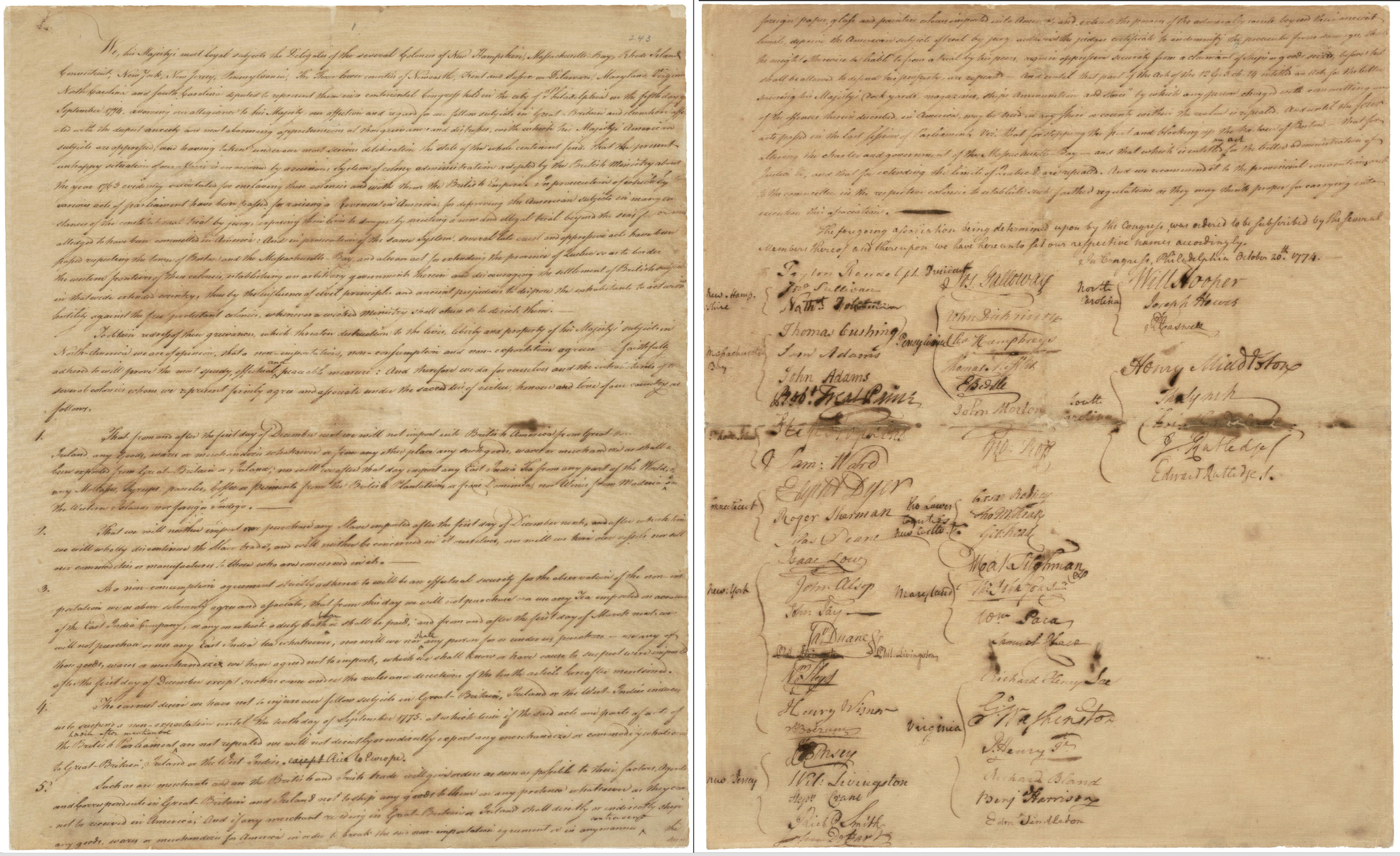
Morris also quoted from the Nonimportation Agreement of 1774 and the “Continental Association” (or “Articles of Association”) which instituted an economic boycott against Britain to protest the Intolerable Acts. As succinctly stated by Morris, it was “a melancholy truth that to make men reason, they must be made to feel.”[46] The boycott began with non-importation and non-consumption of British goods in December of 1774. If the Intolerable Acts were not repealed within nine months, Congress scheduled a ban on colonial exports to begin in September of 1775. After putting this plan in motion, the First Continental Congress adjourned on 26 October 1775, having determined that the Second Continental would reconvene in May of 1775.
Copied below is the first page and signature page of the Continental Association. Click here for a link to the National Archives’ manuscript copy.
Stressing the point that the colonies were “solicitous for peace,” Morris described Congress’s Address to the People of Britain and its October 1774 letter to General Thomas Gage, the Commander-in-Chief of British forces in North America.[47] Both sought de-escalation as the colonies wished to remain attached to Great Britain “if it were possible to be so without the total prostration of all our rights.” Morris explained that Congress’s letter entreated Gage “to forebear measures tending to irritate the people of Massachusetts Bay.” At the same time, Congress advised the citizens of Massachusetts to conduct themselves peacefully toward Gage and his troops.[48]
Despite the earnest efforts of the First Continental Congress, Morris regretted that “the petition to the king received no other notice than to be thrown on the table of Parliament among the mass of American papers…” For Morris, King George thus “fully declared” his intention as “his ministers avowed their determination to compel us to obey” the Intolerable Acts.[49]
Ticking through the pre-war chronology, Morris characterized Lord North’s so-called Conciliatory Resolution of February 1775 as “directly the reverse.” As the Resolution was sent to the individual colonies and purposely ignored Congress, it was properly understood as an effort to divide the colonies. Morris quoted from Congress’s Resolution Rejecting Lord North’s Proposals as “unreasonable and insidious.” Regardless of North’s motivations, his Conciliatory Resolution did not arrive until it was too late. “For on the nineteenth of April, the fatal blow was struck at Lexington which severed the empire.” As poetically described by Morris, “[h]ere then commences a new era.”[50]
British generals Howe and Burgoyne arrived in America with reinforcements in May of 1775. Describing the British siege of Boston, Morris recounted that at “Bunker’s Hill a second and more bloody sacrifice was made to the god of war.” Morris quoted dismissively from the 30 May 1775 letter from Lord North to Congress. Rather than being intimidated by Lord North’s threats, Congress responded with Resolves concerning the defense of New York.[51]
The colonies correctly anticipated that additional British troops would attempt to take New York following their withdrawal from Boston. Morris acknowledged the strategic importance of the Hudson River, which was “in the power of the enemy, if they chose to take it.” Morris also admitted that New Yorkers were “much divided in sentiment,” in light of the “very critical situation” and “fear of impending danger.”[52] Indeed, Morris’s own family reflected these differences.[53]
One of the most important Congressional actions at this point was the adoption of the Declaration on Taking Arms, adopted on 6 July 1775. Morris set the stage by explaining that “[n]o country perhaps in the world was ever in a more delicate situation at this period.” Morris’s prose describing the “crisis” faced by the colonies is worthy of repetition below:
They saw one of the most powerful nations upon earth, whose fleets covered the ocean—whose flag had waved in triumph thro’ the four quarters of the globe, ready to dart all her thunders against them; at the same time, America was without ships, without arms, without clothes, without money, without officers, without discipline, without a single fortification, a very considerable faction ready to join her enemies, exposed thro’ an immense frontier to the irruptions of savage tribes, whose lust of blood was daily stimulated by all the arts which an unfeeling inhuman policy could dictate; while a herd of slaves were urged by the insidious offer of freedom, to plunge an assassin’s dagger in the bosom of domestic security. In this crisis, however, it was determined to risk every thing, rather than tamely submit to the yoke; but, at the same time, it was necessary to avoid as much as possible giving an alarm to the description people, by the mortifying display of their comparative weakness.[54]
Two days after the adoption of the Declaration on Taking Arms, Congress adopted the famous Olive Branch Petition.[55] In poetic language, Morris described the objective of the Olive Branch Petition as “prophetic” and “remarkable” notwithstanding the fact that Britain treated it with contempt:
Where the affections of mankind are deeply interested, they are not easily prevailed on to relinquish the object. Reason in vain opposes her feeble barrier to the torrent of passion. Nature will be heard: she speaks to the heart in the tenderest, most persuasive language, and she cannot speak in vain. Tho’ it was evident as the sun, that the king and parliament of Great-Britain had determined never to sheathe the sword, but upon the unconditional submission of America to the most humiliating bondage; yet, in a delirium of their former attachment, the Congress prepared another petition to the king, and another address to the people of England. Strange as it may seem, it is nevertheless true, that notwithstanding all our interests were clearly opposed to the measure, still a connection with the people, and subjection to the sovereign of Great-Britain, were considered as the most desirable of human events: for it may truly be affirmed, that next to the love of liberty, loyalty to his prince, and love of his fellow subjects, were the ruling passions of an American’s bosom. The prophetic language contained in this petition and address is remarkable; and altho’ it was treated by our enemies with the same contempt as our solemn professions not to submit to their tyranny, yet now that, the heat of the chase being abated, a cool moment of reflection presses itself upon them, it is probable they will, when too late, give to both their share of credit.[56]
Copied below is the first page and signature page of the Olive Branch Petition. Click here for a link to the New York Public Library’s manuscript copy.

The Olive Branch Petition (also known as the “Second Petition from Congress to the King”) was accompanied on July 8, 1775 by Congress’s Address to the Inhabitants of Great Britain. Pointing to the “ties that bind us together,” the Address was directed to “Friends, Countrymen, and Brethren!” in Great Britain.[57] Morris quoted both publications in their entirety, allowing the text to speak for itself.[58]
As any good historian would do, Morris was mindful of the implications of pending hostilities on the “Indian nations.”[59] Morris emphasized that the colonies “openly declared” and manifested their “disposition for peace.” Once again, Morris spoke with poetic and impassioned language to describe effort to avoid the fury of the native American tribes. “Taught by adversity to feel for the woes, and by freedom to respect the rights of mankind,” Morris wrote that the colonies hoped to avoid confrontation with our “fellow men,” the native American tribes.
From native American rights in Indian lands to the freedom on the high seas, Morris also addressed Congress’s reluctant authorization to legalize just reprisals against enemy shipping. Morris observed that Congress began consideration of the outfitting of privateers in November of 1775 but delayed taking action until March of 1776.[60] When it eventually voted on a Resolution authorizing letters of marque and reprisal authorizing letters of marque and reprisal, it did so pursuant to and in compliance with the law of nations.[61]
Consistent with his humanitarian instincts, Morris noted that Congress went out of its way to respect the rights of third parties. According to Morris, “the most generous provision” was made to feed and clothe prisoners who were placed in our power. Morris quoted the so-called Tory Act of January 1776, several resolutions adopted by the Second Continental Congress governing the treatment of Loyalists.[62] Morris highlighted the fact that Congress condemned British wartime barbarity while insisting that “cruelty should find no admission among a free people.” Morris may have taken pride in the fact that Congress affirmed that “no page in the annals of America” should be stained by any action “which justice or Christianity may condemn.”[63]
Morris may also have taken pride in discussing the 15 May 1776 Resolution on Independent State Governments.[64] As described by Morris, “a state of political anarchy could not long be tolerable to any society: the evils resulting from it must at length have produced the most fatal consequences; and it was impossible to foresee what might be the event of a contest in which mankind were set loose from the restraints of law.” Impressed with this concern, Congress adopted the Resolution informing the colonies to adopt their own state constitutions “as shall, in the opinion of the representatives of the people, best conduce the happiness and safety of their constituents in particular, and America in general.” [65]
After the adoption of this critically important Resolution on Independent State Governments, Morris would become one of the drafters of the New York Constitution. As reflected in his autobiography and correspondence, John Adams considered the Resolution to be a form of de facto independence, describing it as “independence itself.”[66] For Adams, it was “the most important Resolution, that ever was taken in America.”[67]
With Congress’s plan in place to prepare new state constitutions, Morris described the fateful step that followed in Philadelphia. In prose worthy of the events of July 4, 1776 Morris explained:
At length, fully convinced of what reason had long dictated, that no rational security for our liberties could be obtained during a connection with Great-Britain, and that every idea of dependence tended to enfeeble our efforts, in a cause on which every thing was at stake, the fine spun thread, which held the two countries together, was cut on the memorable 4th of July, 1776 by, the following Declaration [of Independence].[68]
After quoting the Declaration in full, he explained that “this decisive step was taken in the face of the whole British force collected on our shores.” Morris also recognized that “from that moment” everything changed. “Whether we should be conquered enslaved provinces, or free and independent states? And on this proposition every man was in capacity to take his decided part.”[69]
Almost by definition, any history that followed would be comparatively dry. Morris continued nonetheless with a discussion of the message from Lord Howe to Congress following the Battle of Long Island. As indicated by Morris, Howe’s message was delivered by General John Sullivan after his release from captivity on September 3, 1776 following the “action of Long Island.” Morris also quoted from Congress’s response of September 5 leading into the fruitless Staten Island Peace Conference. The negotiations on September 11, 1776 ended after only three hours.
The American negotiators (Benjamin Franklin, John Adams and Edward Rutledge) communicated that they were only empowered to hear British proposals, which they would report back to Congress. While the meeting was cordial, Lord Howe asserted that the colonies should “return to their allegiance and obedience” to the King and that he lacked the authority to recognize American independence. Morris quoted from the Report of the American delegation to Congress.[70]
Thereafter, Morris condensed two years of military history into a page of text spanning the period from September of 1776 to April of 1778. Morris indicated that “[f]rom this moment the war raged with the utmost violence, and was prosecuted by the enemy with unabated vigor and barbarity.” Morris explained that “[t]o recite the numerous instances in which their faith, solemnly pledged, hath been broken, would be tedious and perhaps useless”:
Victory declared herself for a long time in favor of their superior numbers and superior discipline, and their insolence was equal to their success. Unable to comprehend the whole of the object they had undertaken, and overjoyed at the acquisition of the minuter parts, already the needy greedy parasites of a voluptuous court had in imagination carved out our possessions among them, and wantoned in the prospect of enjoying the fruits of our laborious industry.[71]
Without identifying the Battle of Saratoga or the American commanders by name, Morris summarized that General Burgoyne was defeated by the “determined bravery” of the Americans. Morris explained that France subsequently joined the war when convinced of “our fortitude and perseverance”:
The splendor of our success in that quarter called the attention of Europe to our fortitude and perseverance. The weight and importance of a country which could resist the astonishing efforts made by Great-Britain, were evident to the most careless observation. The acknowledgement of our independence became therefore an object of serious deliberation. Awakened from their dream of glory to a view of their danger, the ministry of England determined, if possible, to recover what they had wantonly thrown away.[72]
It is this part of Morris’s Observations to which Thomas Paine objected. Writing under his pseudonym Common Sense, Paine explained that, “There is no part in the pamphlet, where half a dozen pages might have been employed to more honour and advantage, than in concisely setting forth the principal circumstances which passed between the conference our Staten Island and the arrival of the draughts of the British bills at York Town.”[73]
After the Battle of Saratoga, Parliament proposed the Taxation of Colonies Act of 1778, an effort to restart peace negotiations by declaring that Parliament would no longer tax the colonies to raise revenue. Morris quoted from a draft of the bill[74] conceding taxation, along with another bill appointing peace commissioners (the Carlisle Commission).[75] General Washington feared that the British proposals were a Trojan horse to forestall an American alliance with France. Congress’s detailed response was drafted by none other than Gouverneur Morris.[76] Quoting from his own work not an exercise in vanity by Morris, as his report was unanimously adopted by Congress. Morris artfully rejected the British proposal in no uncertain terms: the British must “either their fleets and armies” or “in positive and express terms” acknowledge the independence of the United States.[77]
Morris next recounted the arrival of copies of the treaties of alliance and commerce with France, delivered by Simeon Deane from Paris on May 2, 1778.[78] Morris was then appointed to prepare an Address of Congress to the Inhabitants of the United States of America, to be distributed around the nation and read in churches of all denominations.[79] As described by historian William Howard Adams, the purpose of the address was “[t]o underline the importance of the announcement and to reinforce the dangers of falling for London’s seductive offer of peace.”[80] Click here for a link to Part 1 which contains a lengthy discussion of Morris’s work replying to the Carlisle Commission.
As described by historian Richard Brookhiser, during the spring, summer and fall of 1778, “the twenty-six-year old Morris wrote several official responses to the commission, and a number of essays in the Pennsylvania newspapers, signed an American, which took a stern view of its offers.”[81] William Howard Adams agrees that, “[e]very report and response in the crisis carried Morris’s distinctive stamp of calm but steely resolve.”[82] In other words, Morris “set the uncompromising tone that would guide the ensuing peace negotiations in which he played a crucial role, his major achievement in the Congress.”[83]
While Morris did not attempt to claim credit for his work, he may have known that doing so was unnecessary. Upon reading Congress’s response to the Carlisle Commission, John Jay wrote to Morris in May of 1778 indicating that it “was too strikingly marked with Morris not to be known by his friends to have been produced by his pen.” Jay further explained that “your history of that business gives me pleasure.”[84]
The next subject addressed in Observations was the 27 May 1778 letter from Lord Howe and the 3 June letter from General Clinton containing the formal Conciliation Acts approved by Parliament to further facilitate negotiations.[85] The first act repealed the Massachusetts Government Act of 1774. The second act repealed the Tea Act of 1774 and attempted to “remove all doubts and apprehensions concerning taxation.” The third act formally authorized the Carlisle Commission with “sufficient powers” to negotiate upon “the means of quieting the disorders now subsisting in certain of the colonies” in North America.[86]
Having failed in their mission to undermine America’s commitment to the war, the Carlisle Commission published a “Manifesto and Proclamation” offering a pardon for all Americans who accepted conciliation but threatening dire consequences to all who refused.[87] Morris aptly described the motivations for the Carlisle Commission’s Manifesto as follows: “Being thus foiled in their several attempts to deceive, nothing remained but to terrify.” After quoting the Manifesto, Morris reproduced Congress’s own Manifesto Replying to the Carlisle Commission on 30 October 1778.[88] Once again, it was Morris who held the pen of Congress.

Morris concluded Observations with the following stirring prose:
CONSIDERING our present situation and connections, we cannot but be sensible that the independence of America is fully secured, and nothing left to guard against but the ravages of a cruel foe, and the derangement of our finances. To effect the former, we must hold ourselves ready to repel force by force wherever assailed, and firmly retort every infringement of the law of nations with unfeeling perseverance. To remedy the latter, economy in the expenditure of money, and taxation, are the natural means, and, in addition to these, private economy, founded on a conviction that the monies wantonly expended in the present moment of depreciation, will soon be deeply regretted when it hath recovered its full value. By such steps we shall frustrate the designs of our enemies, and hasten that moment when the United States of North-America, rising from distress to glory, shall dispense to their citizens the blessings of that peace, liberty and safety for which we have virtuously and vigorously contended.
THE portals of the temple we have raised to freedom, shall then be thrown wide, as an asylum to mankind. America shall receive to her bosom and comfort and cheer the oppressed, the miserable and the poor of every nation and of every clime. The enterprise of extending commerce shall wave her friendly flag over the billows of the remotest regions. Industry shall collect and bear to her shores all the various productions of the earth, and all by which human life and human manners are polished and adorned. In becoming acquainted with the religions, the customs and the laws, the wisdom, virtues and follies and prejudices of different countries, we shall be taught to cherish the principles of general benevolence. We shall learn to consider all men as our brethren, being equally children of the Universal Parent—that God of the heavens and of the earth, whose infinite majesty, for providential favor during the late revolution, almighty power in our preservation from impending ruin, and gracious mercy in our redemption from the iron shackles of despotism, we cannot cease with gratitude and with deep humility to praise, to reverence and adore.
In sum, Morris’s Observations were not merely a reprinting of Congressional resolutions, petitions and declarations. Rather, Morris tied these sources together to tell the history of the American Revolution with his identifiable running commentary. By so doing, Morris’s impact may have rivaled Thomas Paines’ Common Sense, particularly for British audiences.[89]
As will be described in Part 3 (Pending), Morris’s Observations were nothing less than a “call to national greatness and humanitarianism.”[90] As will be argued in Part 3, Morris’s vision for America can be found not only in his Observations, but also in his remarkable New York Oration on the Necessity for Declaring Independence in 1776.[91] The same vision echoes across time in the Preamble of the Constitution.
Endnotes
[1] JCC, 12:519.
[2] Perhaps future researchers will investigate whether Lazarus had access to Morris’ Observations. For example, Morris’s prose was quoted in speeches to Congress in 1845. Washington Union, 7 March 1845, p1; Portland Press Herald, 24 November 1845 p. 2.
[3] The first published history of the British colonies was Captain James Smith’s The Generall Historie of Virginia, New-England, and the Summer Isles, published in 1632.
[4] Ilan Rachum, “From ‘American Independence’ to ‘American Revolution,’ ” Journal of American Studies 27, no. 1 (April 1993): 73–81; https://www.jstor.org/stable/40464078. Morris likely drew inspiration from William Henry Drayton, the Chief Justice of South Carolina, who referred to the American Revolution as early as April of 1776 in a charge to a grand jury. https://www.amrevmuseum.org/virtualexhibits/season-of-independence/pages/charlestown-south-carolina-grand-jury-presentments-april-23-1776 Drayton was also a colleague of Morris on the three-member committee charged with responding to the Carlisle Commission. JCC, 10:367.
[5] In a letter to John Adams dated 27 March 1777, William Gordon indicated that he was “collecting materials for an history of the rise progress and successful issue of the American revolution.” https://founders.archives.gov/documents/Adams/06-05-02-0074
Nonetheless, Gordon would not publish his history for another decade. William Gordon, The History of the Rise, Progress, and Establishment, of the Independence of the United States of America, 4 vols. (London, 1788). Accordingly, while Morris did not originate the term “the American Revolution,” he certainly popularized it.
[6] Morris’s abilities as a public speaker were evident in 1768 when he delivered a commencement address at King’s College. At his graduation he was also awarded a medal by the “Literary Society.” New-York General Advertiser, 26 May 1768. During the summer of 1787 Morris and fellow Pennsylvania delegate, James Wilson, spoke more times than any other delegates at the Constitutional Convention. https://csac.history.wisc.edu/2021/05/18/speeches-motions-and-committee-assignments-in-the-constitutional-convention/
[7] Morris’s historical addresses included an 1812 discourse on New York history, an 1813 oration to the Washington Benevolent Society and his 1816 inaugural address to New-York Historical Society. These speeches will be discussed below.
[8] James J. Kirschke, Gouverneur Morris: Author, Statesman, and Man of the World (Thomas Dunne Books, 2005), 259. Morris was the Vice President of the New-York Historical Society from 1810 – 1815. He passed away in 1816, the year he was elected the President. Robert Hendre Kelby, The New York Historical Society, 1804-1904 (1905), 29. One can only speculate what additional historical work he might have produced had he not passed in 1816.
[9] Max M. Mintz, Gouverneur Morris and the American Revolution (University of Oklahoma Press, 1970), 104.
[10] Gouverneur Morris to Robert Morris, 17 August 1778; LMCC, 3:376-77.
[11] Morris refers to the Townsend Acts as “a statute commonly called the glass, paper and tea act,” as today’s conventional labels and terminology had not yet been agreed upon. Observations at 6.
[12] Observations at 12.
[13] Morris cites the Declaration of Independence as the “DECLARATION by the Representatives of the UNITED STATES of AMERICA, in Congress assembled,” the title in the original printed version of the Declaration. The subsequent, more popular engrossed version was signed beginning on August 2, 1776.
[14] The Carlisle Peace Commission arrived in America in June of 1778 and did not return to England until December. Frustrated in their efforts to negotiate with Congress, in October the Commission issued an appeal directly to the American people, with a 40-day deadline to accept the King’s offer of pardon. The Observations were thus part and parcel of the Congressional response to the British overtures. Paul H. Smith, Letters of Delegates to Congress (Library of Congress, 1985), 12:xxvii.
[15] Among other things, Morris’s 1776 speech to the New York Provincial Congress recognized a bright American future and a government which would secure “the blessings of liberty” and exalt “the dignity of mankind.” J. Jackson Barlow, ed., To Secure the Blessings of Liberty: Selected Writings of Gouverneur Morris (Liberty Fund, 2012), 22.
As recently described by historian Scott S. Greenberger, Morris’s Oration on independence in 1776 “painted a portrait of a glorious future: A united and economically thriving republic, enlarged by western settlements and blessed with a growing and educated population.” Greenberger, The Forsaken Founder (Simon & Schuster, 2026), 38.
[16] JCC, 12:519.
[17] Paul H. Smith, Letters of Delegates to Congress (Library of Congress, 1985), 12:xxvii.
[18] Edmund C. Burnett, Letters of Members of the Continental Congress (Carnegie Institution, 1926), 3:xv.
[19] Dunlap’s Pennsylvania Packet, 20 March 1779.
[20] Shortly after its publication in America, Morris’s Observations were circulating in London. William Howard Adams, Gouverneur Morris: An Independent Life (Yale University Press, 2003), 111. Observations was republished in 1779 by the British periodical The Remembrancer. Morris biographer James Kirschke suggests that the republication of Observations by John Alnon in London was propitiously timed. According to Kirschke, “[i]t is quite possible,” that Observations may have helped swing British public opinion against the war. In fact, Alnon was accused of libeling King George and was imprisoned for two years. Kirschke, 92.
[21] Congress authorized payment of $2,986 to Stiner & Cist for printing of 1,300 copies of Observations on April 5, 1779. JCC, 13:421.
[22] The full title of the 122-page work declares that it was “Published According to a Resolution of Congress by their Committee for the Consideration of those who are Desirous of Comparing the Conduct of the Opposed Parties and the Several Consequences which have Flowed from It.”
[23] American Journal and General Advertiser, 24 May 1780.
[24] Kirschke, 90.
[25] A copy can be found in the Jefferson Collection at the Library of Congress. George Washington also owned a copy. https://www.mountvernon.org/library/special-collections-archives/books-owned-by-washington
[26] Richard Henry Lee to Thomas Jefferson, LDC, 12:421. See also RHL to John Adams, LDC, 12:379. John Jay sent a copy to the Spanish Foreign Minister, Floridablanca on 25 April 1780. https://founders.archives.gov/documents/Jay/01-02-02-0033
[27] Paul Smith, LDC, 12:xxvii.
[28] Harvard historian and President, Jared Sparks, also wrote a biography of Morris (1832), along with biographies of George Washington (1834-1837) and Benjamin Franklin (1836-1840).
[29] Theodore Roosevelt, Life of Gouverneur Morris (Houghton, Mifflin and Co., 1888), 187-188.
[30] Observations at 1. When citing below to Morris’s Observations, the first Philadelphia edition by Styner and Cist will be used.
[31] Observations at 18.
[32] Observations at 1.
[33] Observations at 2.
[34] Observations at 2.
[35] Observations at 3.
[36] Observations at 4.
[37] Observations at 5.
[38] The official name of the famous Congressional address was the “Memorial to the Inhabitants of the British Colonies,” appropriately re-labeled by Morris as Congress’s “address to America of October 1774.” Observations at 4.
[39] Observations at 7-8.
[40] Observations at 12.
[41] Observations at 10-11.
[42] Observations at 8.
[43] Observations at 11.
[44] JCC, 1:115.
[45] Observations at 12-16.
[46] Observations at 16.
[47] Observations at 18-19.
[48] Observations at 18-19.
[49] Observations at 19.
[50] Observations at 24. Morris might have been invoking Thomas Paine’s Common Sense, which similarly declared in 1776 that “We have it in our power to begin the world over again.”
[51] JCC, 2:59.
[52] Observations at 25-26.
[53] Morris’s mother and half-brother were loyalists at the same time than another half-brother, Lewis Morris, would become a signatory to the Declaration of Independence.
[54] Observations at 29.
[55] Observations at 36-40.
[56] Observations at 35-36.
[57] JCC, 1:163-170.
[58] Observations at 40-49.
[59] Observations at 49.
[60] JCC, 4:229.
[61] Observations at 50.
[62] JCC, 4:18.
[63] Observations at 51.
[64] Observations at 52-53: JCC, 4:342, 4:357.
[65] JCC, 4:342.
[66] https://founders.archives.gov/documents/Adams/01-03-02-0016-0120
[67] John Adams to James Warren, 15 May 1776;
https://founders.archives.gov/documents/Adams/06-04-02-0079
[68] Observations at 53-57.
[69] Observations at 57-58.
[70] Observations at 58-61; JCC, 5:765.
[71] Observations at 61.
[72] Observations at 62.
[73] https://thomaspaine.org/recently-discovered/response-to-observations-on-the-american-revolution/
[74] Observations at 62.
[75] Observations at 63-66.
[76] Observations at 66-72.
[77] Mintz at101; Kirschke at 81.
[78] Observations at 72-78.
[79] Mintz at 103; JCC, 11:474.
[80] William Howard Adams at 105.
[81] Brookhiser at 51.
[82] William Howard Adams at 106. Adams also cites to 19th century historian William Henry Adams’s opinion that Gouverneur Morris was “cool, even-tempered, incredulous, with convictions chiefly practical and illusions largely rhetorical.
[83] Adams at 104.
[84] John Jay to Gouverneur Morris, 20 May 1778.
[85] Observations at 79.
[86] Observations at 79-84.
[87] Observations at 110-118.
[88] Observations at 118.
[89] Kirschke at 85, 90
[90] Mintz at 112.
[91] Among other things, Morris’s speech recognized a bright American future and a government which would secure “the blessings of liberty” and exalt “the dignity of mankind.”