“Finding Eliza in Poughkeepsie” – “Eliza Poughkeepsie Surprise”
New Insights into the New York Ratification Convention in Poughkeepsie

Dozens of biographies and historical texts have examined Alexander Hamilton’s life and works. Following the success of the Hamilton musical, scholars have broadened their focus to explore Elizabeth (“Eliza”) Hamilton’s story. Yet, no scholarship has examined what Eliza was doing during the summer of 1788, a pivotal moment in Hamilton’s career. Recently assembled primary sources – discussed for the first time below – shed new light on Eliza’s whereabouts during the New York convention that ratified the U.S. Constitution. We can now affirmatively conclude that in mid-July of 1788 Eliza attended “the convention where it happened,”[1] prior to New York’s vote to join the union as the eleventh state.
The Constitutional Convention famously met in Philadelphia during the summer of 1787. Due to the Convention’s “rule of secrecy,” only delegates were permitted to attend the deliberations at the Pennsylvania State House (later renamed Independence Hall). By contrast, in 1788 the New York ratification convention in Poughkeepsie was open to the public. While there were no women in attendance at the Constitutional Convention, it is not unreasonable to ask where was Eliza Hamilton when the Constitution was being publicly debated in New York? Recently compiled evidence supports the conclusion that Eliza was in the gallery at the New York ratification convention in Poughkeepsie in mid-July of 1788. If so, Eliza no doubt proudly watched Alexander Hamilton deliver some of the most important speeches in New York history.
For six contentious weeks in June and July of 1788, Alexander Hamilton, John Jay, and Robert R. Livingston led the heavily outnumbered Federalists at the New York’s ratification convention.[2] They faced off against Hamiton’s political rivals, Antifederalists Melancton Smith, Robert Yates, John Lansing Jr., and New York Governor George Clinton, who presided over the dramatic debates.[3] The bitterly contested New York convention lasted longer than any of the other state ratification conventions. Ultimately on July 26 the New York convention voted to ratify the Constitution by the then[4] narrowest margin of any state, 30 to 27.[5]
This blog post, “Finding Eliza Hamilton,” begins with an overview of the growing Hamilton family. Next, it is useful to attempt to pinpoint their location in either New York City or Albany during the spring and summer of 1788. Following this introduction, new ground is broken by providing definitive proof that Eliza attended the New York ratification convention in mid-July of 1788. The remainder of this blog post provides context for Eliza’s exciting but unexpected trip to Poughkeepsie, which is organized as follows: 1) an overview of the hard-fought New York ratification convention, 2) a summary of Hamilton’s convention speeches in mid-July when Eliza was in attendance, and 3) New York’s July 26thratification vote and its aftermath. A follow-up blog post, “the Founding Mothers and Ratification,” (pending) will explore the other state ratification conventions and the role of women more generally in 1788.
Hamilton family in 1788
It is no exaggeration that 1788 was an extraordinarily busy year for the Hamilton family. James Alexander, the fourth Hamilton child, was born in April of 1788.[6] At the time of James’ birth Alexander was still writing the final installment of his fifty-one The Federalist essays.[7] The nearly seven-week New York ratification convention would convene three months later, beginning on June 17.[8]
A year earlier, as one of three New York delegates to the Constitutional Convention, Hamilton made three trips to Philadelphia during the summer of 1787. If not busy enough, the Hamiltons welcomed an orphan into their growing family during the Philadelphia Convention. Fanny Antill came home[9] with Alexander following a meeting of the Society of the Cincinnati in July of 1787.[10] For the next ten years the Hamiltons raised two-year-old Fanny as their own, until she went to live with her older, married sister.[11] Click here for a discussion of Little Orphan Fanny.
The historic record is unclear, however, where Eliza resided during her pregnancy with James. Historians have also puzzled over Alexander’s whereabouts in the weeks immediately preceding the New York ratification convention. As Eliza had recently given birth to James on April 14, historians have generally assumed that Eliza would sensibly have remained in the Hamilton family home in New York City during the New York ratification convention. Other historians have speculated that Eliza resided in Albany with her parents, the Schuylers, during her pregnancy and Alexander’s absence at the Poughkeepsie convention.
Temporary residency in Albany during the spring and/or summer of 1788 would have been a logical decision for Eliza. The Hamiltons were married at the Schuyler mansion in December of 1780.[12] After the Battle of Yorktown, Alexander and Eliza lived with the Schuylers while Alexander studied for the New York bar.[13] After they moved to New York City, Alexander and Eliza routinely visited the extended Schuyler family during the summer months. They also stayed at the Schuyler home (known as “the Pastures”) when Alexander was attending sessions of the New York Supreme Court in Albany.[14]
Indeed, according to Hamilton family lore, written down years after the fact, Alexander is believed to have begun writing The Federalist in October of 1787 while traveling on a Hudson river boat (sloop) during a prior Albany trip.[15] Yet, no published scholarship has entertained the possibility that Eliza managed to visit Alexander during the New York ratification convention. To begin with, James was only three months old in July of 1788. Moreover, for Eliza to take the trip to Poughkeepsie, she likely would have required help with little James, three-year-old Fanny, and the three other Hamilton children.
If Eliza was living at home[16] in New York City after she gave birth to James in April, she would have traveled north up the Hudson River to attend the New York ratification convention in Poughkeepsie. Alternatively, if Eliza was residing in Albany with the Schuyler family during the spring/early summer of 1788, she would have traveled south down the Hudson to Poughkeepsie. Either trip was approximately 80 miles, as Poughkeepsie is located approximately midway between Albany and New York City. Thankfully, larger river sloops were equipped with cabin(s) for passengers.[17]
Finding the Hamiltons in the spring and summer of 1788
In 1957, historian Broadus Mitchell published a two-volume biography of Alexander Hamilton. Mitchell acknowledged that Hamilton’s whereabouts were uncertain during the weeks leading to the New York ratification convention. As described by Mitchell, “[w]e do not know whether Hamilton came up from New York City or down from Albany.”[18] In a 2003 biography, Willard Sterne Randall contemplated that Hamilton and Jay “sailed upriver to attend the convention,” after being seen off by a thirteen-gun salute from the Battery in lower Manhattan.[19] Biographer Marie Hecht agrees that, “Hamilton was probably among the delegates who set out on the eighty-mile sail up the river” with Federalist colleagues on June 14.[20]
Copied below is a newspaper report of the delegations setting sail for Poughkeepsie.[21] Governor Clinton and the Antifederalists departed first in the morning. The Federalists set sail in the afternoon. Federalists James Duane (the mayor of New York City) is mentioned in the newspaper report, as is Supreme Court Justice John Sloss Hobart. Unfortunately, the newspaper report doesn’t mention Hamilton or Jay by name, leaving readers to wonder which Federalist delegates traveled together from New York City to Poughkeepsie on June 14.[22]
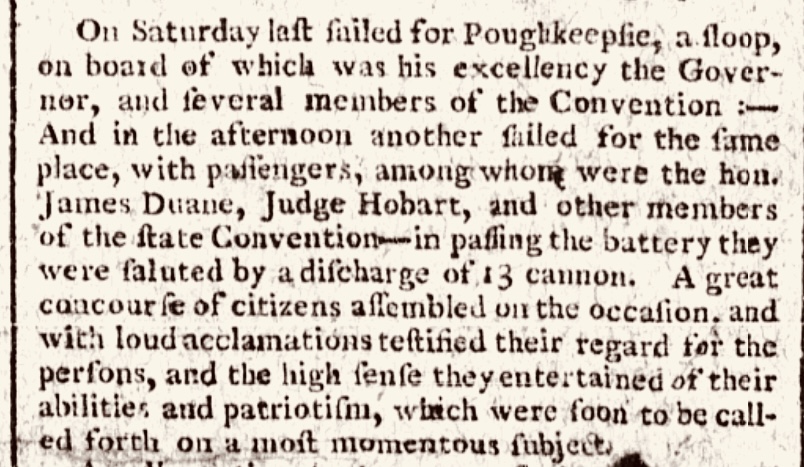
Similar questions have been asked about Eliza’s whereabouts during the Poughkeepsie convention. As framed by Broadus Mitchell, Eliza might have resided at the Hamilton home on Wall Street during the six-week Poughkeepsie convention, or she may have bided her time at the Schuyler mansion in Albany during Alexander’s absence.[23] In 1976, Robert Hendrickson authored another two-volume Hamilton biography. Imagining the scene of Hamilton’s return to his loving family following the ratification vote, Hendrickson assumed that Eliza was in New York City during the New York ratification convention.[24]
Historian Jacob Cooke was a co-editor of the Hamilton papers. In a 1982 biography, Cooke expressed the conventional wisdom that Alexander would not have seen Eliza and their children during the six-week convention.[25]Statutesandstories.com is excited to demonstrate below the exciting discovery that the Hamiltons reunited in mid-July in Poughkeepsie, during a critical phase of the ratification convention. The newly compiled evidence further supports the conclusion that women, including Eliza, were witnesses to the remarkable New York convention debates.[26] As described by a newspaper report from late June as many as two hundred spectators were able to watch the debates in Poughkeepsie:
The spectators who seldom make a number less than a hundred and oftentimes are twice so many, enjoy a mental feast exquisite as uncommon. The first geniuses of the country have here a field on which their powers have ample room.[27]
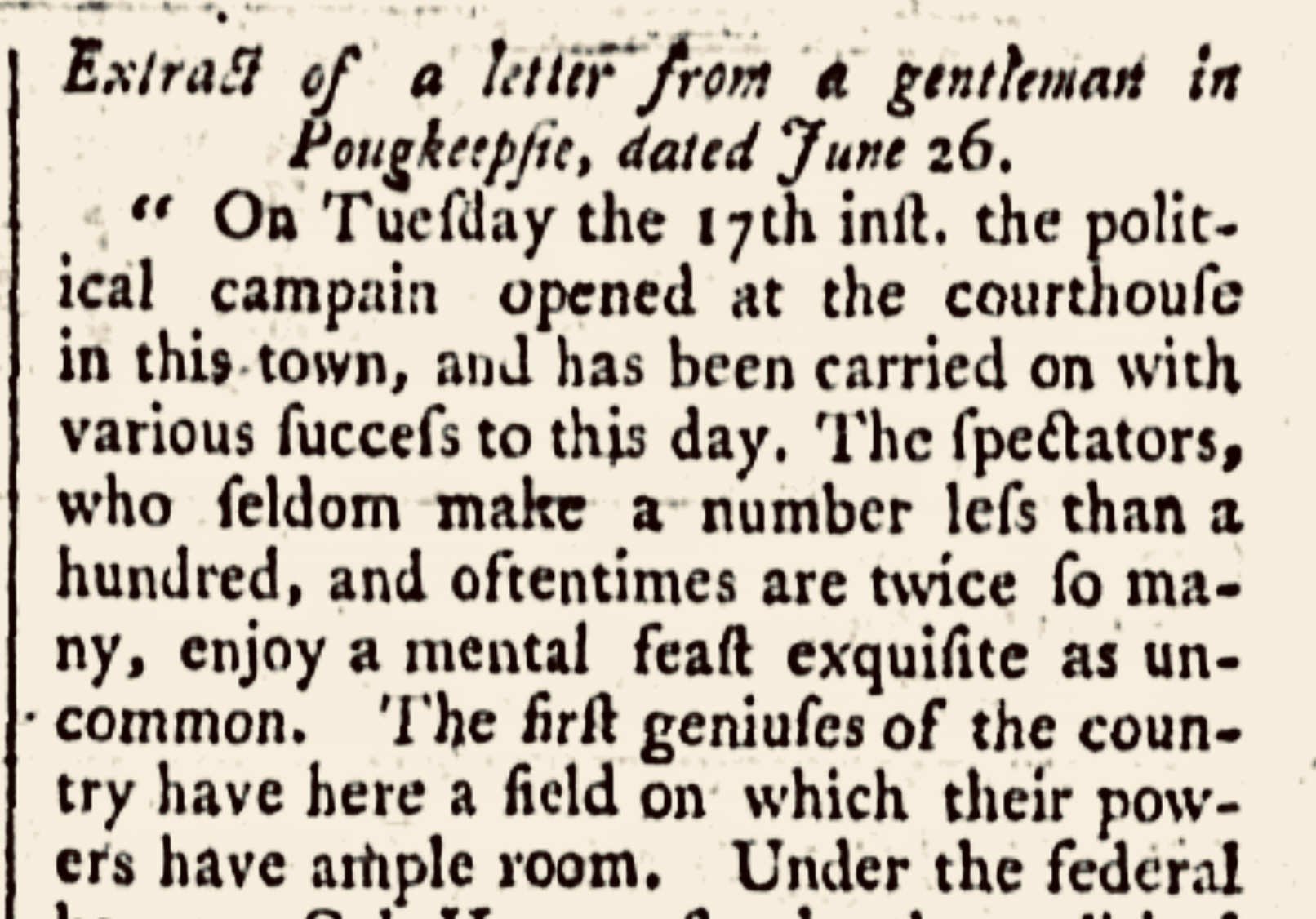
In mid-July of 1788, both Eliza and her father, Philip Schuyler, would have been among the spectators observing the proceedings. The New York ratification convention was held in the newly built Dutchess County courthouse in Poughkeepsie. When the British occupied New York City during the war, Poughkeepsie had been the state capital. The large, two-story stone building was designed as a “place of meeting.”[28] For example, in January of 1788 the New York state legislature convened at the Dutchess County courthouse.[29]
Proof that Eliza visited the New York ratification convention in mid-July
The surprising proof that Eliza visited Alexander during the New York ratification convention comes from the reliable pen of her father, Philip Schuyler. While he was not a convention delegate, Schuyler was a prominent Federalist and New York state senator.[30] On July 15, Schuyler wrote to his son-in-law, Stephen Van Rensselaer, summarizing the deliberations.[31] Astute Hamilton fans may recall that Stephen Van Rensselaer was married to Eliza’s sister, Peggy. At the end of the long-overlooked letter, Schuyler mentioned that Eliza arrived in Poughkeepsie on Sunday, July 13:
“Mrs. Hamilton arrived on Sunday evening, she, Phill[ip] & the little one [James] are here, the other two are gone on with the sloop.”
Providing useful confirmation that General Schuyler was referring to none other than his daughter, Eliza, the letter elaborates that “she Phill. & the little one are here, the other two are gone on with the Sloop.”[32] In 1788, Eliza had four children Phillip (the oldest), James (the youngest), and two other siblings (Angelica and Alexander). Accordingly, Schuyler’s letter indicates that Eliza remained in Poughkeepsie with Philip and James, while the two middle children continued their trip by sloop with other relatives.[33]
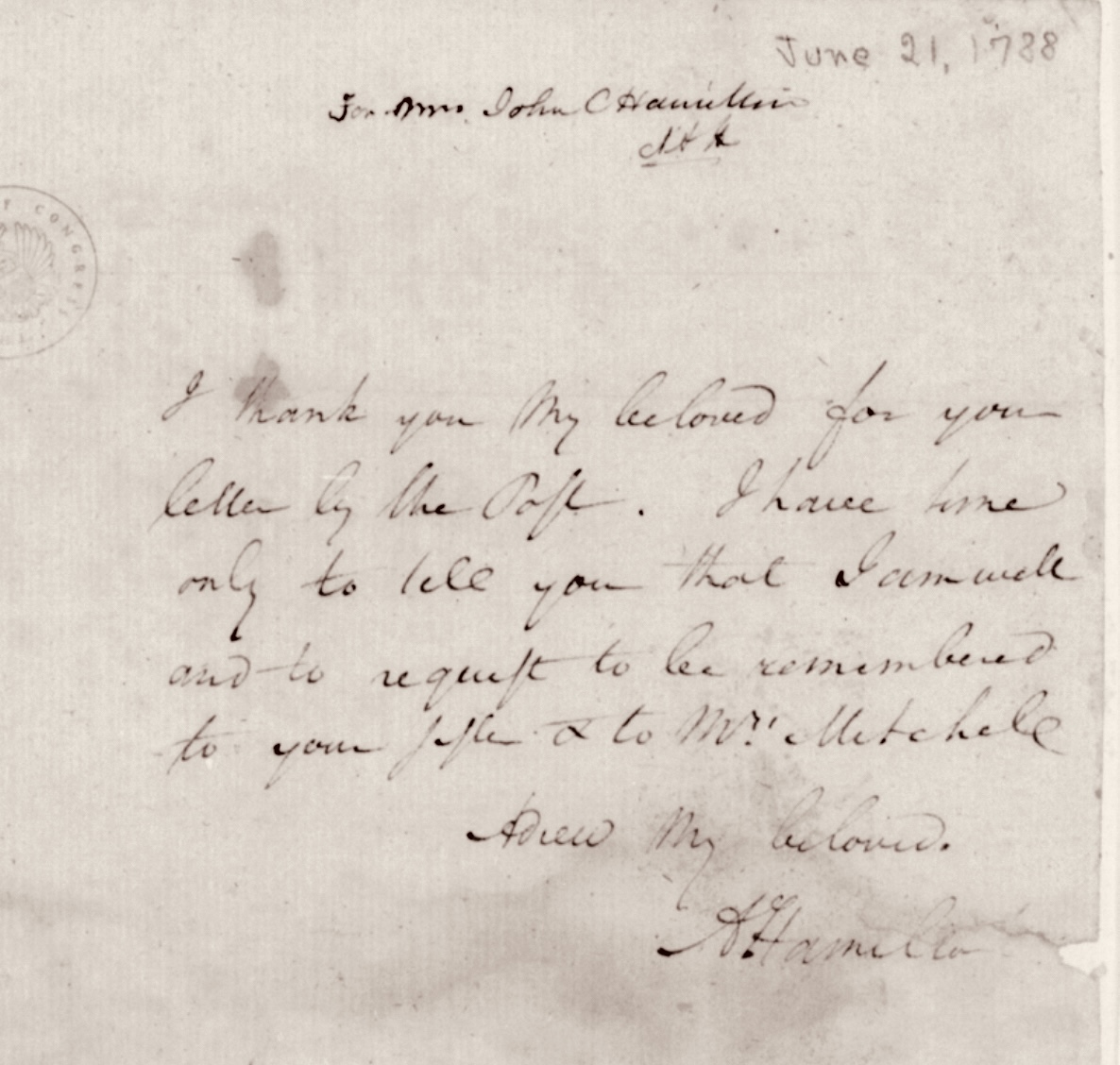
Additional clues can be found in a letter Alexander wrote to Eliza from the Convention. The June 21 letter updated Eliza about Alexander’s safe arrival in Poughkeepsie. Importantly, the brief letter was addressed to Eliza in New York City. Alexander’s letter (pictured below) also provides the helpful information that Eliza was with her sister and Mrs. Mitchell (a cousin of Alexander’s from the Caribbean). It is likely that Eliza’s sister (who is not named in the letter) and Mrs. Mitchell were assisting Eliza with childcare duties, after Eliza delivered James on April 14.[34]

Another clue that the Hamiltons were residing in New York City prior to the Convention includes a series of letters from Hamilton to James Madison, written from New York City in May and June of 1788.[35] Also noteworthy is a May 28 letter sent from New York City from Antifederalist Abraham Yates, Jr., to Abraham G. Lansing.[36] After summarizing a conversation with Hamilton on May 28, Yates indicates that Hamilton had invited Yates to dinner on June 1. Yates, an ardent Antifederalist, declined. Writing to James Madison on June 8 from New York City, Hamilton coordinated ratification strategies with his Federalist colleague in Virginia. Hamilton’s letter to Madison illustrated his concerns over the uphill ratification battle in New York – and possibly reflected his discussions with Yates. As indicated below, Hamilton was clearly worried about the possible outcome in Poughkeepsie, including disunion and civil war:
[T]he more I can penetrate the views of the Antifœderal party in this state, the more I dread the consequences of the non adoption of the Constitution by any of the other states, the more I fear an eventual disunion and civil war. God grant that Virginia may accede. Her example will have a vast influence on our politics. New Hampshire, all accounts give us to expect, will be an assenting state.[37]
In hindsight, the conclusion that Eliza traveled to the New York ratification convention in Poughkeepsie should not be surprising. It was also recently discovered that Eliza visited Alexander in Philadelphia during the Constitutional Convention. When in Philadelphia Eliza no doubt providing moral support for her husband when he prepared his famous all day convention speech on June 18, 1787. Click here for a discussion of Eliza’s trip to Philadelphia (the “Eliza Philadelphia Surprise”). Accordingly, Eliza’s story comes into sharper focus now that we have a better understanding of her proximity to Alexander during some of the most important moments of his political career – during both the Constitutional Convention and New York ratification convention.[38] Prior generations of historians did not have access to the recently completed Documentary History of the Ratification of the Constitution, which is an invaluable resource which makes this research possible.
Overview of proceedings at New York convention in mid-July
Eliza arrived in Poughkeepsie during a crtical stage of the ratification convention. Although breaking news arrived in early July that Virginia had ratified the Constitution, the Antifederalists remained committed to their longstanding insistence on conditional ratification with antecedent amendments. Federalists, by contrast, insisted that only unconditional ratification would be acceptable to Congress and the ratifying states. The convention was thus facing a “perfect crisis”[39] when Eliza came to town.
During the convention debates two principal speakers, Hamilton and Antifederalist Melancton Smith, “carried more than half of the debate between them.”[40] The delegates completed their section-by-section review of the Constitution on July 7,[41] which was followed by a “week-long stalemate.”[42] Eliza arrived in Poughkeepsie on Sunday evening, July 13. While it is unclear which dates Eliza attended, the dramatic Convention proceedings in mid-July are illustrated below:
- Monday, July 14: Impatient Antifederalist William Harper called for a vote, asserting that they had “spent three days doing nothing but talk” about competing proposals.[43] Hamilton sought to delay a substantive vote since “he supposed it would amount to a rejection.”[44] As described by Federalist David Bogart, “[t]he important decisive question would have been put this morning, had not the eloquent Hamilton and Mr. Jay pleaded the postponement (at least till tomorrow), of a question the most serious and interesting ever known to the people of America.”[45]
- Tuesday, July 15: A “flurry” of competing motions were made by Melancton Smith and Alexander Hamilton.[46]Each offered dozens of proposed amendments intended to break the deadlock. Several of Hamilton’s proposed amendments were modeled after recommendations from the Virginia convention, which Hamilton pledged to support by way of compromise.[47]
- Wednesday, July 16: Fearing the outcome of a vote, the outnumbered Federalists recognized that adjournment would be preferable to defeat. Federalist delegate John Sloss Hobart, a justice on the New York Supreme Court, moved for adjournment until September.[48] James Duane, the Federalist mayor of New York City, seconded Hobart’s motion. For the next two days the delegates debated over the implications of adjournment. “Mr. Hamilton made an excellent speech, and was followed by a call for the question,” which was temporarily postponed for the day.[49]
- Thursday, July 17: A month after the Convention began many of the delegates were “impatient” to return home.[50] Nevertheless, the Antifederalists remained largely unified. In a victory for the Antifederalists, the Federalist motion for adjournment was overwhelmingly defeated by a vote of 40 – 22. The Convention thereafter resolved itself into a committee of the whole and began reviewing prior motions. Hamilton’s motion for unconditional ratification with explanatory and recommendatory amendments was easily defeated, but a handful of Antifederalists from southern counties began to realign.[51]
- Thursday, July 17 (Melancton Smith’s pivot): “The maze of motions was becoming mind-boggling” as the convention was facing a formal vote.[52] At this point, the convention took an unexpected turn. Smith announced that he no longer supported his prior motion for conditional ratification because he was now convinced that Congress would reject it.[53] Smith announced that he was “mistaken” and wished to “withdraw” his earlier motion.[54] After Smith’s announcement, Smith, Jay and Hamilton gradually navigated a conciliatory path to ratification.[55] Ultimately, a dozen Antifederalists would follow Smith’s lead, voting in late July for unconditional ratification with recommended amendments and a call for a second general convention. As described by Philip Schuyler, “perseverance, patience and abilities have prevailed against numbers and prejudice.”[56]
Descriptions of Hamilton’s bravura performance in mid-July
During the convention Hamilton delivered at least twenty-six speeches.[57] One Federalist observer praised Hamilton’s oratory, referring to him as the “American Cicero.” Another observer opined that “[o]n the whole I believe that in no state in America has the new constitution been fairer canvassed, abler defended, or more powerfully opposed.”
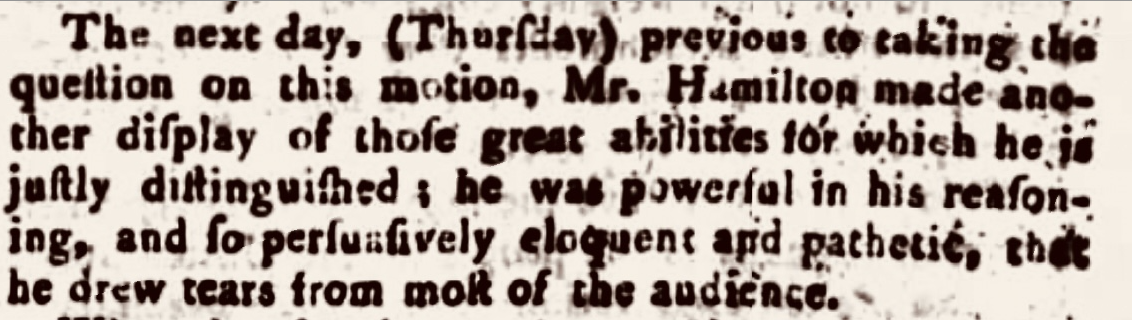
Copied below is a description of Hamilton’s July 17 speech, mentioning his “great abilities for which he is justly distinguished.” In particular, it was reported that Hamilton was “so persuasively eloquent and pathetic (compassionate/touching/moving), that he drew tears from most of the audience.”[58] While there is no confirmation that Eliza attended Hamilton’s July 17 speech, she very well may have been in the crowd[59]:
The opening days of the convention are described below. To his credit, Melancton Smith acknowledged on June 21 that “Mr. Hamilton had, by his reasoning, removed the objection he had made” regarding apportionment of representatives under Article 1. The “eloquence and reasoning” of Hamilton’s speech was described as “irresistible.” The speech was reported as lasing one hour and twenty minutes, during which “objections which had been made vanquished” before Hamilton.[60]
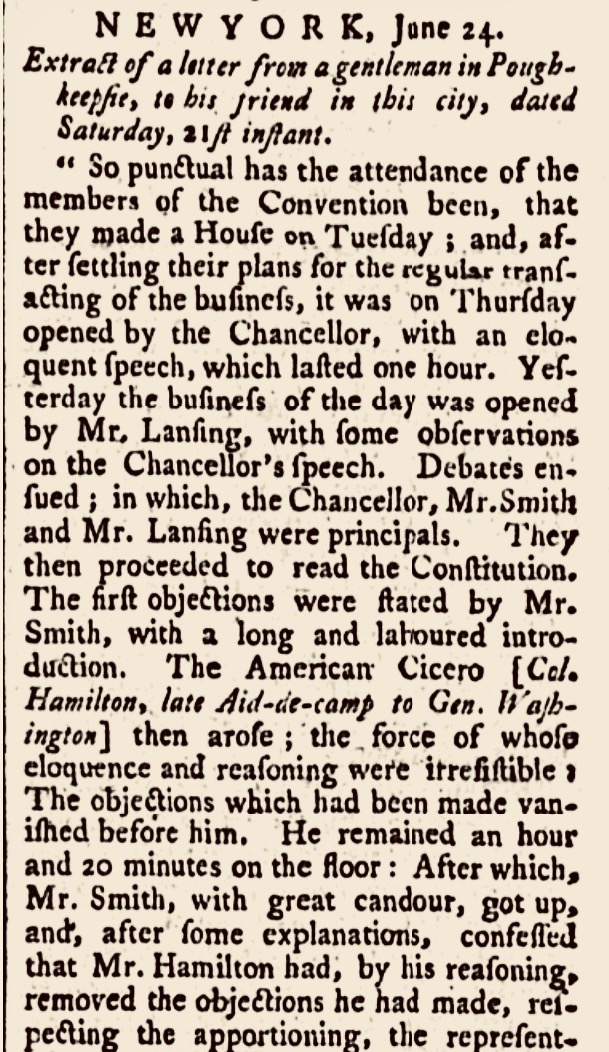
The following report from June 26 recounted the “first geniuses of the country” on a field where “their powers have ample room.” Colonel Hamilton was described as a “political porcupine, armed at all points,” brandishing a shaft at every opponent.[61]:

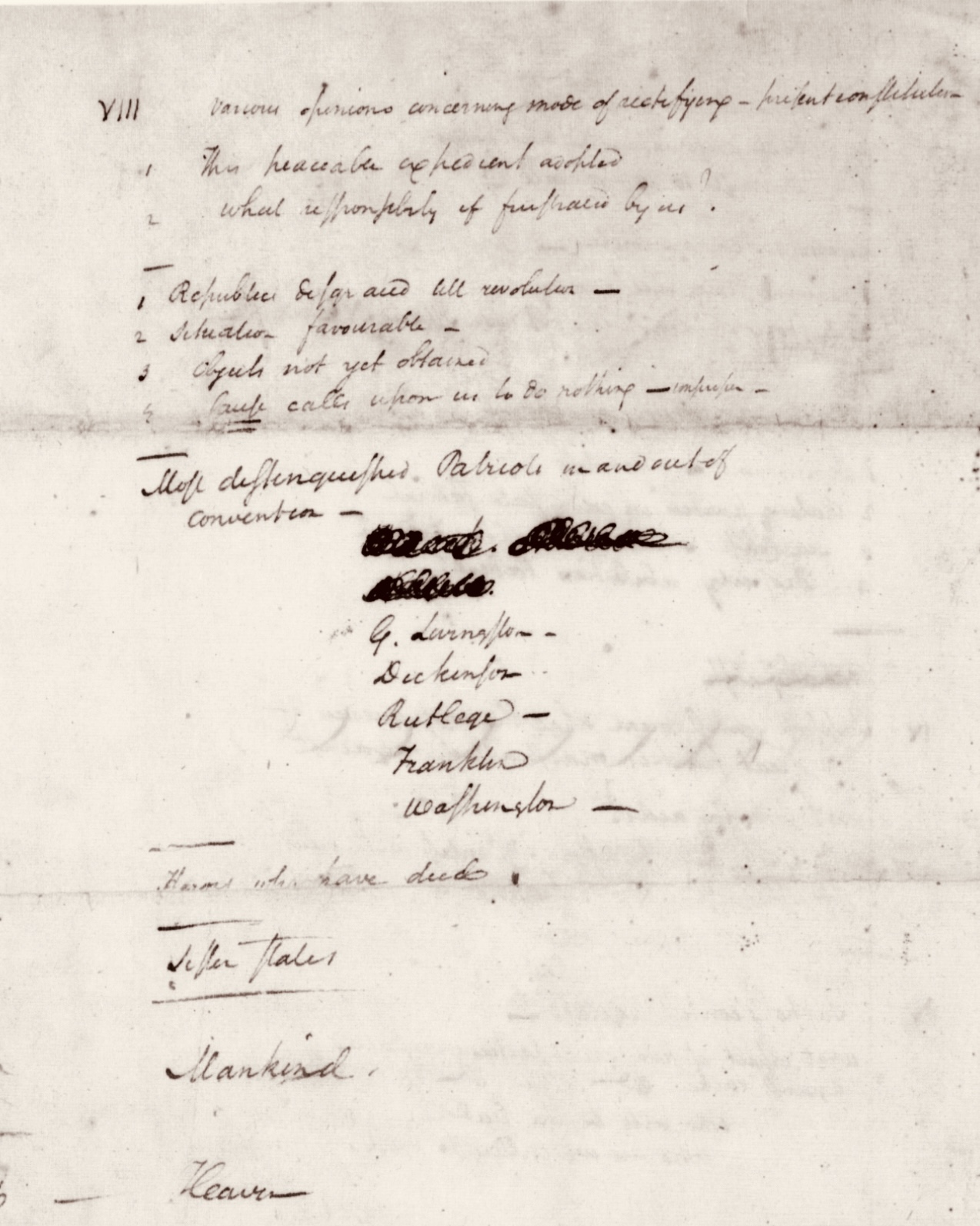
Copied below are Hamilton’s notes of his speech of July 17, which are housed in the Hamilton Papers in the Library of Congress. It is likely that the portion of Hamilton’s speech which drew tears from the crowd may have been his invocation of Washington, Franklin, departed patriots, sister states, mankind and heaven. One detailed transcription of the speech quotes Hamilton as describing Franklin as “this old grey headed patriot looking into the Grave,” who approved the Constitution.[62]
Ratification celebrations in New York City
Returning to New York City on July 28, Hamilton, Jay, Duane and their colleagues were greeted with an eleven-gun salute as they passed the battery at Fort George at the southern tip of Manhattan. A second greeting awaited each delegate at their home, where eleven guns were discharged at the “dwelling house of each member, attended with repeated huzzas from a large concourse of people.”[63] Yet, Hamilton and his colleagues were not present for the earlier celebration in New York City that they missed on July 23.
The respect and gratitude displayed on Hamilton’s arrival in New York City, “paled in comparison” with the celebrations in Hamilton’s honor the prior week.[64] On July 23, New York City celebrated the ratification of the Constitution with a grand procession in which dozens of organizations of craftsmen, merchants, farmers, college students, clergy and militia paraded. At the center of the grand parade was a detailed replica of a thirty-two gun frigate, 27 feet long x 10 feet wide, manned by more than thirty sailors. The ship was named after New York’s only signer of the Constitution, Alexander Hamilton. The Hamilton was drawn by ten horses “amid the acclamation of thousands.”[65] The procession “of nearly 5,000 people extended upwards of a mile and a half.”[66] It remains a mystery, however, whether Eliza and the Hamilton children were in the adoring crowd.
A subsequent artistic rendering of the festivities is pictured below:

Unanswered Questions
The following as yet unanswered questions remain. While we may never know definitive answers, hope springs eternal. Researchers and scholars are invited to join this collaborative undertaking:
- How long did Eliza remain in Poughkeepsie after she arrived on the evening of July 13?
- Did she return south to New York City or continue north to Albany to visit her mother and other family?
- Was Eliza able to witness the celebratory procession in New York City on July 23? Was she in New York City on July 28 when “huzzahing” crowds gathered at the houses of delegates?
- Did she wait until the convention adjourned on July 26 and return with Alexander to New York City? Alexander was transmitting the executed copy of New York’s ratification, including the cover letter from Governor Clinton and the circular letter to the state executives.[67] Historians have speculated that Alexander would have allowed Philip and young James to gaze upon the weighty papers they were delivering to Congress.[68]
- Or did she return to Albany with her father Philip?
- Where did Eliza stay in Poughkeepsie? Federalists commonly resided at Hendrickson’s Inn and Antifederalists preferred Poole’s Inn. Judges and jurors regularly boarded at Hatch’s Tavern when court was in session.
- Did the Hamiltons/Schuylers have their own private accommodations in Poughkeepsie? As a member of the New York legislature, Philip Schuyler (and Alexander) would have been familiar with Poughkeepsie and likely had the means to secure larger quarters.
- Were any other wives of delegates in town in mid-July? It would be particularly interesting if Margaret Mott Smith, Sarah Jay,[69] Mary Stevens Livingston, Mary Livingston Duane or others made the trip. Many of the delegates were related by marriage.
- Did Eliza have a relationship with any of the wives of the Antifederalists who ultimately voted for ratification. Did Eliza have an opportunity to confer with any of the twelve Antifederalist delegates who voted for ratification or their wives from Queens County, Suffolk County, Dutchess County and Orange County?[70]
- After the convention had wound itself up to a crisis[71] in mid-July, did this provide an opportunity for Eliza or any other wives to exert a moderating influence behind the scenes?
- Did Eliza have an opportunity to speak with Governor Clinton’s wife, Cornelia Tappen Clinton, before Eliza departed for Poughkeepsie? Might Eliza have delivered mail from Cornelia to Governor Clinton?
This essay will continue with a follow-up blog post, “the Founding Mothers and Ratification,” (pending), which will endeavor to explore the other state ratification conventions and the role of women more generally during the ratification debates.
Statutesandstories.com is indebted to Professor John P. Kaminski for his assistance on this project.
Endnotes
[1] With apologies to Lin-Manuel Miranda, the conceit of “the convention where it happened” is a respectful reference to The Room Where it Happens, the fifth song from Act 2 of the Hamiton musical.
[2] The New York convention began on June 17 and concluded on July 26, 1788. The Federalists were outnumbered by a margin of more than two to one, with 19 Federalist delegates squaring off against 46 Antifederalists. DHRC,22:1669.
[3] DHRC, 22:1669.
[4] Rhode Island would subsequently ratify by a vote of 34-32 on May 29, 1790. DHRC, 26:985.
[5] DHRC, 22:1674.
[6] James, the fourth Hamilton child, was born on April 14, 1788. James A. Hamilton, Reminiscences of James A. Hamilton (Charles Scribner and Co., 1869), 1.
[7] Federalist No. 76 was published in the New York Packet on 1 April 1788. DHRC, 17:4. Federalist No. 77 was published the following day in the New York Independent Journal. DHRC, 17:9. Federalist essays 78 to 85 were not published until May 28, when they appeared in the second bound volume of The Federalist, printed by J. & A. McLean. DHRC, 20:889, n. 5.
[8] Syrett, PAH, 3:673.
[9] The Hamiltons lived at 57 Wall Street in New York City in the mid and late 1780s. Broadus Mitchell, Alexander Hamilton: Youth to Maturity (Macmillan Company, 1957), 332. They would later move to Philadelphia in 1790 when Hamilton served as Secretary of Treasury. The Residence Act of 1790 relocated the nation’s capital to Philadelphia for ten years while Washington, DC was being built.
[10] Alexander made three trips to Philadelphia to attend the Constitutional Convention during the summer of 1787. He returned to New York City at the end of June where he remained until a brief return trip to Philadelphia in August. Hamilton’s final and most important trip to the Constitutional Convention took place in September. He signed the Constitution as the only delegate from New York on September 17.
[11] https://www.statutesandstories.com/blog_html/eliza-hamiltons-goddaughter-little-orphan-fanny/
[12] Marie B. Hecht, Odd Destiny: The Life of Alexander Hamilton (Macmillan, 1982), 68.
[13] Mitchell, Alexander Hamilton: Youth to Maturity (describing the Schuyler mansion as a “haven” for the Hamiltons), 330. Willard Sterne Randall, Alexander Hamilton: A Life (Harper Collins, 2003)(describing a brief summer vacation in 1783 when Hamilton was serving in Congress), 285.
[14] After the battle of Yorktown, Hamilton resided with the Schuylers for approximately two years when the British occupied New York City. The first Hamilton child, Philip, was born in Albany in 1782. Alexander studied for the New York bar during this period, living comfortably at the Schuyler mansion. Ron Chernow, Alexander Hamilton (Penguin, 2004), 167-168.
[15] According to Eliza, the first number of the Federalist was written on board a sloop during a week-long journey north to attend the fall session of the Supreme Court. Interview with Mrs. Hamilton, August 1851, Joel Munsell, ed., The Annals of Albany (Albany, 1850-1859), vol. III, 227. According to John Church Hamilton’s retelling, the Federalist essay was written during the return trip from Albany to New York City. John C. Hamilton, History of the Republic of the United States, as Traced in the Writings of Alexander Hamilton and his Contemporaries (Philadelphia, 1864), 369.
[16] James Alexander indicates that he was born in New York City. Reminiscences, 1. Alexander Hamilton: Youth to Maturity, 332.
[17] John C. Hamilton, The Life of Alexander Hamilton (Houghton, Osgood & Co., 1879), vol. 3, 369.
[18] Mitchell, Youth to Maturity, 429.
[19] Willard Sterne Randall, Alexander Hamilton: A Life (Harper Collins, 2003), 350.
[20] Hecht, Odd Destiny: The Life of Alexander Hamilton, 151.
[21] New York Daily Advertiser, 16 June 1788; DHRC, 33:2343.
[22] There is a strong argument that Hamilton would have wanted to travel with his fellow delegates to Poughkeepsie, as he would have been able to collaborate with his colleagues. Of course, its also possible that Hamilton and Jay left for Poughkeepsie prior to June 15.
[23] “If Eliza Hamilton and her four children were then in New York – were not waiting out the convention with the Schuylers at Albany – they certainly witnessed the procession….” Mitchell, 464.
[24] Robert Hendrickson, Hamilton I: 1757 – 1789 (Mason, 1976), 527-528.
[25] Jacob Ernest Cooke, Alexander Hamilton (Charles Scribner’s Sons, 1982), 64-65 (“Hamilton’s immediate focus” following the Poughkeepsie convention was on “shoring up his law practice and in enjoying the company of his wife and children, from whom he had been separated for almost six weeks”).
[26] In convention speeches on July 2 by Robert R. Livingston and Melancton Smith both indicate that ladies were present in the convention gallery as spectators. DHRC, 23:2064, 2067. Similarly, a report from the Poughkeepsie convention on July 5 confirms that a number of “ladies” were in attendance. DHRC, 22:2018.
[27] Poughkeepsie Country Journal, 1 July 1788. One can speculate whether Eliza read this report from Country Journal? It was reprinted in the New York Journal on July 1. If so, might this report have motivated Eliza to take a trip to Poughkeepsie to visit (and possibly surprise Alexander)? Or, was the trip planned in advance, as the Hamilton’s commonly traveled to Albany to visit the Schuylers?
[28] Linda Grant De Pauw, The Eleventh Pillar: New York and the Federal Constitution (Cornell University Press, 1966), 187.
[29] De Pauw, 187-188.
[30] Although Schuyler who was a leader of the anti-Clintonian party, he did not have a vote at the convention, as he was attending only as a spectator. DHRC, 19:499. Nevertheless, during the convention Schuyler wrote several informative letters and was likely assisting his Federalist colleagues behind the scenes.
[31] DHRC, 19:500.
[32] DHRC, 23:2176.
[33] It is here suggested that the two Hamilton children (their aunt and Mrs. Mitchell) traveled up river to Albany to visit with their grandmother, Catherine Van Rensselaer Schuyler to spend the summer at the Schuyler mansion.
[34] Ron Chernow suggests that “Eliza spent the summer with her family in Albany, attended by an unexpected visitor: Ann Venton Mitchell.” Chernow, 261.
[35] Syrett, PAH, 4:647-648. https://founders.archives.gov/documents/Hamilton/01-04-02-0234
[36] Abraham Yates Jr to Abraham G. Lansing, 28 May 1788, DHRC, 20:1115.
[37] Syrett, PAH, 5: 2-4. https://founders.archives.gov/documents/Hamilton/01-05-02-0003
[38] Both historic events shared much in common, including Hamilton’s prolonged absences from his family. The discovery that Eliza was able to visit Alexander on both occasions becomes less surprising when both trips are viewed together.
[39] The convention was facing a “perfect crisis, with two opposing proposals on the table, each rigidly supported by one party or the other.” Pauline Maier, The People Debate the Constitution: 1787-1788 (Simon & Schuster, 2010), 381.
[40] De Pauw, 198.
[41] DHRC, 22:1672.
[42] Melvin Yazawa, Contested Conventions: The Struggle to Establish the Constitution and Save the Union, 1787-1789 (Johns Hopkins University Press, 2016), 192.
[43] DHRC, 23:2171. Maier, 386.
[44] DHRC, 23: 2172.
[45] DHRC, 23:2175 (David S. Bogart to Samuel Blachley Webb, 14 July 1788).
[46] Maier, 386.
[47] DHRC, 23:2178.
[48] Federalists suggested that adjournment would enable the delegates to consult their constituents. Adjournment was also a means of delaying a vote which the Federalists feared would result in a de facto rejection of the Constitution. Maier, 387.
[49] DHRC, New York Supplement, 430.
[50] DHRC, 23:2370.
[51] Maier, 387.
[52] Maier, 388.
[53] Maier, 389.
[54] DHRC, 23:2213.
[55] Smith’s dilemma as the floor manager for the Antifederalists – and much of Smith’s strategic thinking – is outlined in a series of letters between Smith and Nathan Dane. Dane was a pragmatic Antifederalist from Massachusetts serving as a member of Congress in New York City. DHRC, 22:2015, DHRC, 21:1254.
[56] The convention voted to ratify on July 25 and approved a declaration of rights, form of ratification, explanatory amendments, recommendatory amendments, and a circular letter to the other states on July 26. DHRC, 22:1674.
[57] Randall, 351. By Randall’s count, Smith delivered at least forty-five speeches. Id.
[58] DHRC, 23:2198
[59] DHRC, 23:2197 (New York Daily Advertiser, 21 July 1788).
[60] DHRC, 22:1741 (New York Packet, 24 June 1788).
[61] DHRC, 23:2360 (Poughkeepsie Country Journal, 1 July 1788).
[62] DHRC, 23:2196-98.
[63] DHRC, 23:2404 (New York Packet, 29 July 1788); Yazawa, 207.
[64] Yazawa, 207.
[65] DHRC, 21:1646 (New York Daily Advertiser, 2 August 1788). Yazawa, 208.
[66] DHRC, 21:1655 (New York Daily Advertiser, 2 August 1788).
[67] DHRC, 23:2335.
[68] Hendrickson, Hamilton I: 1757 – 1789 (Mason, 1976), 527-528.
[69] Several letters between Jay and Sarah in late June and July suggest that she resided in Elizabeth Town, New Jersey, during the convention. DHRC, 23:2370; DHRC, New York Electronic Supplement, 357.
[70] Melancton Smith (Dutchess County), Zephaniah Platt (Dutchess County), Gilbert Livingston (Dutchess County), John De Witt, Jr. (Dutchess County), Stephen Carman (Queens County), Samuel Jones (Queens County), Nathaniel Lawrence (Queens County), John Schenck (Queens County), Jonathan N. Havens (Suffolk County), Henry Scudder (Suffolk County), John Smith (Suffolk County), and Jesse Woodhull (Orange County). DHRC, 2:1677.
[71] DHRC, 22:2150.