History of Pensions Exhibit at FPPTA for America 250
September 27 & 28, 2026

The following founding era documents and pension related artifacts were assembled by Statutesandstories.com for exhibition at the Florida Public Pension Trustees Association’s Fall Trustee School, to honor America’s 250th birthday, otherwise known as the Semiquincentennial or “America 250.”
Virginia Act IX of 1644
Disability benefit for soldiers
Henings’ Laws of Virginia (reprinted in 1809)
The United States has a long history of paying military pensions. In fact, disability and survivor pensions date back to the colonial period. The earliest pension was enacted in 1636 by the colony of New Plymouth whereby the Pilgrims provided for the care of soldiers who were disabled in defense of the colony. The New Plymouth law was soon followed by the colonies of Virginia, New York, Rhode Island and Maryland.
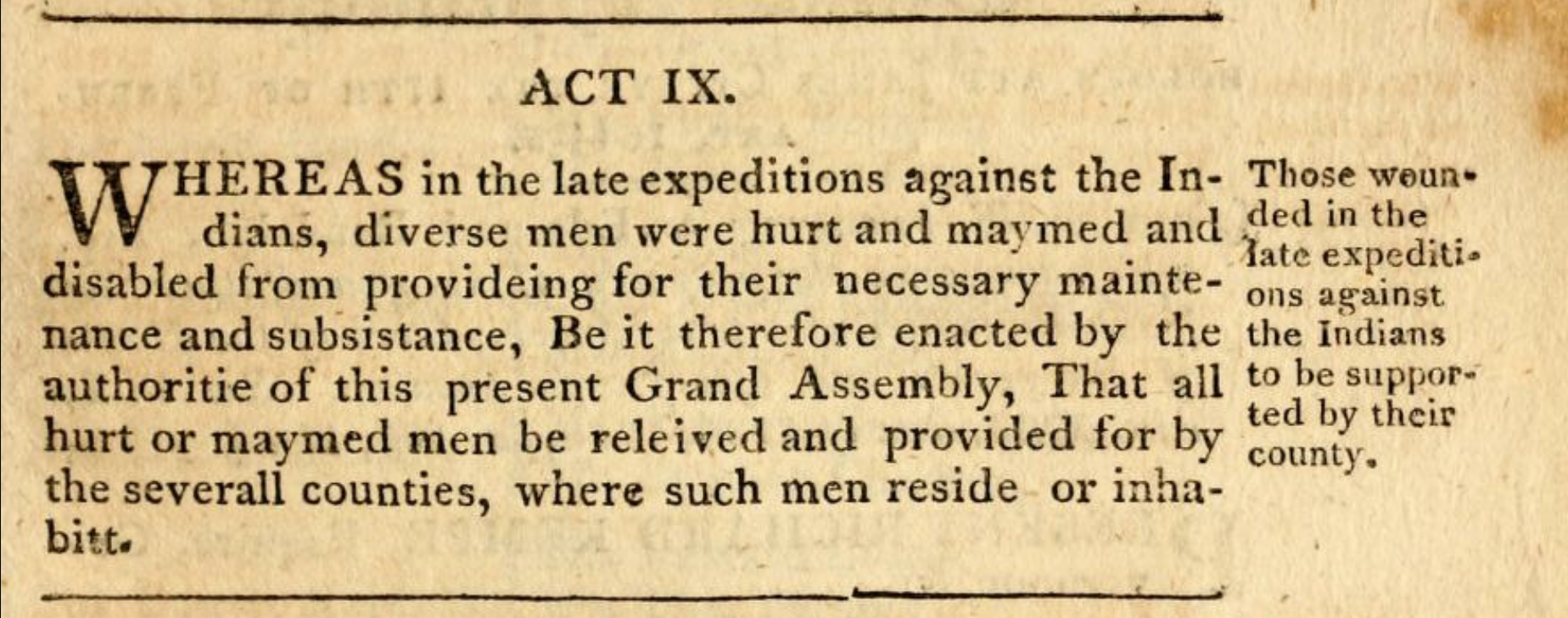
Pictured below is a colonial law from Virginia in 1644 providing disability benefits for injured soldiers defending the colony:
“…Be it therefore enacted by the authoritie of this present Grand Assembly, That all hurt or mahymed men be relieved and provided for by the severall counties, where such men reside or inhabitt.” Click here for a link to a blog post about the first American colonial pensions.
Virginia Act I of 1675
Death benefit for soldiers
Henings’ Laws of Virginia (reprinted in 1823)
In 1675 Virginia expanded its pension law to provide not only for the support of disabled soldiers but also promised to support widows and orphans. “An act for the safeguard and defense of the country against Indians” provided that “due consideration shalbe had by the grand assembly of the indigent ffamilies of such as happen to be slaine, and of the persons and ffamilies of those who shalbe maimed and disabled in this war.” This expansion of pension protections was adopted during King Philip’s War, otherwise known as the First Indian War. Click here for a link to Henings’ Laws of Viriginia volume 2.


The pension promise at Valley Forge
During the Revolutionary War, George Washington was a strong proponent of military pensions. During the harsh winter at Valley Forge, he sent Congress a troubling report on January 28, 1778. As recounted by Gouverneur Morris in a letter to John Jay, “an army of skeletons appeared before our eyes, naked, starved, sick, discouraged.”
Washington explained that the requested half pay pension would “not only dispel the apprehension of personal distress at the termination of the war, from having thrown themselves out of professions and employments they might not have the power to resume; but in a great degree relieve the painful anticipation of leaving their widows and orphans, a burthen on the charity of their country, should it be their lot to fall in its defense.”
Following Washington’s report and appeal for action, the Continental Congress unanimously voted on May 15, 1778 for a half pay pension for all commissioned officers who continued in the service of the United States through the end of the war. Journals of Congress, ii, 554-555. In 1780 a resolution was adopted extending half pay to widows and orphan children of officers killed in action. Yet, because the Continental Congress did not have the authority or the funds to make the pension payments, the actual distributions were left the individual states, with varying success.
At the conclusion of the war, the dissolution of the Continental Army in the spring of 1783 was one of the most poignant scenes in American history. The men who had stayed the course and won the war were ushered off without pay, with paper pensions and only grudging recognition of their service. Washington could only weep: “To be disbanded. . . like a set of beggars, needy, distressed, and without prospect. . . will drive every man of Honor and Sensibility to the extreme Horrors of Despair.” Click here for a link to Washington’s letter of April 4, 1783 to Virginia Congressman Theodorick Bland.
George Washington’s Circular Letter to the States
(June 8, 1783)
Before resigning as Commander and Chief of the Continental Army, General George Washington wrote an influential letter to the states which was widely reprinted in the newspapers. Before departing to Virginia his offered his parting advice to his beloved country (arguably Washington’s first Farewell Address). Among his requests in his “last official communication” was his ardent wish that the nation would abide by its commitment to pay a pension for life to continental soldiers, which Washington described as a matter of “public justice.”
Washington began his letter by congratulating the nation on the glorious events which heaven had been pleased to produce. He emphasized that the citizens of America were placed in the most enviable condition as the proprietors of a vast continent. Before concluding his letter, Washington wrote that he “could not omit to mention the obligation this country is under to that meritorious class of veterans” who were granted an “annual pension for life” by the Confederation Congress by the Act of the 23 April 1782.


First “Federal” Pension Laws
To encourage soldiers in the Continental Army to serve for the duration of the war, the Continental Congress passed a resolution on May 15, 1778, allowing half-pay for all officers and a set gratuity of $80 to all enlisted men who remained in service through the conclusion of the war. On August 24, 1780, the Continental Congress passed the first act providing pensions to widows and orphans of Revolutionary War soldiers. Click here for a discussion of the first Revolutionary War pensions.
In 1789, after the ratification of the U.S. Constitution, the 1st Federal Congress assumed the unmet pension obligation for disabled Revolutionary War veterans. The new federal government took responsibility for paying disability pensions promised by the states and the Continental Congress.
Veterans, including Alexander Hamilton, were among the strongest supporters of the new Constitution because they understood that a strong central government was necessary to backstop the national pension obligation. The famous compromise providing for a future federal capital in Washington, D.C., was also adopted on July 16, 1790.
Alexander Hamilton’s Report on the Public Credit
(January 1790)
As the first Secretary of Treasury, Alexander Hamilton was asked in September of 1789 to submit a report to the first Congress on the unpaid revolutionary war debt. During the Congressional recess he produced a fully developed plan that would serve as the underpinning of our modern financial system.
Hamilton was not content to merely report on the revolutionary war debt as requested by Congress. He took the initiative to propose a mechanism to repay all federal debt of approximately $30 million, along with the “assumption of” state debt of approximately $21.5 million. Hamilton reasoned that the states had shouldered much of the cost of the war and thus the federal government should pay off these state obligations incurred during the war. He also recommended a reliable system to securitize and restructure federal debt at par (face) value, and a comprehensive banking, mint and taxation program to implement his fully integrated financial plan. Hamilton would also propose the encouragement of manufacturing through a system of protective tariffs. Click here for a link to Hamilton’s First Report on the Public Credit, as reprinted in the Annals of Congress by Joseph Gales.
Another component of his financial plan was a tax on distilled liquor (the Whiskey Tax of 1791), which Hamilton believed was a necessary additional source of federal revenue. Click here for a discussion of the Whiskey Tax and the Whiskey Rebellion. While the Whiskey Tax was controversial, it provided a needed source of federal revenue and set a precedent for expanded federal authority and the rule of law.
In addition to the First Report on the Public Credit submitted in January of 1790, Hamilton also drafted a Report on Public Debt, a Report on a National Bank (December 1790), a Report on the Establishment of a Mint (January 1791), a Report on Manufactures (December 1791), and a Report on Marine Hospitals (1792). Click here for a discussion of Hamilton’s Report on Manufactures and the Cumberland Road. Click here for Hamilton’s Report on Marine Hospitals and the Yellow Fever epidemic of the 1790’s. According to historian Henry Cabot Lodge, “We look in vain for a man who, in an equal space of time, has produced such direct and lasting effects upon our institutions and our history.”

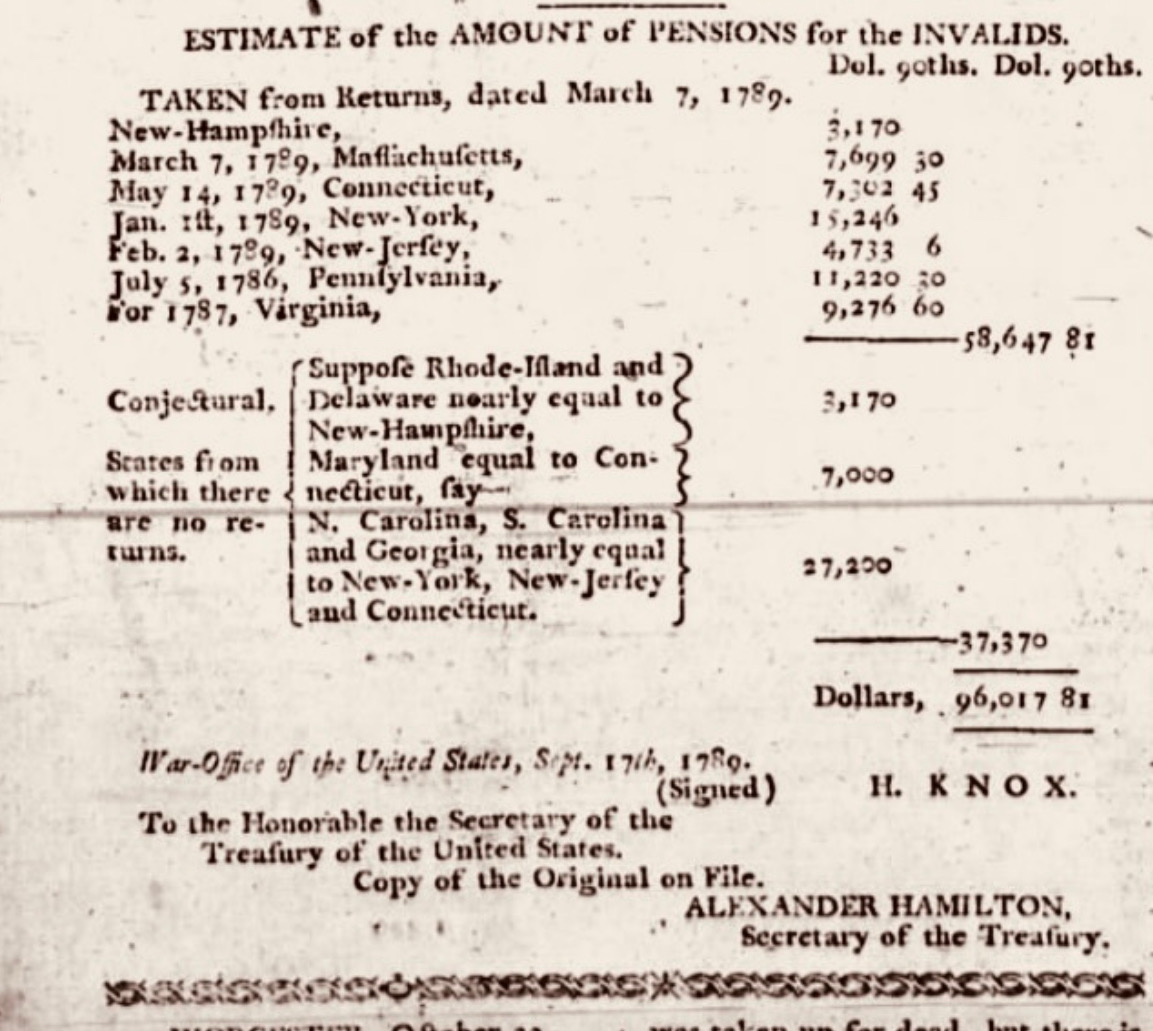
Alexander Hamilton’s estimate of pension costs (1789)
As the nation’s first Secretary of Treasury, one of Hamilton’s goals was to estimate the new federal government’s pension obligation. Hamilton reported his estimate to Congress, along with other anticipated federal expenditures.
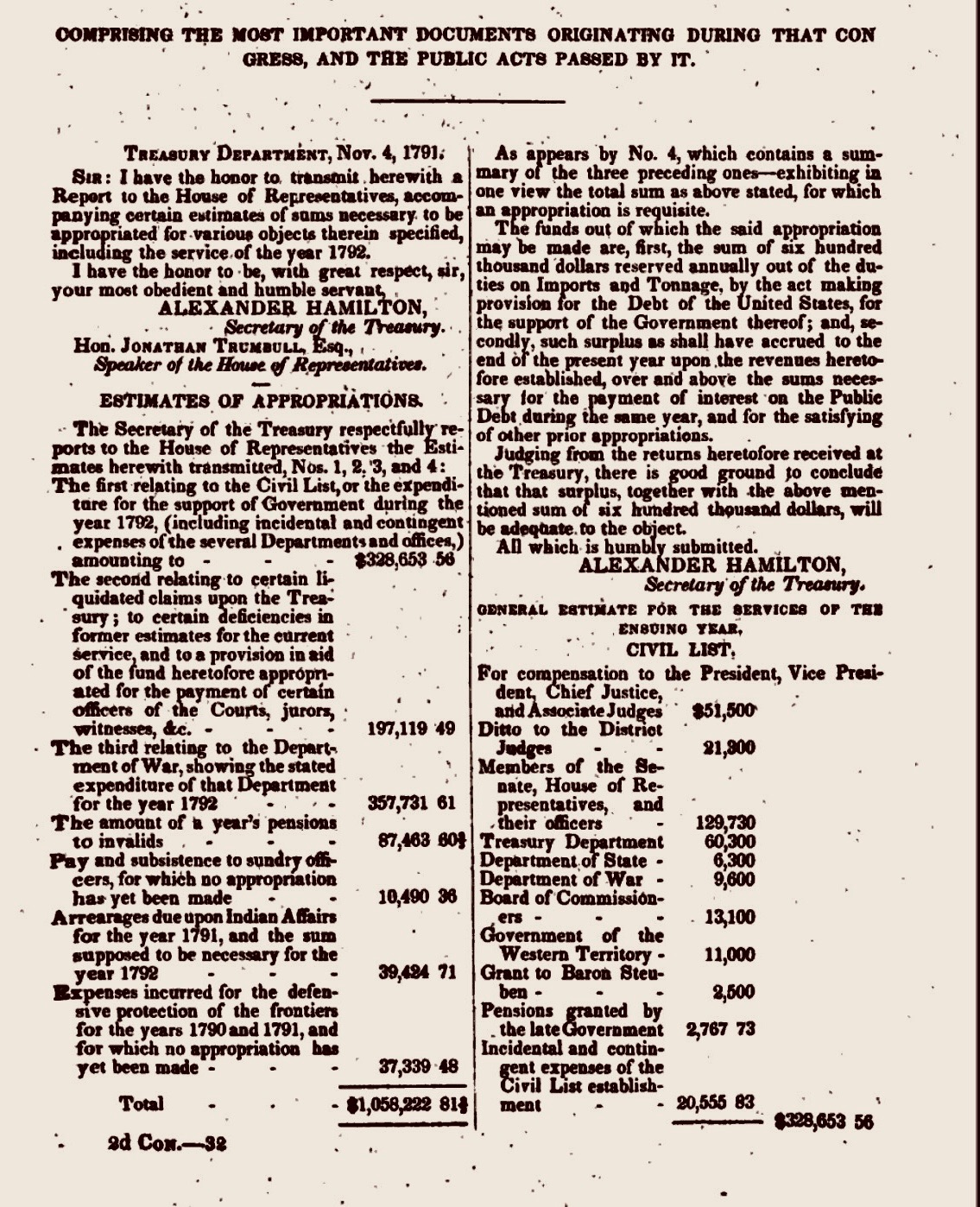
Alexander Hamilton’s estimate of appropriations (1791)
In addition to recommending a financial plan to support the “public credit,” Hamilton also examined anticipated revenues and expenditures. For 1792 Hamilton estimated that “invalid pensions” would total $87,463.
Jefferson’s Pension Act of 1803
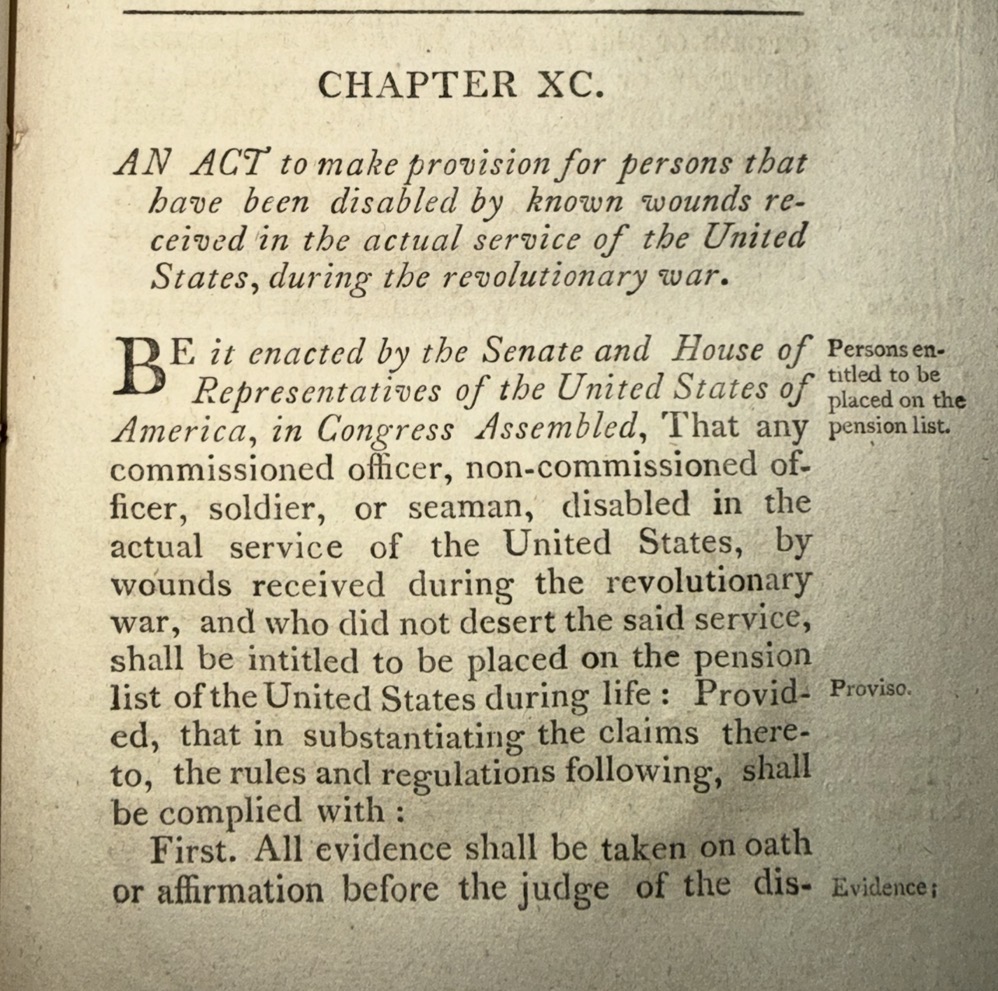
Provided for payment of Revolutionary War pensions by the Dept. of War after each case was reviewed by a federal judge. Causation proved by affidavit from commanding officer, surgeon or two credible witnesses; proof of disability required testimony from a respectable physician. Benefit of $5 per month. Adopted in “Washington City.”
Eliza Hamilton’s Pension
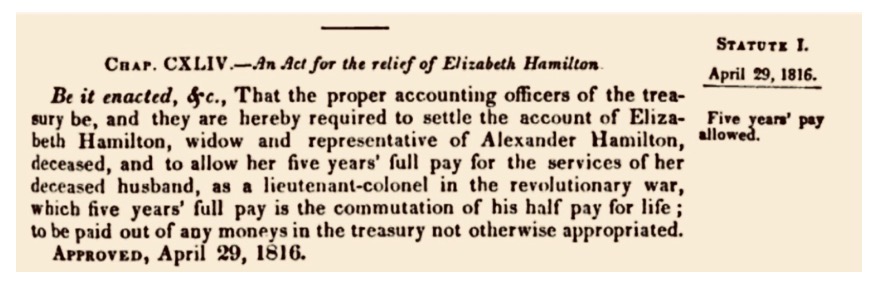
In 1816, almost 12 years after his death, Eliza Hamilton was awarded a 5 year lump sum pension. Before joining Congress in 1782 Alexander waived his rights to a pension to insulate himself from claims of conflicts of interest, surrendering “all claims” attached to his military station.
Eliza waited until 1809 (after Jefferson) to apply, but was initially denied based on the statute of limitations. Congress finally waived the statues of limitations in 1816, at which time Eliza began receipt of her pension. Click here for a discussion of Eliza Hamilton’s pension.
Civil War Pensions (1871)
Regulations Relating to Army and Navy Pensions with Statutes
Issued by the Commissioner of Pensions, the handbook discussed: benefits and limitations, evidence, qualifications for witnesses, instructions, declarations and forms. The book also included all relevant laws relating to U.S. military pensions following the Civil War.
Roster of Examining Surgeons Commissioner of Pensions (1876)
Following the Civil War, the Commissioner of Pensions was charged with supervising a sprawling roll of 1M retirees. The initial disability was $8 per month (private). Eventually the law was amended in 1907 to treat old age itself as a disability. The last surviving Union pensioner passed in 1956.

United States Pension Agency
Notice of Issuance of Pension (1882)
After a military pension was granted, the retiree was notified of the decision with a post card. They would subsequently receive their pension certificate. The assigned regional pension agent would be responsible for payment of the forthcoming pension voucher.

Bureau of Pensions (1908)
Notice of Filing of Application
After a military pension was filed, the Dept. of Interior, Bureau of Pensions, notified the applicant by post card. Vespasian Warner was appointed Commissioner of Pensions by President Teddy Roosevelt in 1905. The Bureau of Pensions was replaced by the Dept. of Veterans Affairs.

Military Pension Certificate Payable Quarterly (1912)
After granting a military pension the Bureau of Pensions would issue a formal pension certificate evidencing the value of the monthly benefit. Private Wilbur Davis was awarded $23 per month, which increased to $32 in 1918.


Notice of Pension Increase
Bureau of Pensions (1920)
In 1920 Congress increased the military pension to $50 per month. Retirees were instructed to securely attach this “slip” to their pension certificate. Receiving this pink slip from the Commissioner of Pension was thus grounds for celebration.


Teachers Retirement System of Florida (TRS)
IBM Punch Card (June 1949)
Commonly known as the “IBM card,” the once ubiquitous punch card held much of the word’s stored data. As the first automated storage devices, they helped make IBM a household name. Punch cards were replaced by magnetic tape and floppy disks. In 1949 the TRS had a $100 per month floor after 30 years of service.


Oregon PERS Early “SPD” (1956)
The pamphlet contains a summary of benefits under the Oregon Retirement Plan, along with examples, annuity tables, and “Questions Most Often Asked.” “It is the belief of the Board that the statements herein are accurate…however, the Board calls attention to the obvious fact that the law will govern in the event of a conflict.”

Motion Picture Industry Pension Plan
Brochure “SPD” (1956)
Established in 1953, the multi-employer Plan covered workers from 20th Century Fox, RKO Radio Pictures, Loew’s, and Technicolor Corp. The employee contribution was 8 cents per straight hour worked. Benefits were capped at $50 per month with retirement at 65 and 20 years.


Milwaukee Brewery Workers’ Pension Plan Booklet “SPD”
Established in 1954, the multi-employer Plan covered workers from the Miller Brewing Company, Pabst Brewing, Schlitz Brewing, Blatz and 4 other brewers. Normal retirement at 65 & 10. Monthly benefit of $2.25 times years of credited service. No employee contribution.

Cleveland Indians Pension Plan
Based on Marsh & McLennan study
In 1969 the Indians studied plan designs for their 28 non-playing employees. Normal retirement: 65 & 10. Monthly benefit: .75% of 1st $7,800 of FAC, plus 1.5% of FAC over $7,800 x years of service. Started in 1947, the average MLB Pension payout is $7,500 per month; $265,000 cap.

Historic Florida Pensions
Judicial Retirement System of Florida (1923)
Florida’s First Public Pension
Initially only covering Justices, the 1923 Act permitted retirement at age 64 with 30 years of consecutive service. The single paragraph law paid life annuity of 100% of monthly salary, with a COLA to match salary of current Justices. No actuarial funding; appropriation from State Treasury.

Florida Non-contributory Plan for State Employees (1927)
The predecessor to the Florida Retirement System, permitted retirement at 65 with 45 years of service. Paid one-half of annual monthly salary for life. No actuarial funding; legislative appropriation from the State Treasury.

Act Creating Miami Police & Fire Pension Fund (1931)
Chapter 15338
Created Miami’s FIPO Plan, in conformity with the Miami Charter & Laws dating back to 1921. Retirement at 55 & 20 or 25 years; benefit of 50% of yearly compensation. Funded by 2% employee contribution; .3 mill tax on property in city limits & direct taxation to maintain balance of $500,000.

Act Creating Firemen’s Relief and Pension Funds in Certain Cities (1939)
Chapter 19112
The first “Chapter 175” law, providing for the creation of municipal Fire Pension plans funded by 1% tax on fire and tornado insurance and 2% employee contribution. Retirement at 55 and 25 years of service; 75% benefit subject to $100 cap. First cities: Jacksonville, Miami, Miami Beach, Tampa, Pensacola, St. Pete.

Act Creating Municipal Police Retirement Funds (1953)
Chapter 28230
The first “Chapter 185” law, creating a 1% tax on casualty insurance to fund municipal police pensions. Investment only permitted in US bonds. Actuarial deficits shall not be obligations of the State of Florida. Retirement at 60 and 10 or 30 and out; 5% employee contribution; 2% multiplier.
