Breaking News: Newly re-discovered letter requires rewinding of Young Hamilton timeline
Young Hamilton – Part 1
After more than 250 years, Alexander Hamilton’s story has yet to be fully told. It has long been known that the young Hamilton was the author of the Farmer Refuted and other celebrated essays written as A Friend to America and A Sincere Friend to America.[1] Historians have also marveled at Hamilton’s foresight when he was only a student at King’s College. Yet, in 2026, Hamilton continues to defy his biographers. In connection with America’s 250th birthday, StatutesandStories.com is pleased to announce that newly uncovered evidence unmistakably demonstrates that young Hamilton was engaging with Revolutionary leaders in Philadelphia at least six months earlier than previously imagined.
It is well known that beginning in November of 1775 Hamilton began offering unsolicited advice to John Jay, a New York delegate to the Second Continental Congress.[2] Hamilton’s early correspondence with Jay is commonly cited as his first foray into national politics. In particular, Hamilton’s 26 November 1775 letter to Jay is widely recognized as “his first attempt to make his voice heard by Congress.” While many members of Congress were already familiar with his anonymous Farmer Refuted essays, “now there would be a name with his voice.”[3]
In late 1775 it made sense that young Hamilton was corresponding with Jay, one of New York’s delegates to Congress.[4]Surprisingly, the newly uncovered evidence revealed for the first time in this blog post demonstrates that as early as May of 1775 Hamilton was also engaging with Richard Henry Lee of Virginia and his future friend, Gouverneur Morris. This newly emerging connection occurred at least a half year prior to Hamilton’s first extant letter to Jay. Apart from its early date, all the more remarkable is the fact that Lee provided Hamilton with access to sensitive internal Congressional deliberations between Lee and Gouverneur Morris, notwithstanding Hamilton’s young age.[5]
This post, Young Hamilton – Part 1, is the first of a series of essays re-examining Hamilton’s early involvement with national politics and Revolutionary leadership. Part 1 begins by introducing the newly uncovered evidence of Hamilton’s connections to Richard Henry Lee and Gouverneur Morris. Part 1 will also explain why prior generations of historians would have overlooked this striking new evidence. Young Hamilton – Part 2 (pending) continues the breaking story with further insights into Hamilton’s early career. As is often the case with discoveries, new answers beget new questions. Part 2 will therefore identify additional research questions and trails for historians and researchers.
Lee – Morris correspondence establishing Hamilton’s early outreach
Pictured below is the first page of a long-overlooked letter from Richard Henry Lee to Gouverneur Morris dated 28 May 1775. Also pictured below is a related, but undated, letter from Morris to Lee. Taken together the “Lee – Morris correspondence” evidences collaboration between two Revolutionary era allies at the vanguard of uniting the colonies in their “happy revolution” against Britain. Yet, Hamilton’s involvement with Lee and Morris in May of 1775 has never been recognized until now.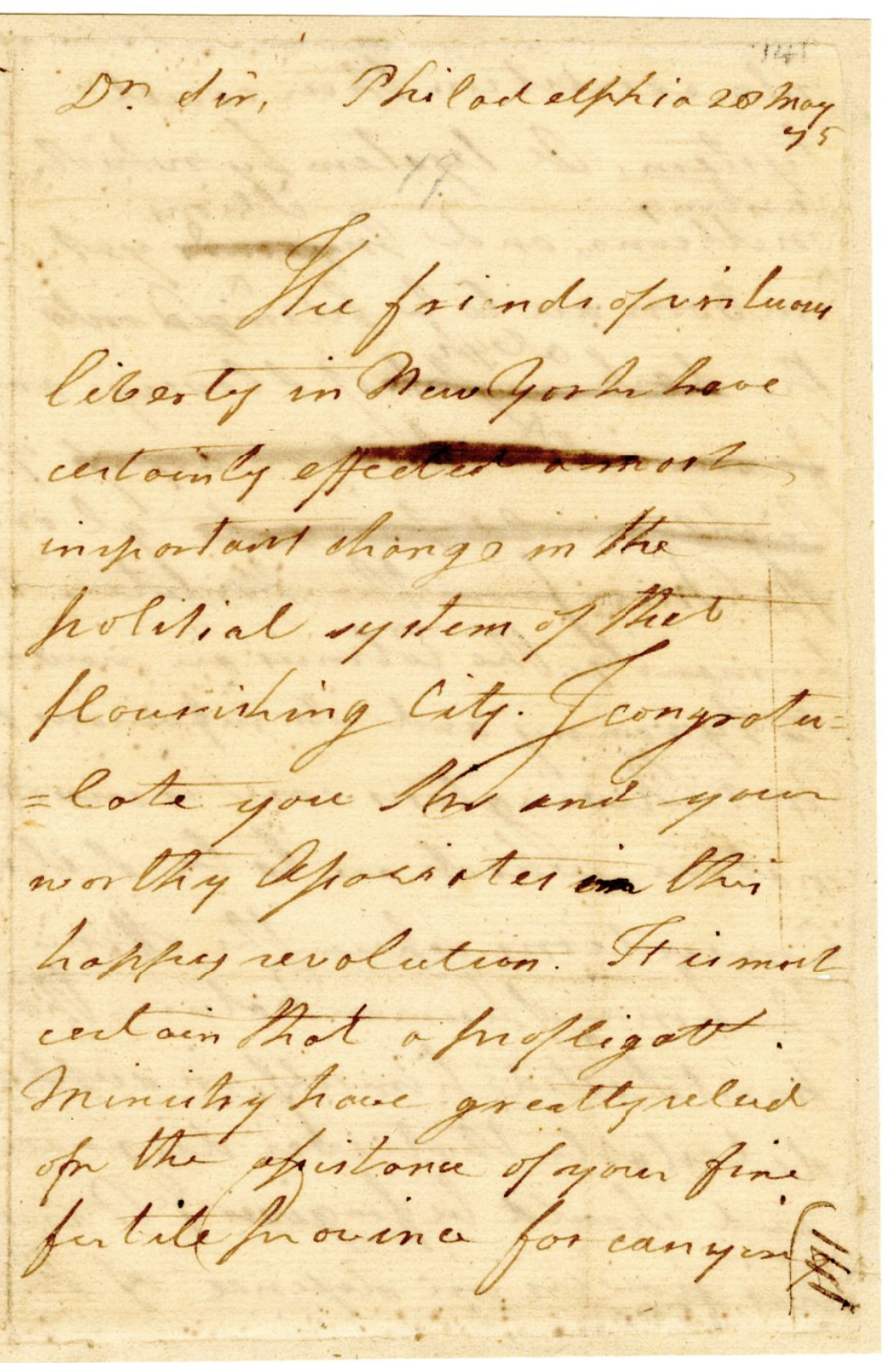

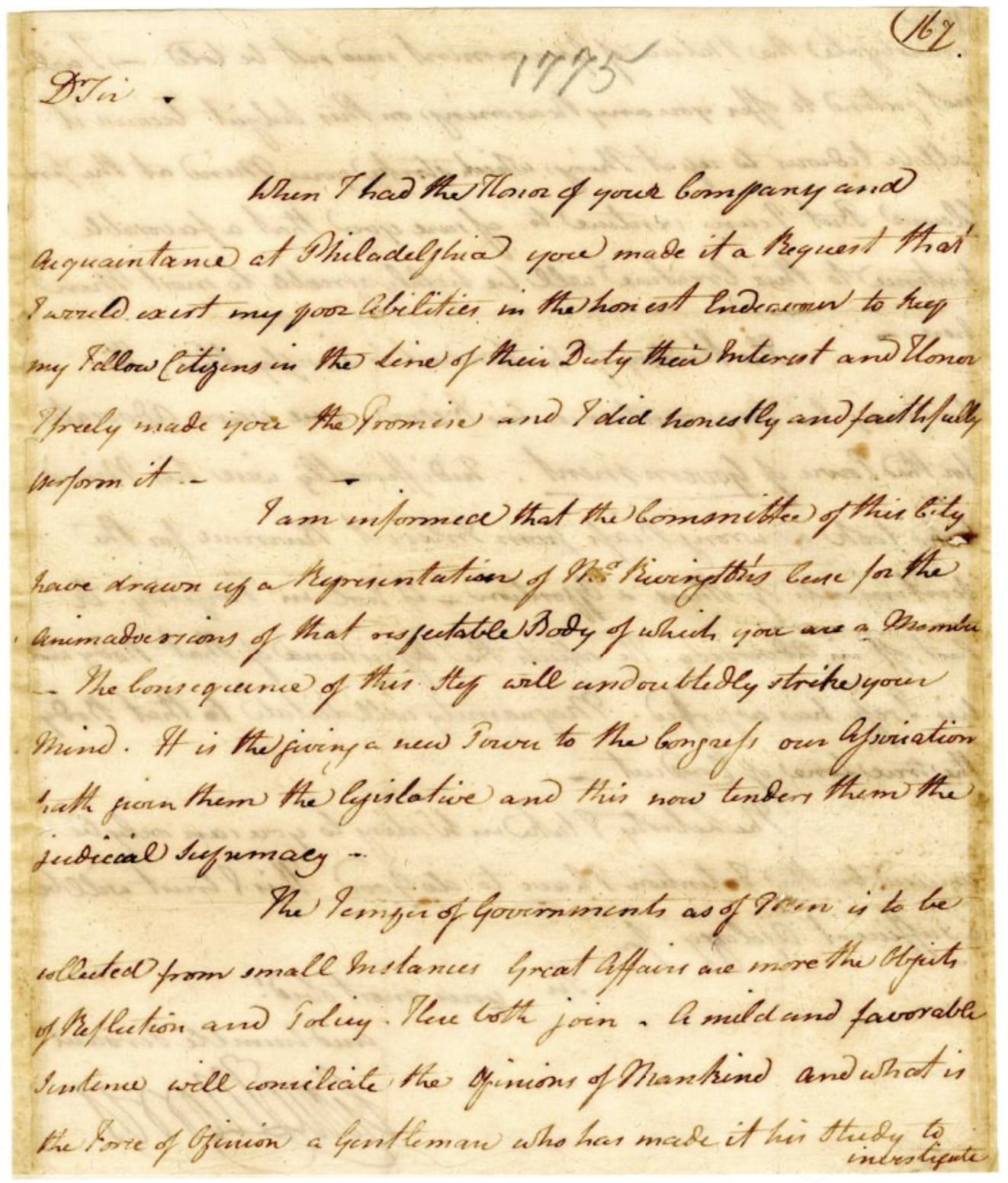
In May of 1775 Lee was a Virginia delegate to the Second Continental Congress. He would subsequently blaze the path to independence with the famous “Lee Resolution” in June of 1776.[6] Morris began serving as a member of the New York Provincial Congress in 1775. He would later join the Continental Congress in 1778.[7] The focus of their correspondence was Morris’s concern for freedom of the press and the fate of Joseph Rivington, a notorious royalist newspaper publisher.[8] Importantly, Rivington published Hamilton’s Farmer Refuted pamphlets along with Hamilton’s other famous essays printed in Rivington’s New-York Gazetteer newspaper.
In his May 28th reply to Morris, Lee congratulated Morris and his “worthy associates”[9] who Lee warmly described as “friends of virtuous liberty in New-York.” Lee observed that “happily for the cause of humanity, the colonies are now united” in their “defiance to tyranny and its infamous abetters.” With regard to “Rivington’s case,” Lee explained that “Rivington had prostituted himself in support of a cause the most detestable that ever disgraced mankind.” Nevertheless, Rivington had repented and Lee believed that he “should be forgiven.” Lee further observed that the Rivington matter was properly addressed at the colonial level in New York, rather than by Congress in Philadelphia. Concluding his letter, Lee mentioned that it was “not yet too late” for Rivington to “exert his powers in defense of liberty.”
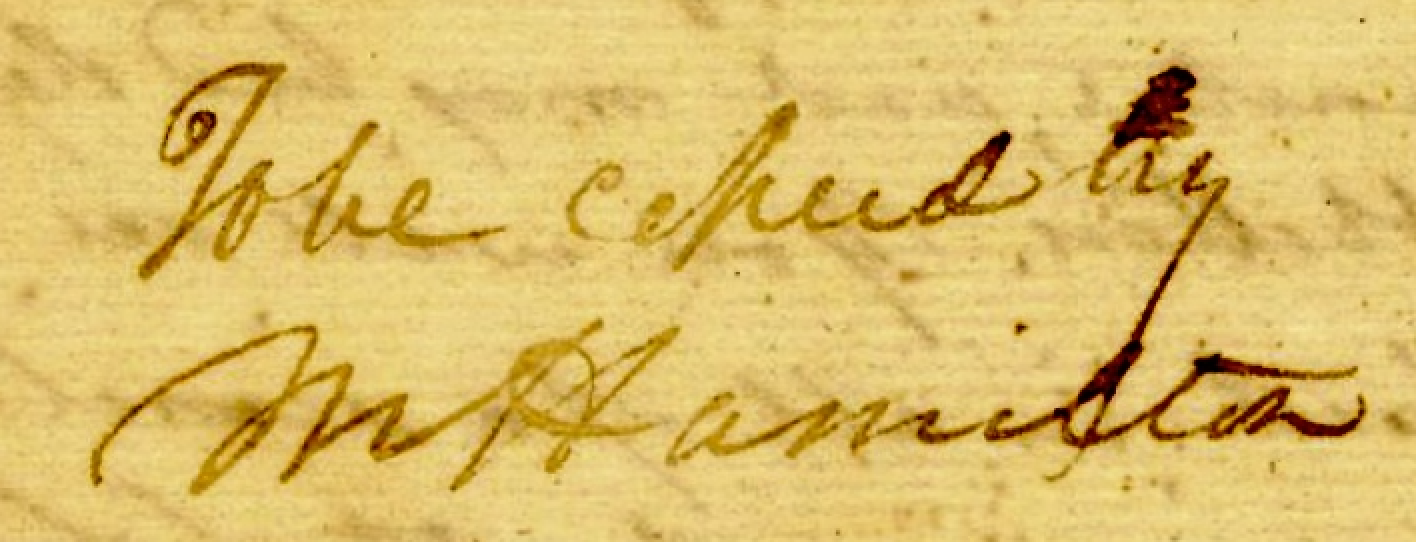
This discussion between Lee and Morris about Rivington has been available to scholars since the late 1830s when the two letters were first published.[10] Unfortunately, the early transcription glaringly omitted the following notation, which clearly appears at the bottom of Lee’s May 28 letter:
To be copied by M[r] Hamilton
One hundred and fifty years later the authoritative collection of letters of delegates to Congress from 1774 to 1789 were transcribed in twenty-six volumes and published by the Library of Congress.[11] Repeating the same unfortunate omission, the 1976 transcription also neglected to include the critical detail that Lee authorized Morris to permit Hamilton to copy his May 28th letter.[12] This long overlooked, but critical detail explains why Hamilton biographers had no idea of the early connection between Hamilton, Lee and Morris dating back to May of 1775.
Fortunately, to celebrate America 250 in 2026, the American Philosophical Society and other research institutions in Philadelphia digitized large portions of their archival collections relating to America’s founding. Here is a link to “The Revolutionary City collection”: https://therevolutionarycity.org/ When reviewing this online collection, StatutesandStories.com, working in collaboration with John P. Kaminski, discovered the long-overlooked Hamilton notation.[13]
Proof that Mr. Hamilton was none other than Alexander Hamilton
Until this recent discovery it is hard to imagine that a second-year college student in New York would have had the ears of a member of the Continental Congress in Philadelphia. Yet, Alexander Hamilton is universally recognized as a prodigy. His preciosity seemingly knows no bounds. As set forth below, there should be no doubt that the Mr. Hamilton granted permission by Lee to copy the May 28th letter was young Alexander Hamilton.
To begin with, the notation “To be copied by M[r] Hamilton” appears only once in Lee’s two volumes of published papers. Moreover, there is no other surviving record of correspondence between Richard Henry Lee and Alexander Hamilton, whose full name does not otherwise appear in Lee’s papers.[14] This should be no surprise. It is likely that Hamilton and Lee did not meet in person for many years.[15] Ironically, they would stake out opposite sides in the debate over ratifying the Constitution.[16] Nonetheless, the following evidence makes clear that the Mr. Hamilton who was concerned with Morris about the treatment of Rivington’s press in 1775 was young Alexander Hamilton.
Importantly, in May of 1775 Hamilton had a direct interest in the continued operation of Rivington’s press as Rivington was the publisher of Hamilton’s Farmer Refuted essays. The following month, on June 15 and 22, Rivington would also publish Hamilton’s Remarks on the Quebec Bill. Moreover, during his career Hamilton repeatedly demonstrated affinity for the rights of Tories/Loyalists, even if he vigorously disagreed with them.[17] As described by Richard Brookhiser, Hamilton “opposed mobs and revolutionary justice all his life, sometimes at the risk of his reputation, or his safety.”[18]
Hamilton courageously evidenced his opposition to “revolutionary justice,” on May 10, the same month as the Lee-Morris correspondence. As confirmed by multiple reputable sources, Hamilton confronted a dangerous mob and helped protect the life of Miles Cooper, the Loyalist President of King’s College. The dramatic confrontation was described by Hamilton’s son, John Church Hamilton, and confirmed by Hamilton’s friends, Robert Troup and Hercules Mulligan, along with other independent sources.[19]
Although the mob failed to tar and feather President Cooper, it succeeded in ransacking Rivington’s print shop. Rivington was an attractive target because he had published Samuel Seabury’s controversial essays from A Westchester Farmer (along with Hamilton’s Farmer Refuted rebuttals).[20] The newsworthy incident was reported to the British Secretary of State for the Colonies, Lord William Legge, by New York’s Lieutenant Governor, Cadwallader Colden:
Mr. Rivington, the Printer of one of our newspapers, was attacked by the same mob & rescued by the resolution of two friends. He has since taken refuge [on] board the man of war, and will not yet venture to return to his house. His crime is only the freedom of his press.[21]
Thereafter Rivington’s press temporarily resumed operations, but would be shut down by the Sons of Liberty later that year. Importantly, Alexander Hamilton’s story once again intersects with both Rivington and Hamilton’s allies in Congress. On or about 23 November 1775, Isaac Sears[22] led a contingent of militia from Connecticut who kidnapped Samuel Seabury and proceeded to destroy Rivington’s press. True to form, Hamilton would pick up his pen and intercede.
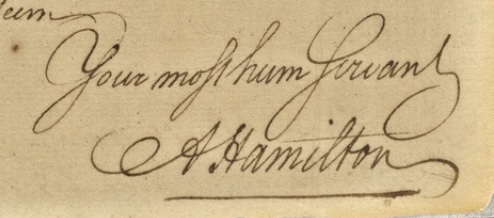
In a widely quoted letter to John Jay dated 26 November 1775, Hamilton criticized the second attack on Rivington’s press. Hamilton was particularly concerned that the use of militia from outside New York could undermine colonial unity. While Hamilton’s detailed suggestions to a member of Congress might appear presumptuous, the letter is pure Hamilton.[23]
I take the liberty to trouble you with some remarks on a matter which to me appears of not a little importance; doubting not that you will use your influence in Congress to procure a remedy for the evil I shall mention, if you think the considerations I shall urge are of that weight they seem in my judgment to possess.
Hamilton’s November 26th letter recounted the details of the attack on Rivington’s press and the “incursion made into this city by a number of horsemen from New England under the command of Capt Sears.” Admitting that Rivington’s paper was pernicious, Hamilton indicated that he could not help “disapproving and condemning” the incident. Hamilton warned about the “great danger of fatal extremes” when passions were “worked up to an uncommon pitch.” Hamilton advised that ill consequences could be prevented “if your body gently interposes a check for the future” by discouraging encroachments by any one province into another. “Believe me sir it is a matter of consequence and deserves serious attention.” Hamilton also took the liberty of suggesting that Congress station troops around New York, predicting that it “will not be long before [the British] turn their attention to it.”
Although there is no record of a matching letter by Hamilton in May, it is reasonable to infer that Hamilton expressed similar sentiments to Lee and/or Morris.[24] Following Hamilton’s November 26 letter, Jay responded in kind. While Jay’s letters to Hamilton have not survived, Hamilton’s subsequent correspondence with Jay confirms an ongoing relationship between the two New Yorkers.[25] In December Jay answered Hamilton “on the subject of Capt Sear’s expedition.”[26] Jay also requested that Hamilton continue to provide information and intelligence “on any matters of importance that may arise.” Indeed, this is likely what Hamilton was doing in connection with the May correspondence between Lee and Morris.
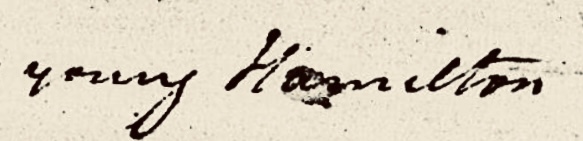
After receiving Hamilton’s November 26 letter, it is clear that Jay agreed with Hamilton’s advice. Jay wrote to Nathaniel Woodhull, the President of the New York Provincial Congress, parroting Hamilton’s concerns.[27] Woodhull and the New York Provincial Congress then proceeded to send a gentle letter of protest to the Governor of Connecticut, Jonathan Trumbull.[28] A week later Jay also wrote two letters to Alexander McDougall[29] providing powerful evidence of Hamilton’s engagement with the Revolutionary leadership. In a letter dated December 4th, Jay explained that “the late valorous expedition against Rivington gives me Pain.” Evidencing his diplomatic skills, Jay indicated that “I feel for the Honor of the Colony, and most sincerely hope they will upon this occasion act a part that may do some little credit to their spirit as well as prudence.” The letter concludes with Jay’s request that McDougall “[b]e so kind as to give the enclosed to young Hamilton.”
It was surely no coincidence that Jay’s decisions in early December aligned with Hamilton’s recommendations of November 26. A second letter by Jay to McDougall dated December 8th also explicitly identifies Hamilton as follows:
I hope Mr. Hamilton continues busy, I have not recd. Holts paper these 3 months & therefore cannot judge of the progress he makes.

In order to unpack this sentence, it is useful to point out that after Rivington’s press was destroyed, Hamilton began submitting articles to John Holt’s New-York Journal. Hamilton is believed to have written fourteen essays as The Monitor between November of 1775 and February of 1776, which were all published by Holt.[30] Accordingly, the content and timing of the Jay-McDougall and Jay-Woodhull correspondence perfectly aligns with Hamilton’s fingerprints.
Additional alignment between Hamilton, Jay and McDougall includes the following:
- There is strong evidence of a close relationship between Hamilton and Alexander McDougall. Hamilton is believed to have publicly supported McDougall at the “great meeting in the Fields,” where Hamilton is credited with a famous speech which impressed the older crowd. Both Hamilton and McDougall also shared proud Scottish ancestry.
- An early, but undated letter by Hamilton to McDougall indicates that Hamilton was borrowing pamphlets and books from McDougall when he was studying at King’s College.
- Hamilton also shared an early relationship with Jay, who dated and married William Livingston’s daughter Sarah. Hamilton lived with the Livingstons until he began his studies at King’s College.
- Interestingly, in his November 26th letter to Jay, Hamilton didn’t need to introduce himself. Likewise, he was able to simply sign the letter “A. Hamilton.”
- McDougall and Jay recommended Hamilton to the Provincial Congress for appointment as a captain of a New York Provincial Artillery Company.
- It is also very possible that Hamilton similarly began forming a relationship with Gouverneur Morris at this time. Morris was a King’s College graduate, preceding Hamilton by only a few years. Although Morris graduated in 1768, he obtained a master’s degree from King’s College in 1771. [31]
Finally, the political arguments that Hamilton made against arbitrary British rule and tyranny were undermined by Rivington’s treatment. For example, Monitor No. 2 was published on November 16. The subject of the essay was “open rebellion v. necessary resistance.” Assuming that the piece was in fact written by Hamilton, it made the argument that “Our enemies falsely charged us with endeavoring to subvert the constitution; but upon the fairest examination, it must be evident that we are its truest supporters….” “[W]e aim not at Revolutions or changes but rather at the prevention of them.” “Rebellion is a resistance by force of arms to just and legal authority; we only resist the unjust and illegal usurpations by Parliament.”
In sum, compelling evidence supports the conclusion that the Mr. Hamilton who was given permission by Richard Henry Lee to copy Lee’s May 28th letter to Morris was in fact young Alexander Hamilton. The record is clear that Alexander Hamilton had gained the confidence of high-ranking Congressional leaders in 1775, despite the fact that he was only a college sophomore. As Hamilton was actively engaging with John Jay and Alexander McDougall in 1775, in hindsight it should not be a surprise that he had also reached out to Morris and Lee.[32]
This post continues in Young Hamilton – Part 2 (pending) with further insights into Hamilton’s early career. As is often the case with historic investigations, new discoveries raise new questions. Part 2 will thus identify additional research questions for historians and researchers.
Endnotes
[1] Hamilton’s famous early essays included, A Full Vindication of the Measures of Congress (December 1774), The Farmer Refuted (February 1775), A Card (December 1774) and his Remarks on the Quebec Bill (June 1775).
[2] Alexander Hamilton to John Jay, 26 November 1775.
[3] Willard Sterne Randall, Alexander Hamilton: A Life (Harper Collins, 2003), 95.
[4] Hamilton is believed to have met Jay when Hamilton was residing with William Livingston in Elizabethtown, New Jersey. Jay would eventually become Livingston’s son-in-law.
[5] It is entirely possible that Lee was unaware of Hamilton’s age and/or status as a college student.
[6] Lee began serving in the First Continental Congress in 1774. He introduced the so-called Lee Resolution on June 7, 1776 declaring “That these United Colonies are, and of right ought to be, free and independent States, that they are absolved from all allegiance to the British Crown, and that all political connection between them and the State of Great Britain is, and ought to be, totally dissolved.” Paul H. Smith, ed., Letters of Delegates to Congress (Library of Congress, 2000), 26:xlvi; 5:425.
[7] Morris began serving as a delegate to the New York Provincial Congress in July of 1775. Journals of the New York Provincial Congress (Thurlow Weed, Printer to the State, 1842), 1:76. Morris was elected to Congress in late 1777, arriving in January of 1778. Paul Smith, ed., Letters of Delegates to Congress (Library of Congress, 2000), 26:xxix. Morris, the “Penman of the Constitution,” would be called upon to prepare the final draft of the Constitution with Hamilton and the three other members of the Committee of Style and Arrangement in 1787.
[8] Morris also noted that Congress was vested with both legislative and judicial powers in connection with Rivington’s case. In under-stated prose, Morris politely observed that the power of government “is to be collected from small instances” whereas “great affairs are more the objects of reflection and policy.”
[9] It is reasonable to infer that Lee was including Hamilton among the “worthy associates” being credited as a friend of virtuous liberty in New York.
[10] Peter Force, ed., American Archives: A Collection of Authentic Records, State Papers, Debates, and Letters, 4thSeries (Washington, 1839), 2:726.
[11] Paul H. Smith, ed., Letters of Delegates to Congress (Library of Congress, 1976), 1:415.
[12] In discussions with John Kaminski, he observes that the notation “To be copied by Mr Hamilton” theoretically could have been appended by Morris, not by Lee.
[13] In 1911, James Curtis Ballagh from Johns Hopkins University transcribed the letters of Richard Henry Lee. James Curtis Ballagh, ed., The Letters of Richard Henry Lee (The Macmillan Company, 1911), 1:140. In theory, researchers could have seen the missing notation in Ballagh’s more complete transcription, had any Hamilton biographers known to look in Lee’s correspondence. In a footnote Ballagh mentions that Lee’s 28 May 1775 letter to Morris was endorsed, in Lee’s autograph, “to be copied by / M Hamilton.” Yet, a Hamilton biographer would have no reason to look for Hamilton fingerprints in Lee’s papers in 1775.
[14] In other words, there is no evidence that the notation referred to another Hamilton, who might have been a clerk or otherwise provided secretarial services. Rather, for the reasons set forth below, available evidence supports the conclusion that Mr. Hamilton was collaborating with Gouverneur Morris out of concern for the “Rivington case.” One might also speculate that the Rivington matter was Hamilton’s first legal case, broadly defined.
[15] Although Lee served as a delegate to the First Continental Congress, Second Continental Congress, and Confederation Congress (serving a President of Congress in 1784), he never overlapped with Hamilton’s brief Congressional service in 1782-1783 and 1788. It is possible that they met during the war and would certainly have met when Lee was a Senator and Hamilton was the Secretary of the Treasury.
[16] It is also noteworthy that the Hamilton papers likewise do not reflect any direct communications between Hamilton and Lee. It is possible that the cool relationship between George Washington and Lee during the ratification debate might provide a partial explanation.
[17] Broadus Mitchell, Alexander Hamilton: Youth to Maturity, 1755-1788 (The Macmillian Company, 1957), 74.
[18] Richard Brookhiser, Alexander Hamilton: American (The Free Press, 1999), 26.
[19] Michael E. Newton, Alexander Hamilton: The Formative Years (Eleftheria Publishing, 2015), 118-120.
[20] Newton, 120. Rivington had also recently announced that he would be publishing another W. Farmer essay.
[21] Id., citing the Collections of the New-York Historical Society for the Year 1877, 422.
[22] Sears has the nickname “King” Sears, based on the control that he exercised with the Sons of Liberty over the streets of New York. Ron Chernow, Alexander Hamilton (Penguin, 2004), 68.
[23] Harold C. Syrett, The Papers of Alexander Hamilton (Columbia University Press, 1961), 1:176. It is safe to assume that Jay remembered Hamilton, the young boarder from Nevis who was living with the Livingstons in New Jersey while preparing to enter college.
[24] The fact that Jay’s letters to Hamilton have seemingly been lost to history potentially helps explain the absence of any surviving communication with Morris/Lee in May.
[25] Hamilton continued sharing intelligence with Jay on December 31 and January 4. Hamilton would subsequently be appointed captain of an artillery unit, upon Jay’s recommendation.
[26] Syrett, 1:178.
[27] John Jay to Nathaniel Woodhull, 26 November 1775; Elizabeth M. Nuxoll, ed., The Selected Papers of John Jay(University of Virginia Press, 2010), 1:155.
[28] Force, 4:422-23; JPC, 1:214.
[29] McDougall was a member of the Sons of Liberty who served in the New York Provincial Congress. In June of 1775 he was appointed colonel of New York’s 1st Regiment overseeing preparations for war. Nuxoll; 1:146–147.
[30] Mitchell, 60-61; Chernow, 70-71.
[31] Leonhard Felix Fuld, Kings College Alumni (New York: 1913), 40.
[32] As described by Chernow, “Hamilton always displayed an usual capacity for impressing older, influential men.” Chernow, 43. There is also evidence, for example, that Hamilton had sent an unsolicited letter to George Washington prior to the Battle of Long Island. Nathan Schachner, The William and Mary Quarterly, “Alexander Hamilton Viewed by His Friends: The Narratives of Robert Troup and Hercules Mulligan” (April, 1947), 211. https://www.jstor.org/stable/1915991