America 250 exhibit at the Florida Bar Convention
June 17-20, 2026
The following artifacts and founding era documents were assembled by Statutesandstories.com for exhibition at the Florida Bar’s Annual Convention to honor America’s 250th birthday, otherwise known as the Semiquincentennial or “America 250.”
Pre-Independence / Colonial
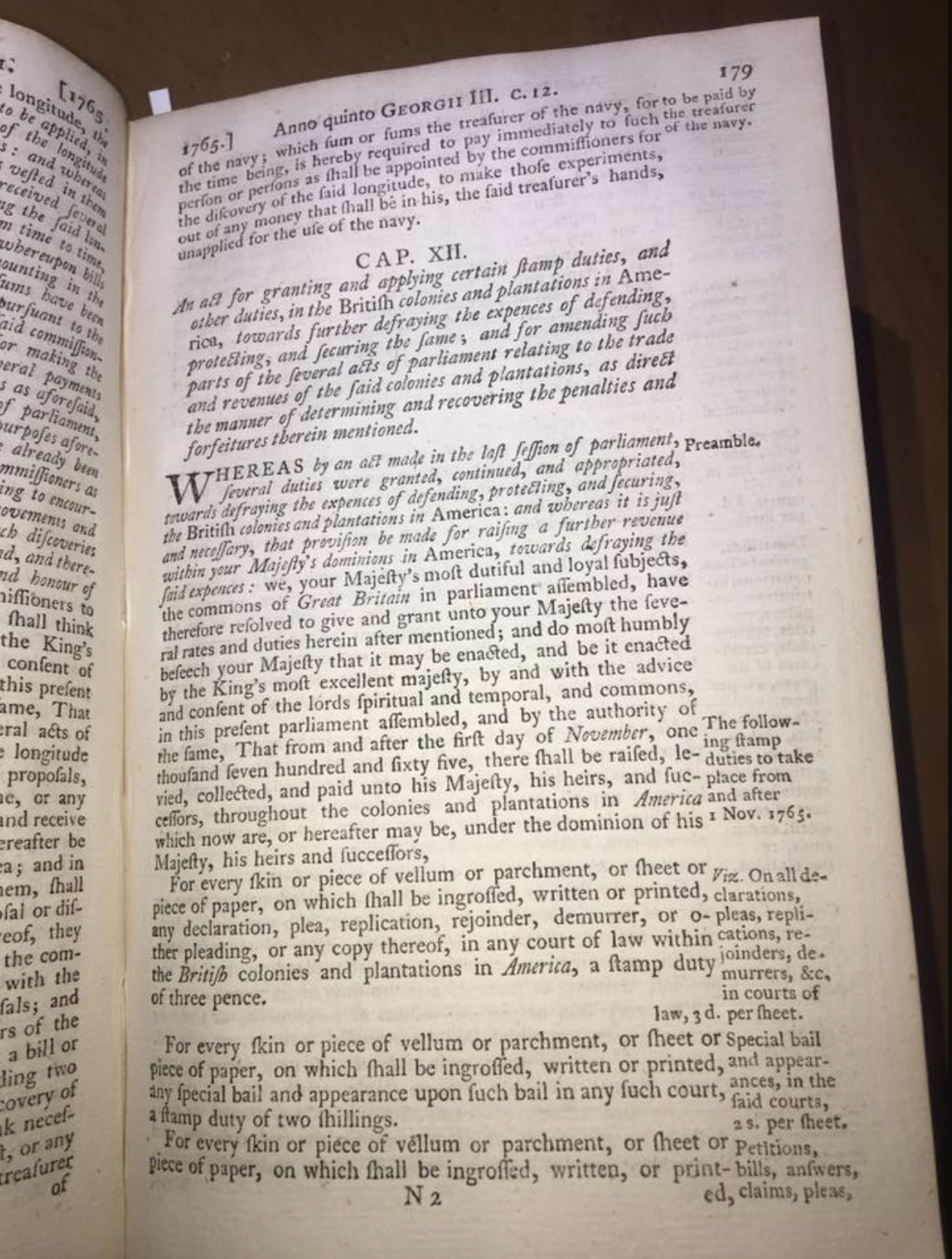
| Stamp Act of 1765, Ch. 12, vol. XXVI, Statutes at Large (printed by Joseph Bentham, 1765) [4 GEO III to 5 GEO III] | London, 1765 |
The Stamp Act of 1765 was the first direct, internal tax levied on the American colonies by England. It was modeled after a similar stamp tax that had been used in Britain for nearly a century. The Act was passed to defray the cost of the Seven Years’ War (1756-63), which was fought against the French.
The Stamp Act imposed a tax on 54 kinds of paper documents. Nearly everything that could be printed or written was subject to the tax, which required colonists to purchase special stamped paper produced in England. The expensive “stamped” paper was required to be imported from Britain. The broadly applied tax applied to newspapers, legal documents, pamphlets, licenses, and playing cards, among other kinds of paper. The Act was passed on March 22 and took effect in November of 1765.
Prime Minister Grenville could not have devised a better method for antagonizing (and unifying) the colonists had he tried. The Stamp Act united the colonies in their opposition to taxation without representation. In October of 1765, delegates from nine colonies assembled in New York at the Stamp Act Congress. Expressing unified colonial resistance, the delegates declared that the Stamp Act was a violation of the colonial rights and liberties. In 1766, Parliament repealed the Stamp Act, but declared its right to impose similar laws “in all cases whatsoever.” Click here to read more about the Stamp Act of 1765.
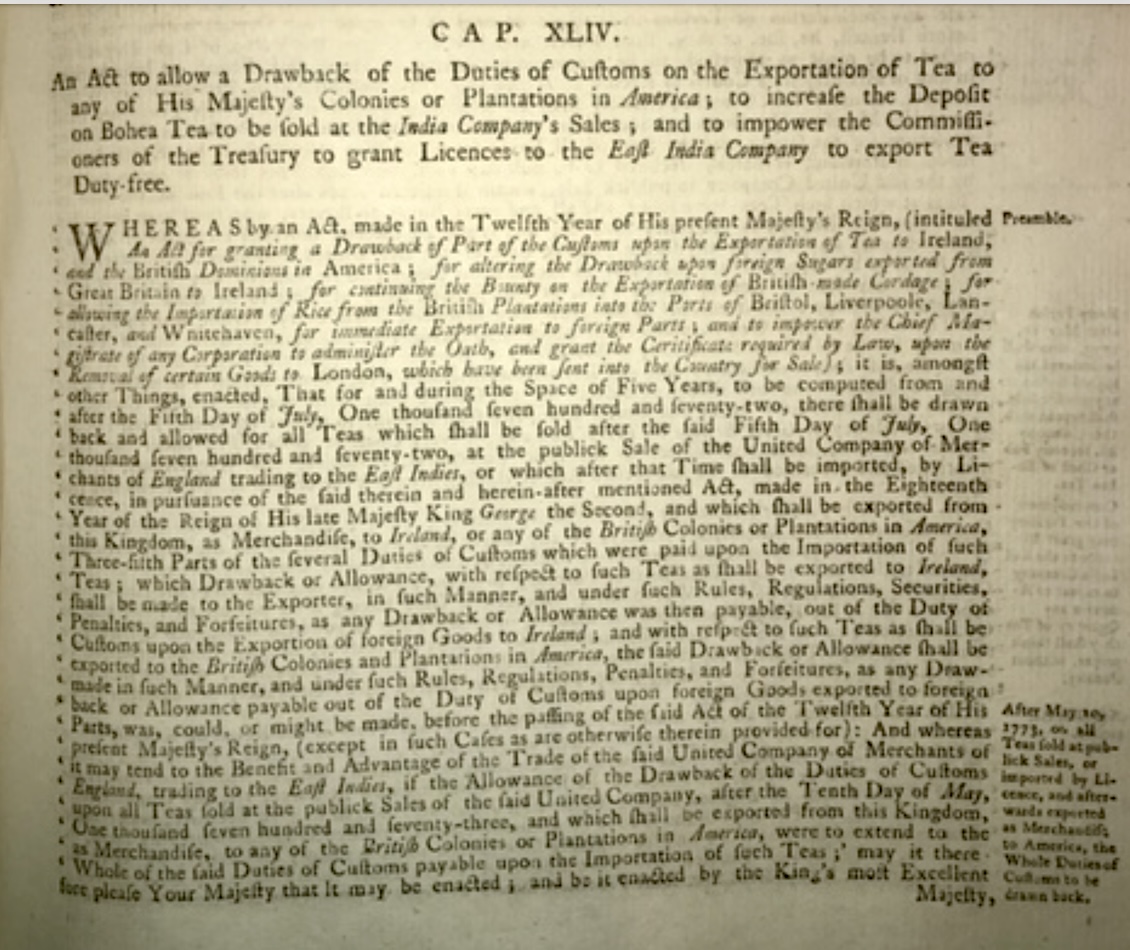
| Tea Act of 1773, Ch. 44, vol. 11, Statutes at Large (printed by Charles Eyre & William Strahan) [10 GEO III to 13 GEO III] | London,1773 |
“Taxation without representation” is commonly understood as one of the causes of the Revolutionary War. Yet, one of the little know ironies of American history is that the Tea Act of 1773, which precipitated the Boston Tea Party, was not a new tax on tea. In fact, Parliament did not anticipate that the Tea Act would be controversial since it actually lowered the cost of tea. Thus, the simmering grievances between the colonies and England weren’t simply a dispute about taxes on tea, but a larger underlying dispute over self-government, arbitrary British rule, resistance to a tea monopoly, and ham-fisted British policy.
Rather than creating a new tax on tea, the Tea Act of 1773 involved the extension of a tea monopoly to the colonies. At the time, Britain’s East India Tea Company held an official monopoly on the tea trade with the Far East. Despite its monopoly, the company was on the verge of bankruptcy. It owed money to the British government and was holding a large quantity of unsold tea that was rotting in warehouses. The company’s financial difficulties were the result of prior boycotts by the colonies, the smuggling of less expensive Dutch tea, and an economic downturn following the French and Indian War.
When the Tea Act was passed on May 10, 1773, seventeen million pounds of unsold surplus tea was stored in London warehouses. The East India Tea Company released tea shipments for the colonial ports of Boston, New York, Philadelphia and Charleston. When the colonies learned of the Tea Act, the Sons of Liberty and colonial committees of correspondence began mobilizing public opinion to resist, as they had years earlier against the Stamp Act. Tea was dumped into Boston harbor. The rest is history.
Click here to read more about the Tea Act of 1773.
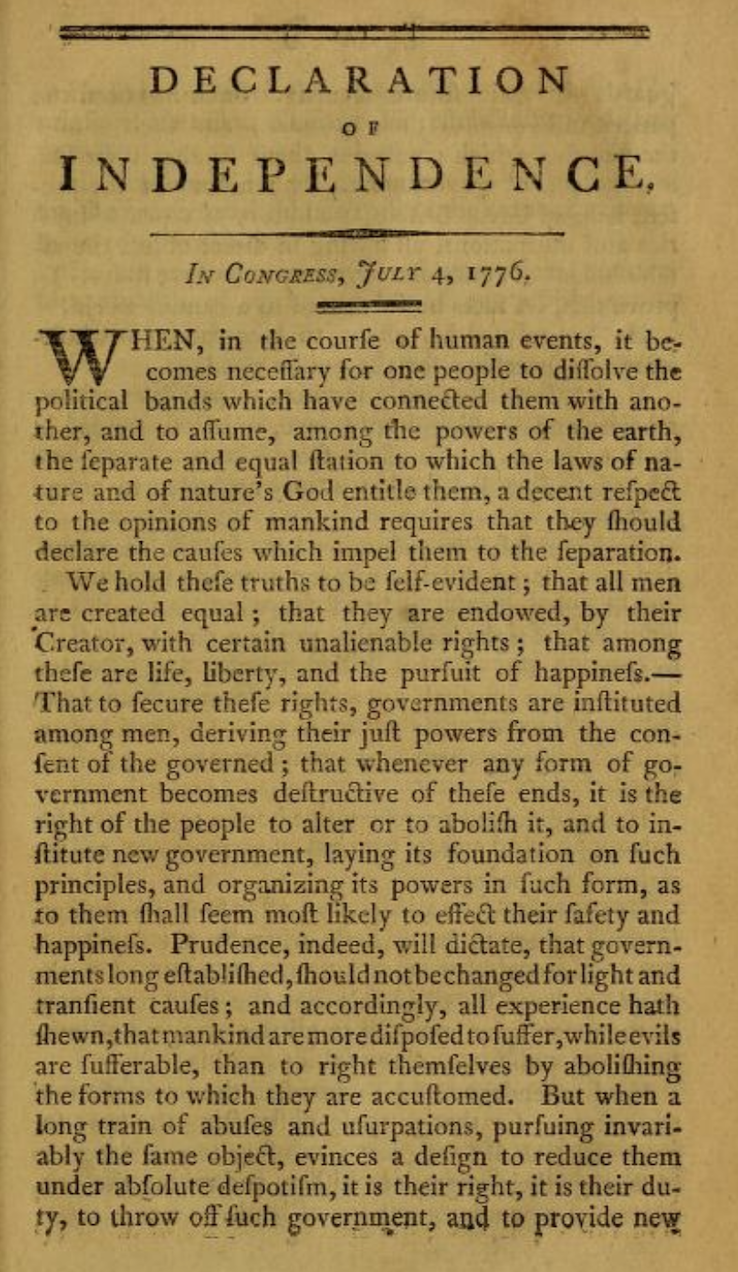
| Declaration of Independence, vol 2., Laws of the United States (published by order of Congress by Richard Folwell, 1796) | Philadelphia, 4 July 1776 |
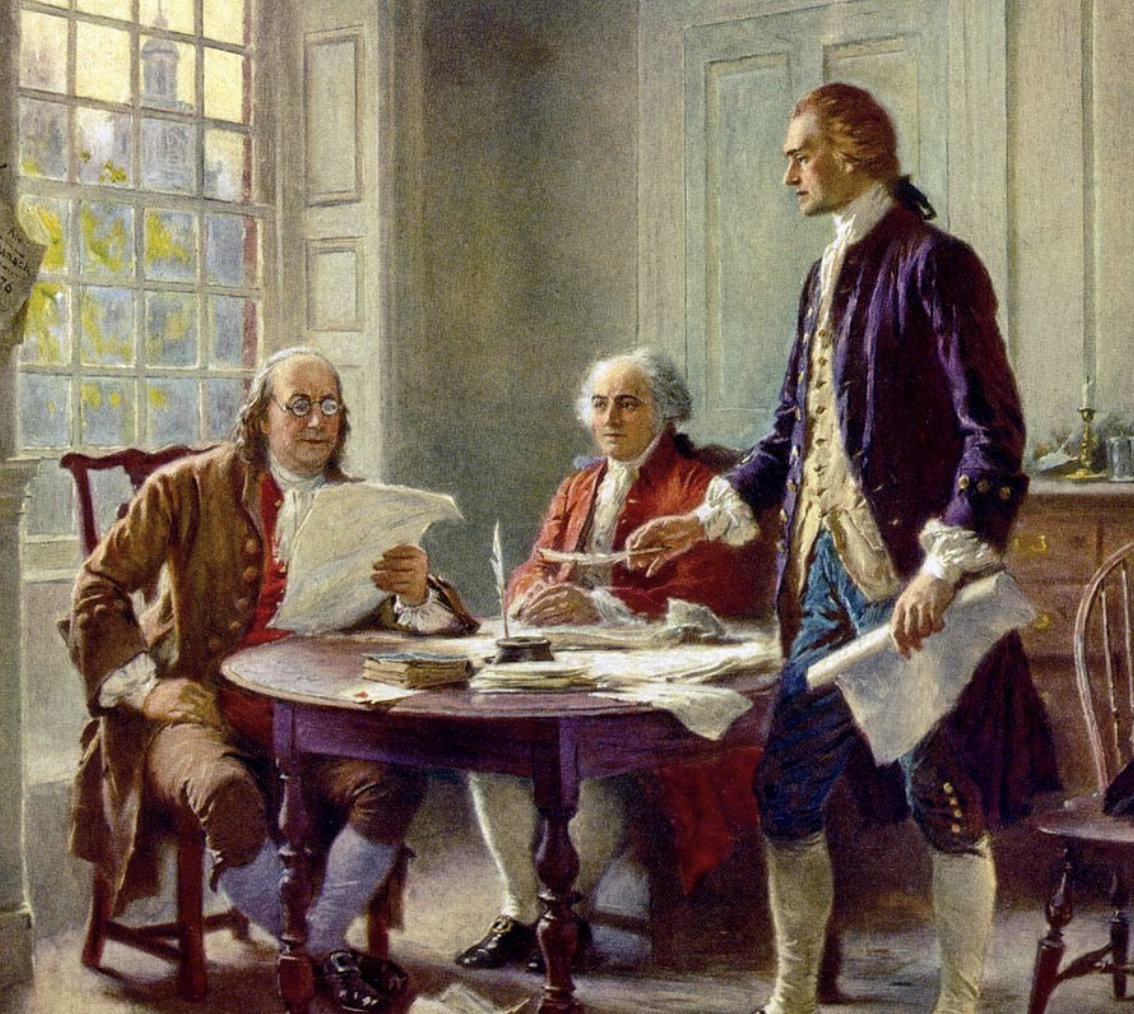
On 7 June 1776 Richard Henry Lee of Virginia introduced a three-part motion before the Second Continental Congress. John Adams seconded the historic motion. Lee’s Resolution sought: 1) a declaration of independence; 2) a call to form foreign alliances; and 3) a plan for confederation. During the tense and uncertain debate at Independence Hall, Congress decided to postpone the vote. An extended recess was called through July 1 to permit further consultation between the delegations and their home colonies. Before departing Philadelphia, the delegates appointed a committee to draft a formal statement in support of independence.
Thomas Jefferson, John Adams, Roger Sherman, Benjamin Franklin and Robert R. Livingston were appointed to the drafting committee, which delegated the assignment to Thomas Jefferson. Jefferson drew upon the Virginia Declaration of Rights, the political philosophy of John Locke, and his own draft of a Virginia constitution. For example, the Virginia Declaration of Rights provided that “all men are by nature equally free and independent, and have certain inherent rights of which . . . they cannot deprive or divest their posterity; namely, the enjoyment of life and liberty, with the means of acquiring and possessing property, and pursuing and obtaining happiness and safety.”
On July 2 twelve colonies voted to declare independence by adopting Lee’s Resolution:
Resolved: That these united colonies are, and of right ought to be free and independent States, that they are absolved from all allegiance to the British Crown, and that all political connection between them and the State of Great Britain is and ought to be totally dissolved.
The ultimate decision to declare independence was the result of over ten years of growing tension with Britain, starting with the Stamp Act of 1765, the Boston Massacre in 1770, and the Boston Tea Party in 1773. The July 2 vote to declare independence came 444 days after the first shots were fired at Lexington and Concord. Without any representation in Parliament, the growing list of grievances and escalating cycle of recriminations resulted in the Intolerable/Coercive Acts passed by Parliament in 1774. All told, the Declaration of Independence lists 27 “repeated injuries and usurpations” which impelled the colonies to their separation from Britain.
Click here to read more about the Declaration.
Early Republic / Confederation Congress
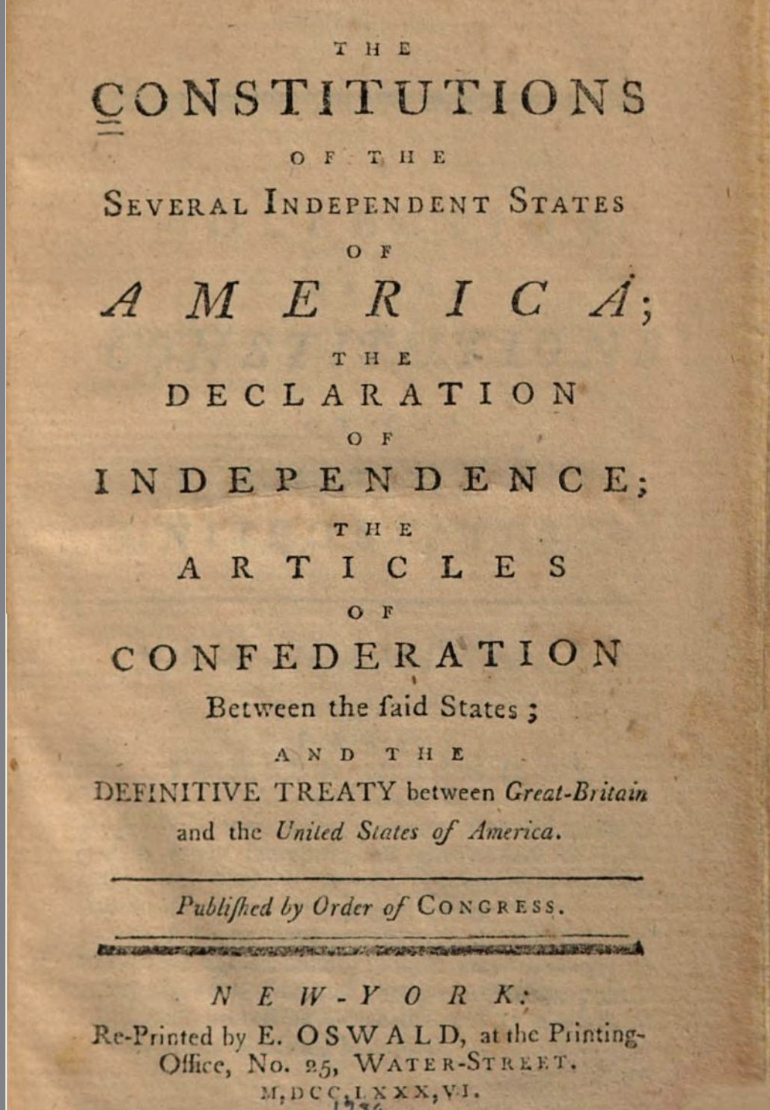
| The Constitutions of the Several Independent States of America; the Declaration of Independence; the Articles of Confederation Between the Said States; and the Definitive Treaty between Great-Britain and the United States of America (published by order of Congress, Eleazer Oswald, New York, 1786). | New York, 1786 |
During the depths of the American Revolutionary War, the Continental Congress voted on December 29, 1780 to assemble and print 200 copies of America’s founding documents. The “small volume” included a copy of the Declaration of Independence, the Articles of Confederation, the state constitutions, and the treaties between America and France. Referred to by rare book dealers as “America’s Magna Carta,” the 1781 publication was an announcement to the world that America was a new nation to be taken seriously, not merely a temporary provincial rebellion.
When the Continental Congress declared independence in 1776, colonies were encouraged to adopt constitutions. The resulting experiment resulted in a diversity of approaches. For example, Pennsylvania created a unicameral and highly democratic model compared with more conservative Maryland.
Subsequent editions of the book, depending on the printer, contain a map of America at the end of the Revolutionary War. The book was also translated and printed across Europe, beginning with a French edition. According to legal historian Kermit Hall, the first American state constitutions would serve as “crucial working models for the framers in Philadelphia” in 1787. As described by historian Willi Paul Adams, “the basic structure of the Federal Constitution of 1787” was modeled after “existing state constitutions writ large.”
Between 1776 and 1780, eleven state constitutions were drafted by the former colonies. These constitutions would not only inform the drafting of the U.S. Constitution, but also inspire the French Revolution and the revolutions that followed in Haiti, Poland, the Netherlands and Switzerland. By 1820, more than sixty new constitutions were drafted across Europe. Within another 30 years, approximately eighty constitutions would be drafted and redrafted in Latin America.
Clink here to read more about early compilations of the state constitutions leading into the Constitutional Convention in 1787.
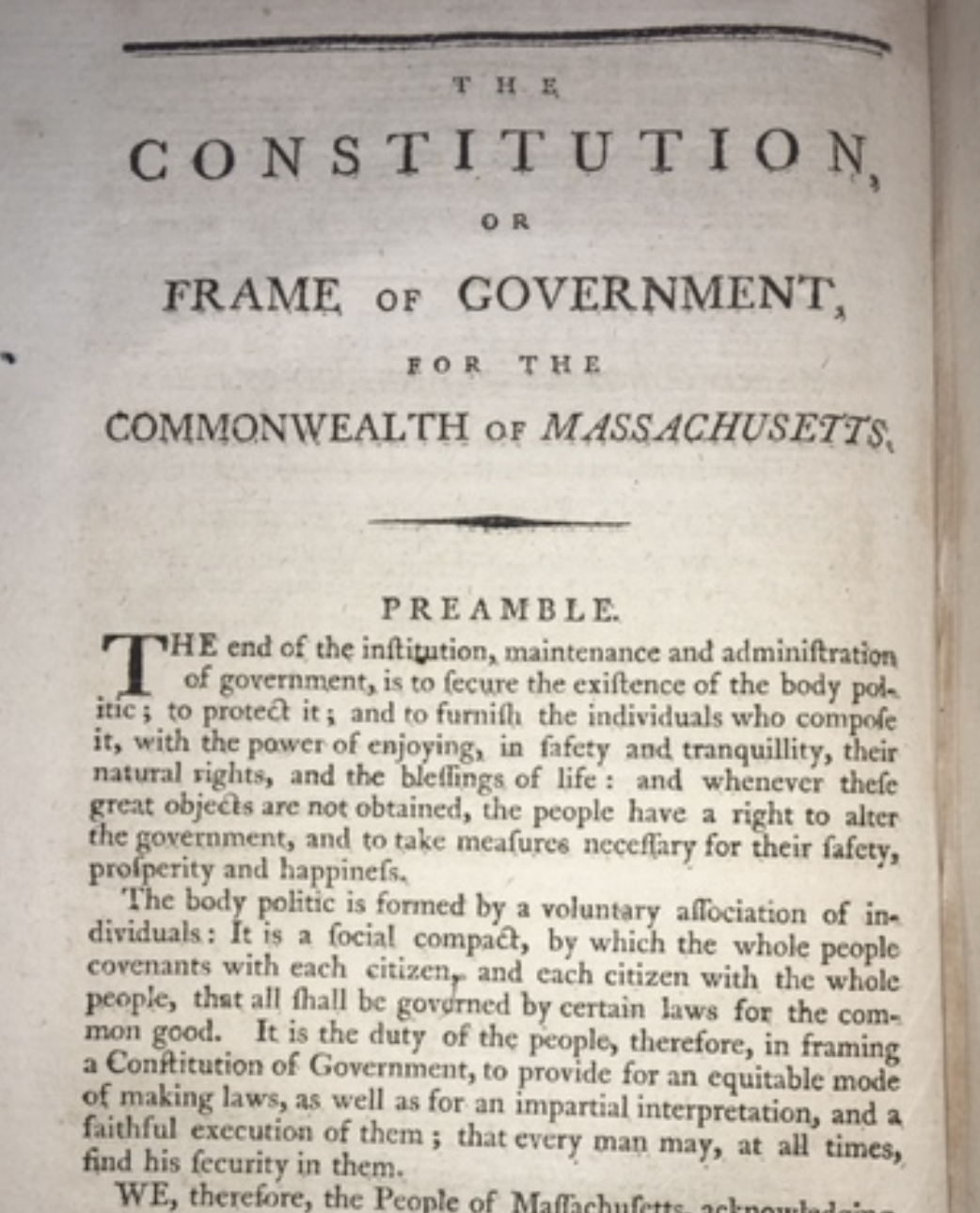
| Massachusetts Constitution of 1780, The Perpetual Laws of the Commonwealth of Massachusetts (published by Isaiah Thomas, 1801) | Boston, 1780 |
While historians widely describe James Madison as the “father of the Constitution,” the U.S. Constitution was built in part upon the intellectual foundation provided by John Adams and his Massachusetts Constitution of 1780. The Massachusetts Constitution was drafted by John Adams, Samuel Adams and James Bowdoin in 1779 and ratified in 1780.
In 1776, Adams recognized that if independence were to be declared, the colonies would need to establish functioning and independent governments to replace the King. The Second Continental Congress agreed, voting on May 10, 1776, to adopt Adams’ resolution recommending that each of the “united colonies” assume the powers of government and “adopt such a government as shall, in the opinion of the representatives of the people, best conduce to the happiness and safety of their constituents in particular, and America in general.”
Adams published his Thoughts on Government (1776) and A Defence of the Constitutions of Government of the United States (1787) which outlined his vision for democratic government: separation of powers among three branches of government: executive, legislative, and judicial, with checks and balances. Grounded on an in-depth study of enlightenment political theory and history, Adams argued that the colonies were presented with an unparalleled opportunity to form the “wisest and happiest government that human wisdom can contrive.”
Today, the 1780 Constitution of the Commonwealth of Massachusetts is the world’s oldest functioning written constitution which famously established a “government of laws, and not of men.” The document is divided into three parts: a Preamble, A Declaration of the Rights of the Inhabitants of the Commonwealth of Massachusetts, and The Frame of Government.
Click here to read more about the Massachusetts Constitution of 1780 drafted by John Adams.
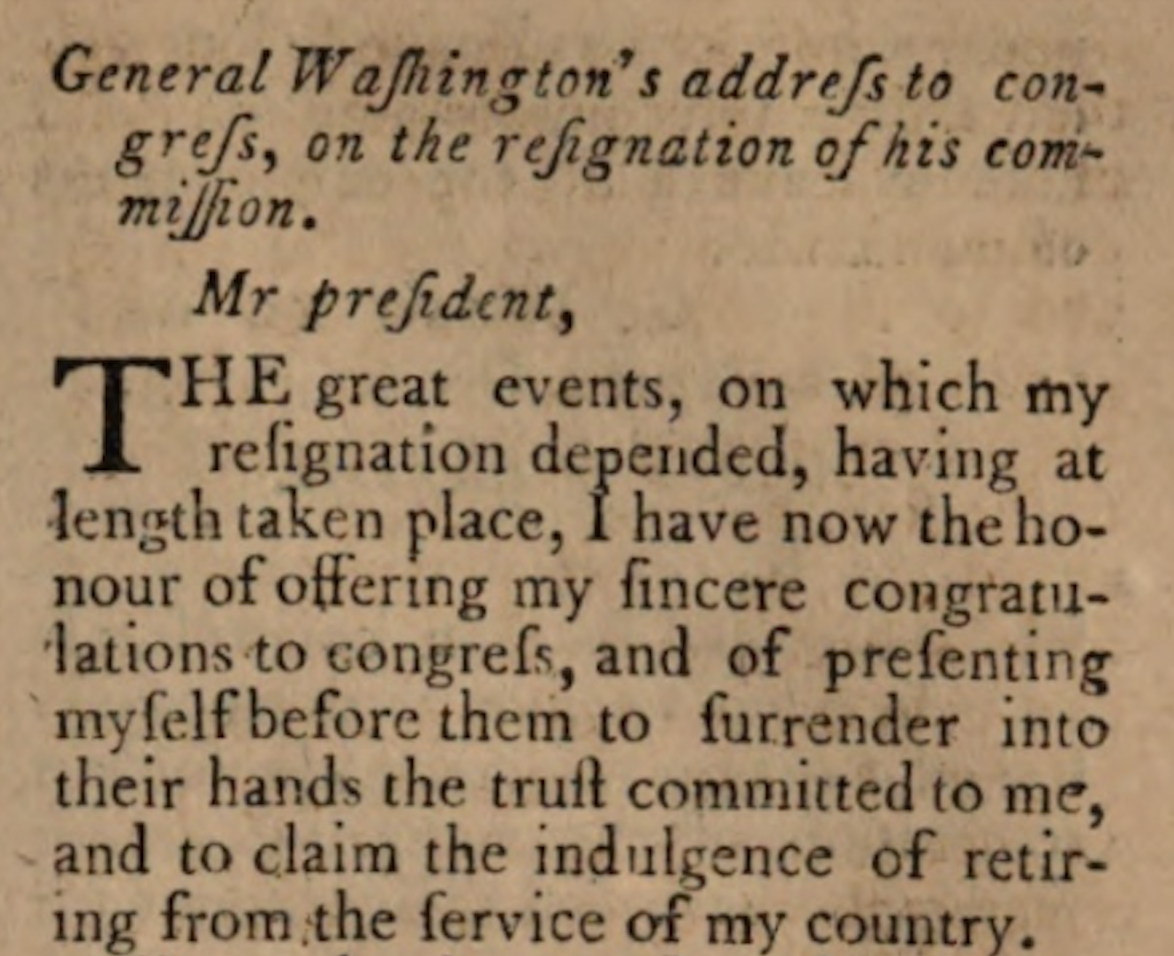
| Washington Address to Congress on the Resignation of his Commission, vol. 4, The American Museum Magazine (published by Mathew Carey, 1788) | Annapolis, December 1783 (reprinted in 1788) |
After the Treaty of Paris was ratified concluding the Revolutionary War, George Washington formally resigned his military commission on 23 December 1783. The scene is famously depicted by John Trumbull’s mural on display at the Capitol Rotunda. Washington had been appointed Commander in Chief on 15 June 1775 and would now be able to return home and retire to Mount Vernon.
In what he considered to be the last act of his public life, Washington handed his commission, along with a copy of his speech, to Thomas Mifflin, the President of Congress. Part of Washington’s legacy is his willingness to surrender power to civilian control.
In London, upon learning of Washington’s resignation, King George III told Benjamin West that “If [Washington] does that, he will be the greatest man in the world.” John Trumbull was also in London during Washington’s resignation, described that the event, “excites the astonishment and admiration of this part of the world. ‘Tis a Conduct so novel, so inconceivable to People, who, far from giving up powers they possess, are willing to convulse the Empire to acquire more.”
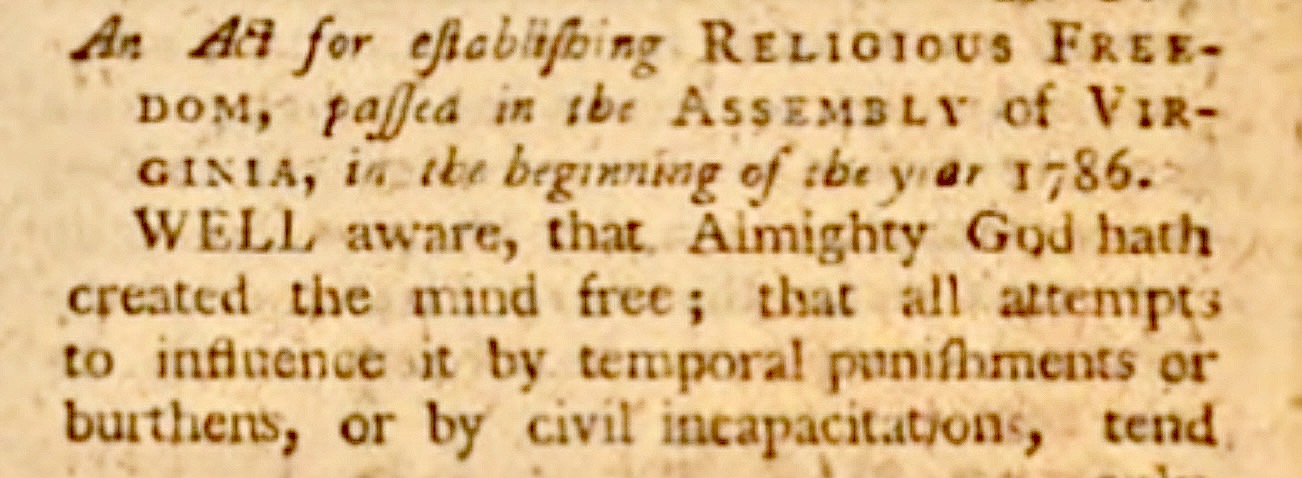
| Virginia Statute for Religious Freedom, The Gentleman’s Magazine (published by Sylvanus Urban, London, January 1787) | Richmond, VA, 1786 (reprinted in 1787) |
Drafted by Thomas Jefferson in 1777, the Virginia Statute for Religious Freedom was eventually adopted in 1786 at the initiative of James Madison. The law disestablished the Church of England in Virginia and guaranteed freedom of conscience to people of all religions. The law provided among other things that, “Almighty God hath created the mind free…and that all attempts to influence it…beget habits of hypocrisy and meanness.” As men are “but fallible,” politicians should not assume “dominion over the faith of others.” “[N]o man shall be compelled to frequent or support any religious worship, place, or ministry…nor shall be enforced, restrained, molested…on account of his religious opinions or belief, but that all men shall be free to profess, and by argument to maintain, their opinions in matters of Religion, and that the same shall in no wise diminish, enlarge or affect their civil capacities.”
The Gentleman’s Magazine was the first periodical to pioneer the concept and use the word “magazine,” from the French for “storehouse.” The British magazine was first published beginning in 1731. The famous English writer, Samuel Johnson, joined the publication in 1738.
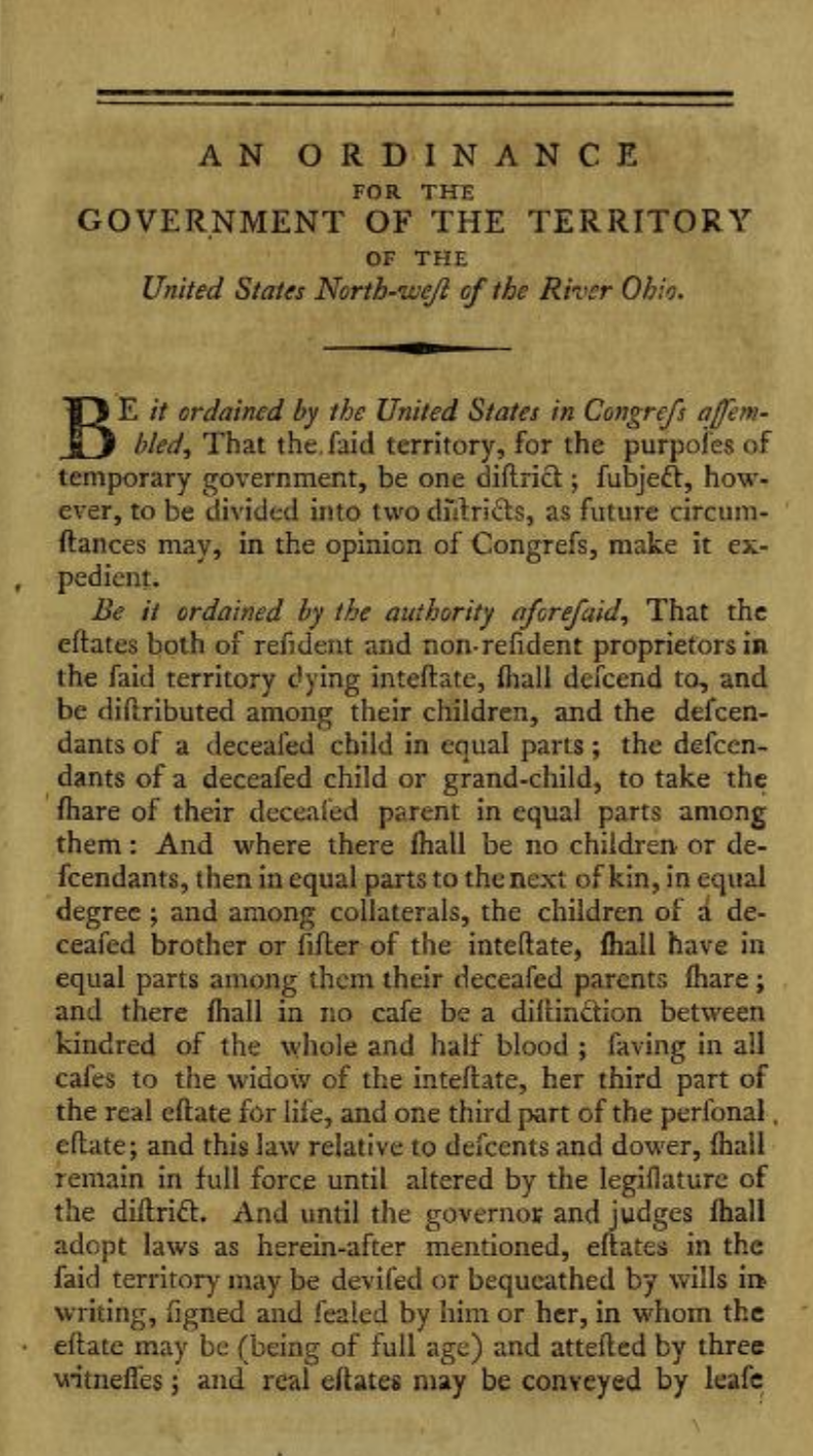
| Northwest Ordinance, vol 2, Laws of the United States (printed by order of Congress by Richard Folwell, 1796) | New York, 13 July 1787 |
Formally titled as “An Ordinance for the Government of the Territory of the United States, North-West of the River Ohio,” the Northwest Ordinance was arguably the most successful legislation adopted by the Confederation Congress. The act built on the earlier Ordinance of 1784 which established the initial framework for establishing territorial governments in the Northwest Territory, which had been acquired during the Revolutionary War. The ordinance established a procedure for new states to apply for admission on an equal footing (Illinois, Indiana, Michigan, Ohio, Wisconsin, and a portion of Minnesota).
Substantively, the ordinance contained an abbreviated bill of rights protecting individual liberties, including religious freedom, the right to a writ of habeas corpus, and the right to trial by jury. As heralded by Abrham Lincoln, the act forbade slavery north of the Ohio River. The landmark legislation was adopted on 13 July 1787 by the Confederation Congress in New York while the Constitutional Convention was meeting in Philadelphia.
| Constitution’s Cover Letter, vol. 1, Laws of the United States (printed by order of Congress by Richard Folwell, 1796) | Philadelphia, 17 September 1787 |
The U.S. Constitution was announced to the nation in a largely unknown “Cover Letter.” Sadly, the transmittal letter that introduced the Constitution to the world has largely been forgotten.
A stunning piece of American history, the Cover Letter was signed by George Washington as the President of the Constitutional Convention. The Cover Letter accompanied the Constitution as it travelled from Philadelphia (where the Constitutional Convention met during the summer of 1787) to New York (where the Confederation Congress resided at the time).
The delegates to the Convention unanimously approved the Cover Letter “by paragraph.” The letter was prepared for Washington’s signature by the same “Committee of Style” that prepared the final draft of the Constitution.
Shortly after the Constitution was signed on September 17, the Cover Letter and the Constitution were printed in approximately 100 newspapers around the country. According to Professor Robert Rutland, “[n]othing similar to this had ever occurred before and has never happened since—a whole nation invited, and even encouraged, to read the entire Constitution.”
Although their secretive work in Philadelphia was concluding, the next chapter in the national saga was just beginning. At this point the Constitution was merely a proposal. It would need to be ratified by nine states before it could take effect. As described by historian Catherine Bowen, the Cover Letter is:
a most skillful and touching document which breathes confidence in what the Convention achieved, makes no apologies but tells with seriousness and humility just what such a convention of diverse states felt it could and could not do.
Click here to read more about the Constitution’s Cover Letter.

| U.S. Constitution, Annual Register for the Year 1787 (reprinted in London, 1789) | Philadelphia, 17 September 1787 |
The Constitutional Convention met between May and September of 1787 in Philadelphia’s Independence Hall. During the long, hot, but productive summer the delegates from twelve states hashed out several innovative compromises that established the longest continuously operating constitution in world history. Although they were directed to revise the Articles of Confederation, they agreed to replace it with a new Constitution.
John Adams described the Constitutional Convention as “the greatest single effort of national deliberation that the world has ever seen.” Yet, John Adams and Thomas Jefferson, who played critical roles in drafting the Declaration of Independence, were only able to participate from a distance. Both Adams and Jefferson were serving as the American ambassadors to England and France in 1787.
Thus, the drafting of the Constitution fell to others founders, including James Madison (the “Father of the Constitution” and drafter of the “Virginia Plan”), Edmund Randolph (who presented the “large state/Virginia Plan” and prepared the first draft with the Committee on Detail), William Paterson (who proposed the “small state /New Jersey Plan”), Roger Sherman (combined equal representation in the Senate with proportional representation in the House, known as the “Connecticut Compromise/Great Compromise”), John Rutledge (Chair of the Committee on Detail), James Wilson (who revised Randolph’s draft in the Committee on Detail), Alexander Hamilton (who presented his own plan and served on the Committee of Style and Rules Committee), and Gouverneur Morris (known as the “Penman of the Constitution”), among others.
As described by historian Joseph Ellis, the founding generation established the first nation-sized republic. “Until then it was presumed that republican governments based on the principle of popular consent could function only in small areas like Greek city-states or Swiss cantons, because of the inherent weakness of republican government made it incapable of decisiveness or the management of far-flung population.”
The Annual Register was a long running reference book recording the significant events each year in Britain and around the world. Beginning in 1758 it was edited by Edmund Burke, a British Conservative statesman. As the adoption of the U.S. Constitution was a seminal event in world history, it was reprinted in full in 1789.


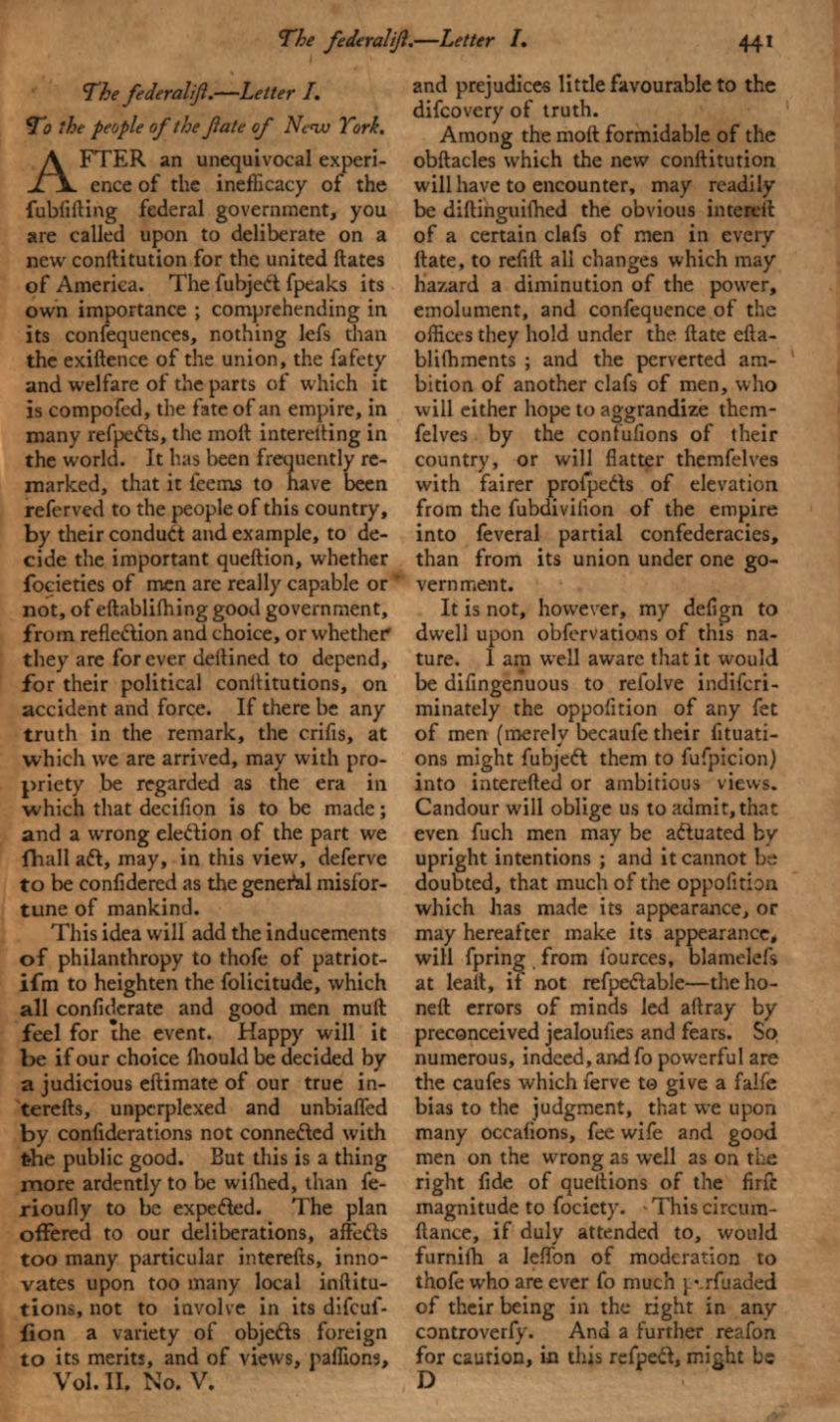
| The Federalist No. 1, Alexander Hamilton as Publius, reprinted in vol. 2, The American Museum Magazine (reprinted by Mathew Carey, 1787) | New York, 27 October 1787 |
Beginning on 27 October 1787, Alexander Hamilton began publishing the first of what would become 85 essays supporting ratification of the Constitution. Hamilton wrote 51 of the essays, along with James Madison and John Jay. In many respects, The Federalist was a response to objections by Brutus, the Federal Farmer and other Antifederalists. In fact, scholars increasingly recognize the iterative nature of the dialogue occurring in the Federalist Papers and the essays of Brutus and the Federal Farmer (now understood to be Melancton Smith and Elbridge Gerry).
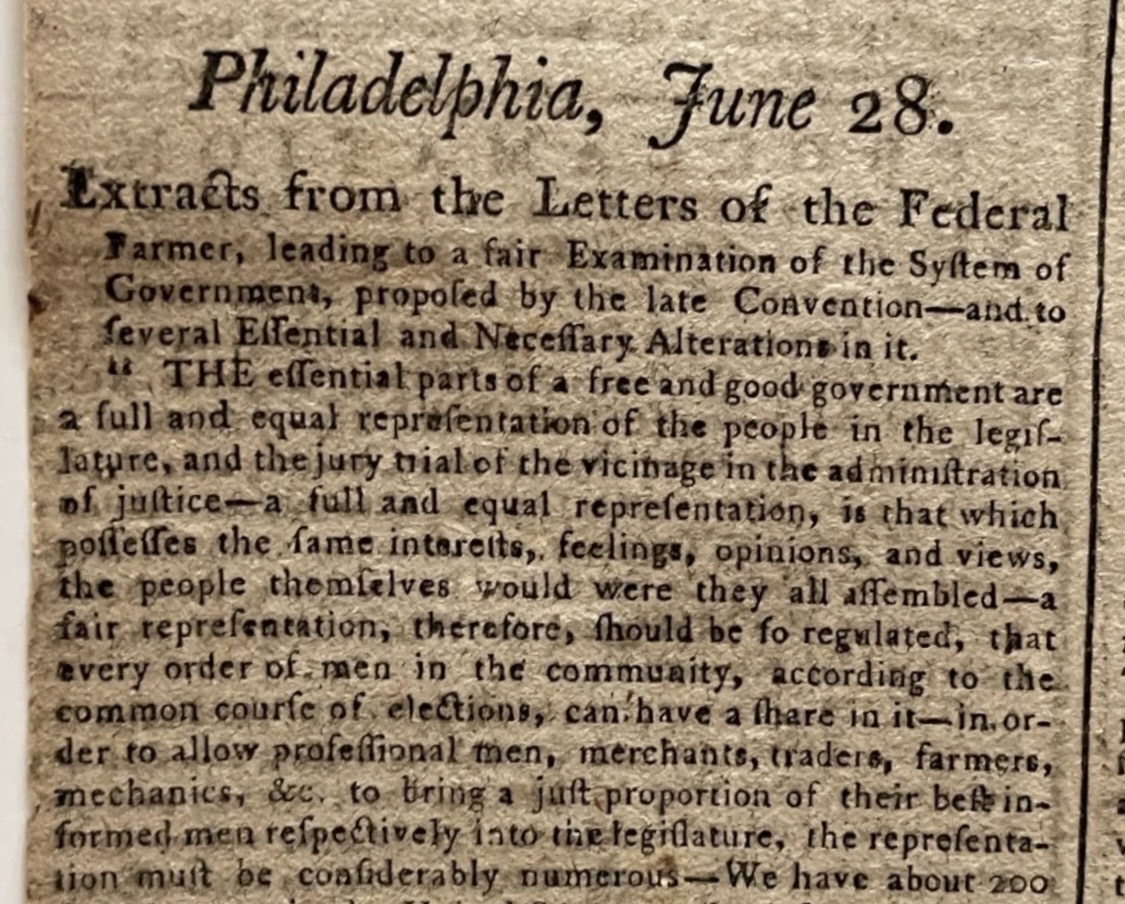
| Federal Farmer No. 2, Elbridge Gerry (reprinted in the Philadelphia Independent Gazetteer or the Chronicle of Freedom, 28 June 1788, published by Antifederalist printer Eleazer Oswald) | New York, November, 1787 (first appeared as a pamphlet) |
The two pamphlets signed by the Federal Farmer are widely regarded as two of most important Antifederalist essays. The Federal Farmer was long believed to have been Virginian, Richard Henry Lee, until Gordon S. Wood convincingly discredited the Lee attribution in 1974. Two decades later, John P. Kaminski floated the thesis, which has been confirmed by recent scholarship, that Elbridge Gerry was the Federal Farmer.
The eighteen letters of the Federal Farmer were printed in two consecutively numbered pamphlets in November of 1787 and May of 1788. In many respects, the Federalist Papers are a debate between Publius and the Federal Farmer. Another well respected Antifederalist author was Brutus, who is believed to have been Melancton Smith.
Elbridge Gerry of Massachusetts was one of only three Convention delegates in attendance who refused to sign the Constitution on 17 September 1787. When the framers of the Constitution arrived in Philadelphia in May of 1787, few delegates had more prestige across America than Gerry. With political experience at both the state and national levels Gerry brought a reputation as a “tried-and-true republican” and the credentials of a signatory to both the Declaration of Independence and the Articles of Confederation. Among his Convention peers, Gerry was one of the most outspoken in denouncing the evils of concentration of power in the hands of the “few.” Gerry has been described as the “most consistently contrary” of his peers and the Convention’s most “ornery delegate.” In the final days of the Convention, Gerry identified a list of his objections which forced him to “withhold his name” from the Constitution. Kaminski argues that Gerry’s September 15 objections and a related letter that he wrote to the Massachusetts Assembly became the basis of the first Federal Farmer pamphlet.
After the Constitution was ratified in 1788, the Federal Farmer was cited as an authority during floor debates in the First Federal Congress. Indeed, the Federal Farmer continues to be regularly cited by the U.S. Supreme Court, along with the Federalist Papers.
Click here to read more about the Federal Farmer.

| “Circular Letter from the Convention of the State of New-York, to the Executives of the different States, to be laid before their respective Legislatures,” vol. 4, The American Museum Magazine (published by Mathew Carey, 1788) | Poughkeepsie, 26 July 1788 |
By a narrow vote of 30-27, New York became the 11th state to ratify the Constitution on 26 July 1788 following the longest and most contested state ratification convention. The New York Convention also agreed that a letter should be sent the other states, asking them to support a second general convention to consider constitutional amendments. The “Circular Letter” was signed by New York Governor George Clinton as the President of the New York Ratification Convention in Poughkeepsie. The letter was part of a compromise brokered between Federalists and Antifederalists.
Written primarily by John Jay, with the assistance of John Lansing, Jr., Alexander Hamilton, and Melancton Smith, the Circular Letter observed that the New York Convention “anxiously desired” that the Constitution be amended, as the government created by the Constitution was “very imperfect.” The letter recommended that a general convention be called “to meet at a period not far remote.” The letter asked state legislatures to apply to the new Congress to call such a convention to consider the amendments proposed by the various state ratifying conventions, including New York.
The first Federal Congress agreed to twelve proposed Constitutional amendments which were sent to the states for ratification. These amendments were primarily “rights based” amendments drafted by James Madison. The Federalists avoided the structural amendments which were also recommended by New York and several other states. One can only speculate how Washington would operate differently in 2026 had more Antifederalist amendments been adopted.

First Federal Congress / Federalist Era
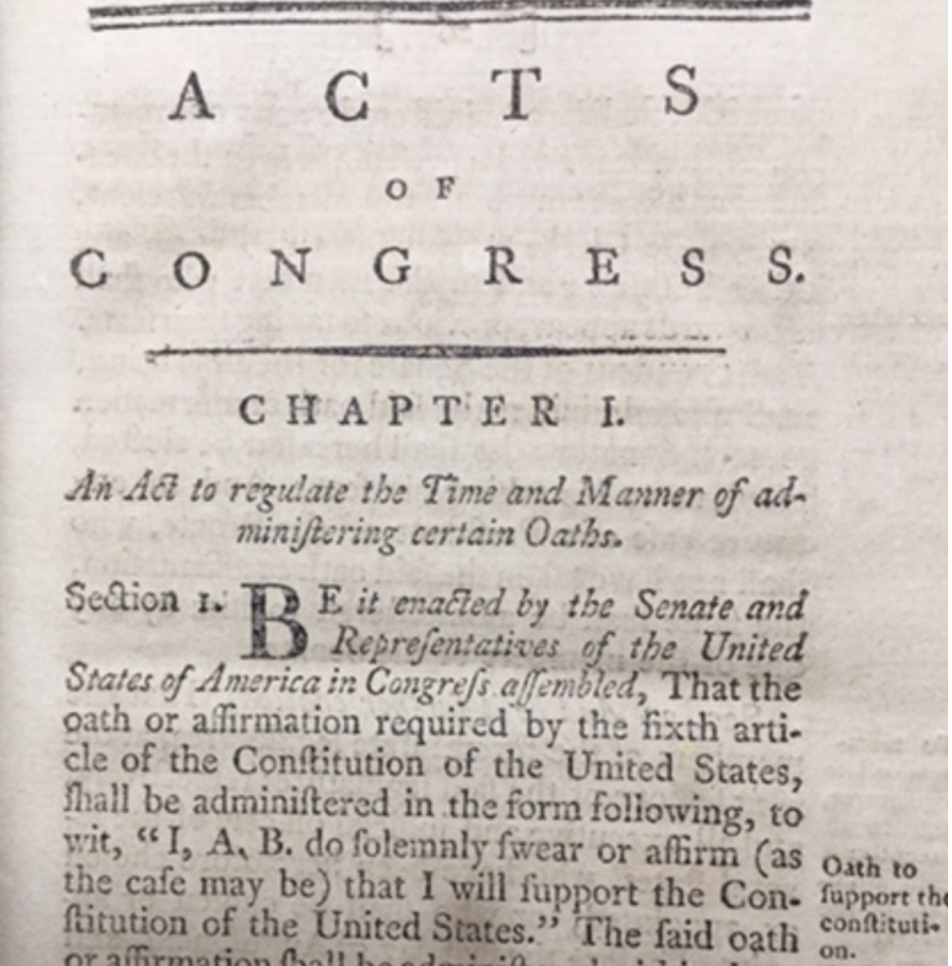
| Oath Act, First Congress, vol. 1, Laws of the United States (printed by order of Congress by Richard Folwell, 1796) | New York, 1789 |
The first Act of the first Congress was passed on 5 May 1789, “An act to regulate the time and manner of administering certain oaths.” Rather than starting with lofty, bold legislation, the first Congress was logical and practical. They decided that the first order of business was the administration of oaths as required by the Constitution.
Meeting for the first time in March of 1789, the first Congress was undertaking an experiment in democracy under our new federal system. Among the important items on their agenda were the establishment of cabinet level departments and the federal judiciary. Ratification of the Constitution had been premised on the adoption of a Bill of Rights. Or, should Congress first create the State Department, Treasury, and War Departments? The first Congress would also need to provide for taxation (the Tariff and Whiskey Acts), establish copyright and patent laws, and create a system of immigration and naturalization. Other small details would include the location of a new capital, the census, and the creation of federal criminal law. Ultimately, out of the hundreds of proposed acts, 118 bills were enacted into law by the busy first Congress.
The Oath Act set forth the simple text of the constitutionally required 14 word oath as follows:
“I, A.B. do solemnly swear or affirm (as the case may be) that I will support the Constitution of the United States.”
Click here for a link to the first act of the First Congress.
| Hamilton’s Report on Public Credit, (Reprinted in the Debates and Proceedings of the Congress of the United States by Joseph Gales, 1834) | New York, 1789 |
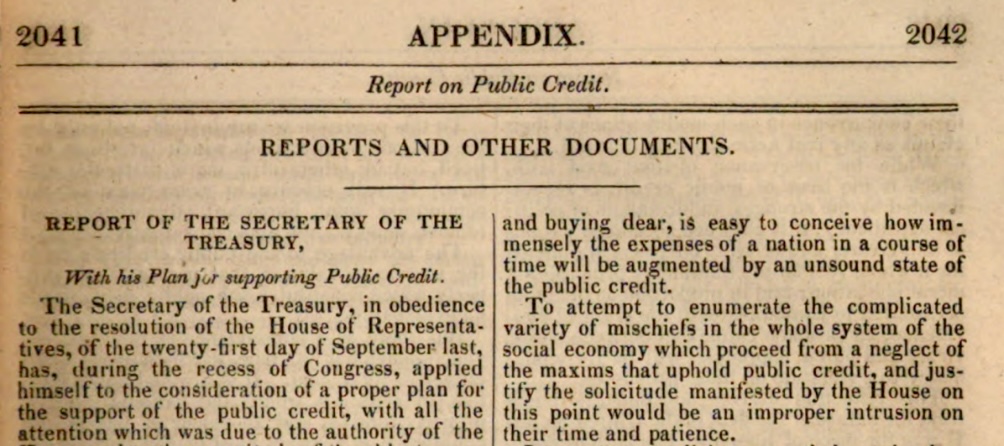
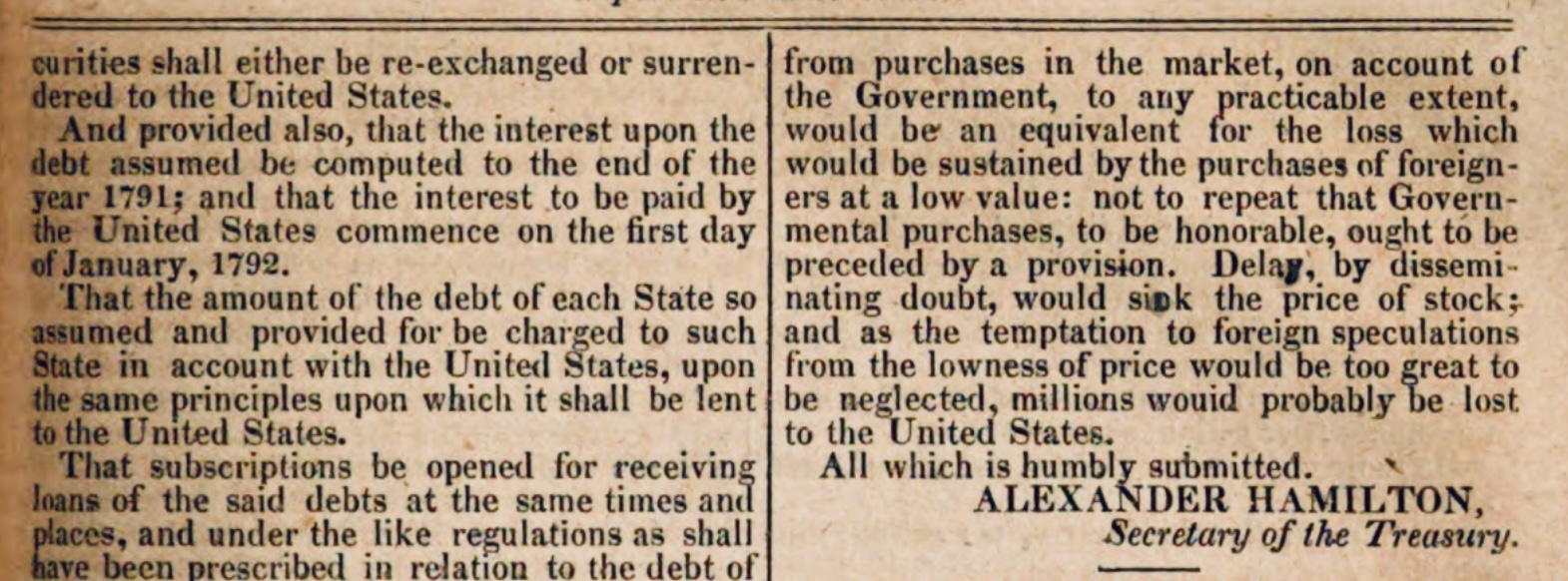
As the first Secretary of the Treasury, Alexander Hamilton was asked in September of 1789 to submit a report to the first Congress on the unpaid revolutionary war debt. During the Congressional recess he produced a fully developed plan that would serve as the underpinning of our modern financial system.
Hamilton was not content to merely report on the revolutionary war debt as requested by Congress. He took the initiative to propose a mechanism to repay all federal debt of approximately $30 million, along with the “assumption of” state debt of approximately $21.5 million. Hamilton reasoned that the states had shouldered much of the cost of the war and thus the federal government should pay off these state obligations incurred during the war. He also recommended a reliable system to securitize and restructure federal debt at par (face) value, and a comprehensive banking, mint and taxation program to implement his fully integrated financial plan. Hamilton would also propose the encouragement of manufacturing through a system of protective tariffs. Another component of his financial plan was a tax on distilled liquor (the Whiskey Tax of 1791), which Hamilton believed was a necessary additional source of federal revenue.
In addition to the First Report on the Public Credit submitted in January of 1790, Hamilton also drafted a Report on Public Debt, a Report on a National Bank (December 1790), a Report on the Establishment of a Mint (January 1791), a Report on Manufactures (December 1791), and a Report on Marine Hospitals (1792). According to historian Henry Cabot Lodge, “We look in vain for a man who, in an equal space of time, has produced such direct and lasting effects upon our institutions and our history.”
Click here to read more about Hamilton’s Report on the Public Credit, which was a central component of his financial plan.
| Residence Act, First Congress, 2nd Session, vol. 1, Laws of the United States (printed by order of Congress by Richard Folwell, 1796) | New York, 1790 |
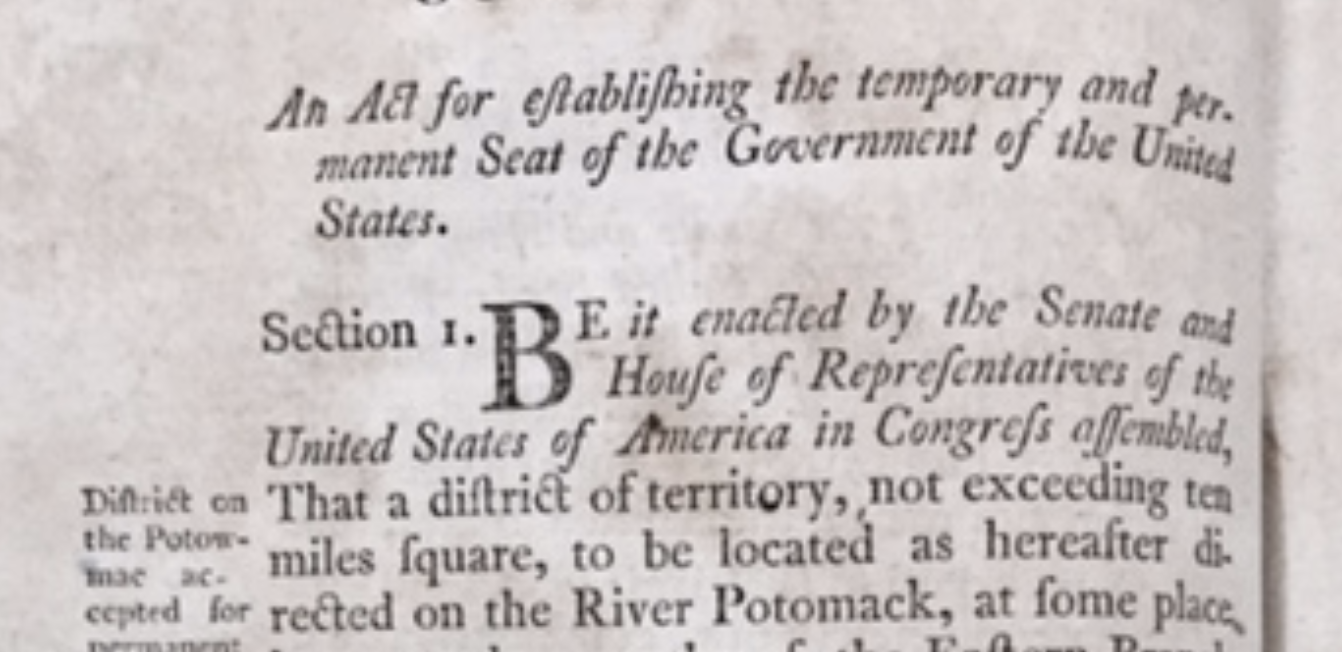
“An Act establishing the temporary and permanent seat of the government of the United States” moved the U.S. Capital from New York to Philadelphia. To overcome southern opposition to his financial plan, Alexander Hamilton negotiated to move the nation’s new capital to Virginia in exchange for James Madison’s support. Hamilton, Madison and Jefferson are believed to have arrived at the grand compromise during dinner on June 20, 1790 at Jefferson’s residence in New York located at 57 Maiden Lane (in the Financial District near Wall Street). As recounted in Lin-Manuel Miranda’s musical, the deal was struck “in the room where it happened.”
The Residence Act provided that: (i) the new capital would be built near Virginia and Maryland along the Potomac River; (ii) Philadelphia would serve as the temporary capital for ten years until the new capital was built; (iii) the new capital would be ready by December of 1800, with construction supervised by President Washington.
Click here to read more about the Residence Act and the Compromise of 1790.
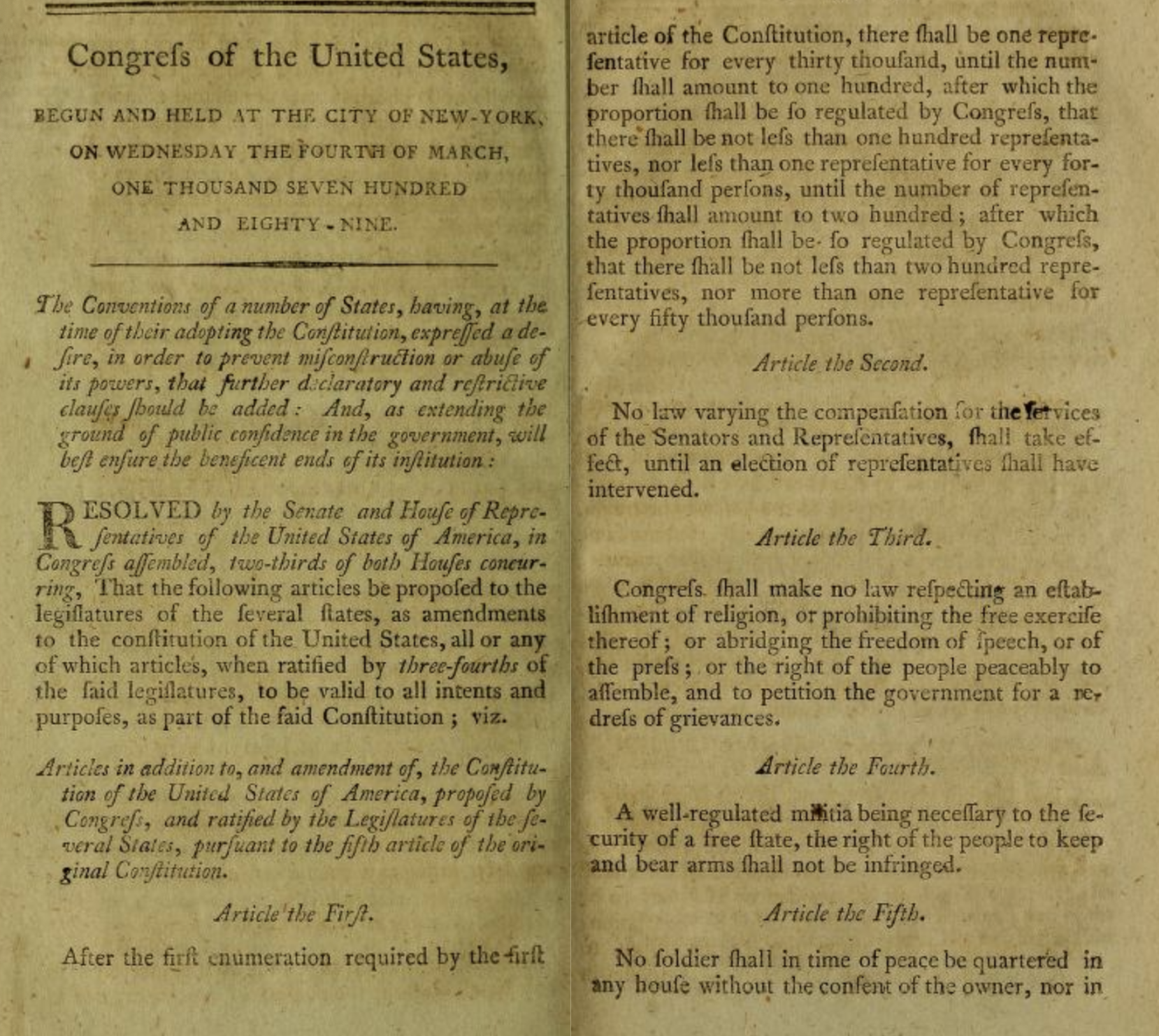
| Bill of Rights, vol. 3, Laws of the United States (printed by order of Congress by Richard Folwell, 1796) | New York, September 1789 (sent to the states; ratified December 1791) |
When the idea of a federal Bill of Rights was first proposed at the Constitutional Convention in 1787, the vast majority of the founders disagreed. At the time, eight state constitutions already included bills of rights. Roger Sherman of Connecticut thought that this was sufficient since the new federal Constitution did not repeal these state protections. In The Federalist 84, Alexander Hamilton warned that a federal bill of rights would be dangerous to liberties that weren’t enumerated.
Madison originally argued that a bill of rights wasn’t necessary because “the government can only exert the powers specified by the Constitution.” Ultimately, Madison was persuaded of the wisdom of the so-called Massachusetts Compromise. Beginning with Massachusetts, several states with powerful Anti-Federalists constituencies agreed to ratify the Constitution based on the assurance that amendments would be adopted by the first Congress. Madison’s conversion to support a bill of rights was also motivated by campaign promises that he made in Virginia to win election to the first Congress.
Following Massachusetts’ lead, the Federalists in both Virginia (led by Madison) and New York (led by Hamilton) were able to narrowly achieve ratification linked to recommended amendments and a Bill of Rights. Virginia voted 89 – 79 on June 25. New York followed suit on July 26 with a 30 – 27 vote.
Click here for a discussion of the Bill of Rights.
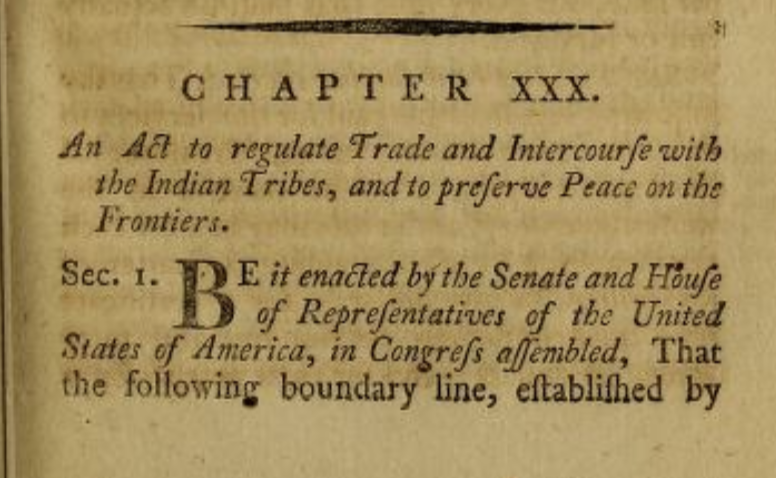
| Indian Non-Intercourse Acts, Third Congress, vol. 3, Laws of the United States, (printed by order of Congress by Richard Folwell, 1796) | Philadelphia, May 1796 |
Starting in 1790, the First Congress attempted in vain to protect the rights of Native American tribes. From 1790 to 1834, six Non-Intercourse Acts, also known as Indian Intercourse Acts, were passed in 1790, 1793, 1796, 1799, 1802, and 1834. The Acts attempted to regulate commerce with Native American tribes and sought to prevent the purchase of Native American lands without the approval of the federal government. The Acts generally required renewal every four years until the 1802 Act.
As requested by President Washington, the Non-Intercourse Act of 1796 attempted to establish clear boundaries of Native American reservations and otherwise addressed legal rights, protections and commerce with Native American tribes. The principal provisions of the Indian Non-Intercourse Act of 1796 are set forth below:
- Established boundaries between the U.S. and Indian tribes.
- Prohibited settlers from hunting or driving livestock onto Indian lands, punishable by a fine of $100 or six months imprisonment.
- Prohibited surveying or settling on Indian lands, punishable by a fine of $1,000 or one year imprisonment.
- Required issuance of passports before traveling onto Indian country, punishable by a $50 fine or three months imprisonment.
- Required licensing of tribal traders who were permitted to trade on tribal land.
- Prohibited purchase of Indian lands, except as permitted by treaty.
- Established penalties for committing crimes against “friendly Indians.” Provided for payment from the U.S. Treasury if the guilty American citizen was unable to afford restitution, but denied restitution from the U.S. Treasury if an Indian victim had sought private revenge or attempted to obtain satisfaction by force or violence.
The Non-Intercourse Act of 1796 was passed after President Washington’s 7th Annual Address asked Congress to strengthen the prior Non-Intercourse Acts which had proven inadequate. In a letter to Washington, former secretary of war Henry Knox explained that “the independent tribes of indians ought to be considered as foreign nations, not as the subjects of a particular state.” Conceptually, Knox and Washington respected the underlying rights of Native Americas as sovereign nations to their lands. As described by Knox, “Indians being the prior occupants of the rights of the soil…To dispossess them…would be a gross violation of the fundamental Laws of Nature and of that distributive Justice which is the glory of a nation.”
According to historian Joseph Ellis, the American victory in the Revolutionary War was a stunning defeat for Britain, but an “unmitigated calamity” for the roughly 100,000 Native Americans living between the Appalachians and the Mississippi River. Despite Washington’s best of intentions, “Indian Country” would be overwhelmed by western settlers notwithstanding the fact that the “principal founders acknowledged that the indigenous people of North America had a legitimate claim to the soil and a moral claim on the conscience of the infant republic.”
Click here for a discussion of the Indian Non-Intercourse Acts.
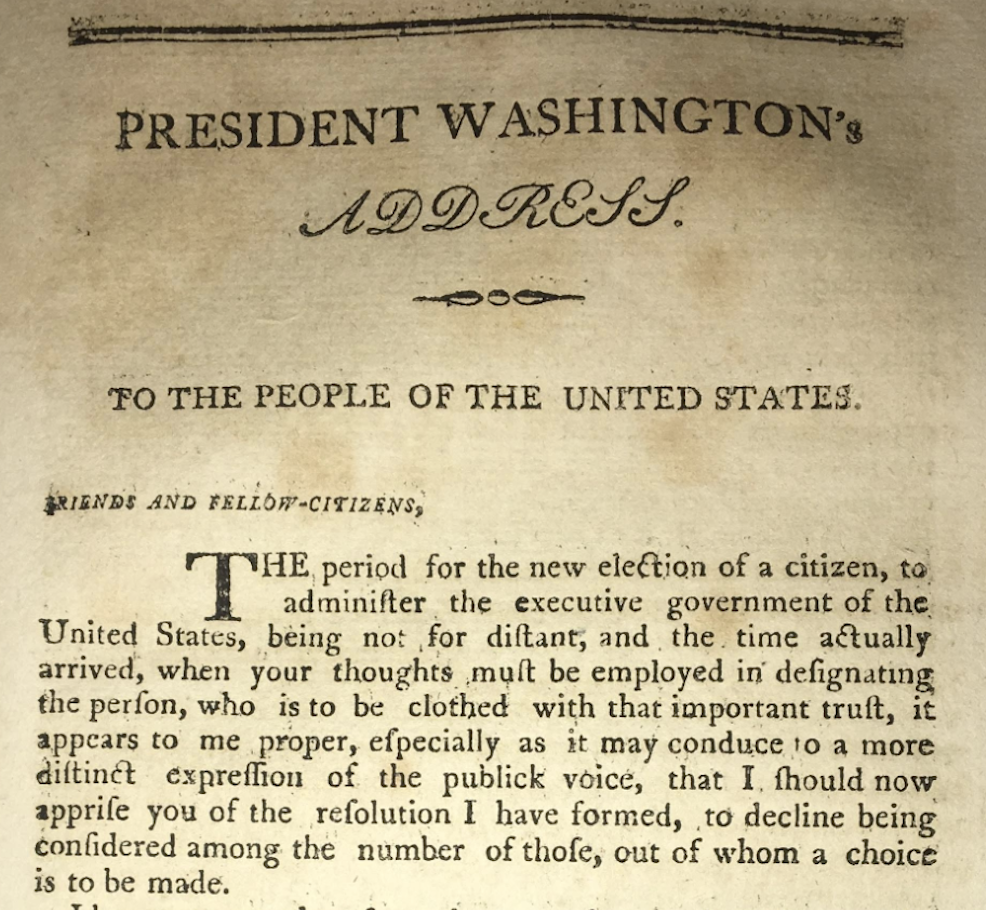
| Washington’s Farewell Address, reprinted in The Perpetual Laws of the Commonwealth of Massachusetts, Isaiah Thomas, 1807 | Philadelphia, 1796 |
When George Washington decided not to stand for a third term in 1796, he did so with full recognition that history was watching. Washington used his carefully crafted Farewell Address to share lessons and insights drawn from nearly a half century of public service. Washington framed his address as the “disinterested warnings of a parting friend” who was stepping down and was now free of “personal motive” that might “bias his counsel.”
Washington’s farewell remarks were presented as an open letter addressed to “The People of the United States of America,” his “Friends and Fellow Citizens.” Reflecting his modesty, Washington signed the letter simply as G. Washington. The address was first published on 19 September 1796 in the Philadelphia American Daily Advertiser and was widely reprinted throughout the country
Distilled to its core, the 7,641 word address was a call for national unity at home and independence abroad. Washington assailed excessive partisanship based on ideological or sectional agendas. According to Washington, “unity of government which constitutes you one people” was subject to attack by both “internal and external enemies.”
For Washington, the corollary to national unity and patriotism at home was neutrality in foreign relations. Washington urged Americans to subordinate their minor differences to the larger national interest. Washington wished that the “union and brotherly affection may be perpetual; that the free Constitution, which is the work of your hands, may be sacredly maintained….”
Click here for a discussion of Washington’s Farewell Address.
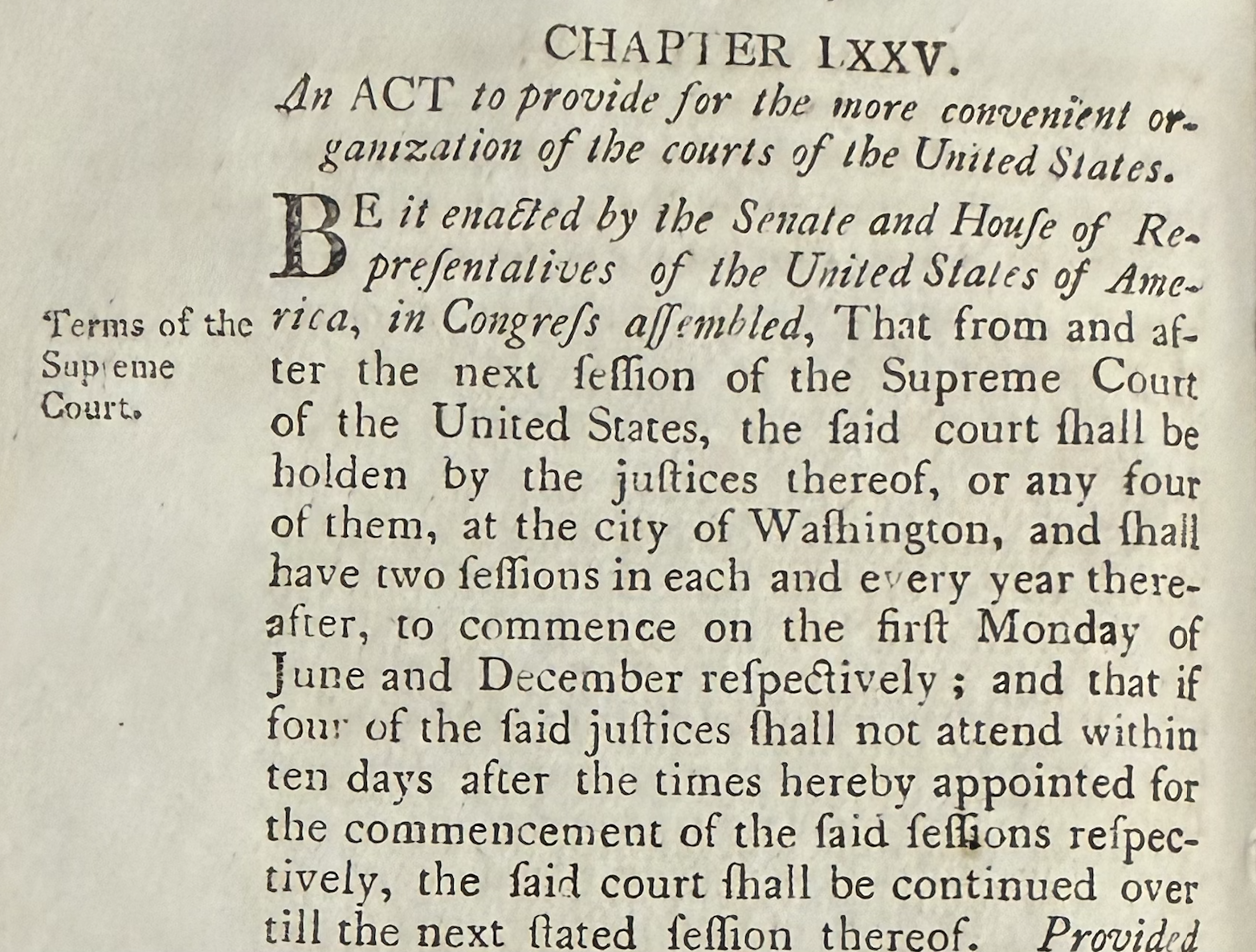
| Judiciary Act of 1801 (Midnight Judges Act), vol. 5, The Laws of the United States, Published by Authority by Samuel Harrison Smith | Washington City, Feb. 1801 |
Officially known as “An Act to Provide for the More Convenient Organization of the Courts of the United States,” the Judiciary Act of 1801 amended the original Judiciary Act of 1789. After John Adams’s defeat in the bitter election of 1800, the Federalists passed the Judiciary Act of 1801 in an effort to restrain newly elected President Jefferson and the Democratic-Republicans. President Adams signed the Act into law less than three weeks before the end of his term. The Act provided for significant expansion and reorganization of the federal judiciary.
The Act decreased the number of U.S. Supreme Court justices from 6 to 5. As a result, Jefferson would be denied an appointment until two vacancies occurred on the Supreme Court. At the same time, the Act increased the number of lower federal trial (district) courts to twenty-one; established six regional (circuit) courts of appeal; and created additional appointments for federal marshals, attorneys, clerks and bailiffs.
In his remaining days in office, Adams made hundreds of appointments which were approved by the lame duck Federalist Senate. By appointing Secretary of State John Marshall as Chief Justice, Adams expected that Federalists judges would be able to serve as a check on the Republicans. Adams used his final hours in office to process the paperwork for his new appointments, which could not take effect until the commissions were delivered to these last-minute “midnight judges.”
When Jefferson was sworn in as President on March 4, 1801, several of the commissions had not yet been delivered. Jefferson instructed his new Secretary of State, James Madison, not to deliver the commissions. A Federalist appointee, William Marbury, brought suit seeking a writ of mandamus to compel certification of his commission as justice of the peace of Washington, D.C.
The resulting landmark case of Marbury v. Madison helped establish the principle of judicial review. While Chief Justice Marshall ruled in favor of Madison and refused to grant a writ of mandamus, Marshall held that the mandamus provisions in Section 13 of the Judiciary Act of 1789 were unconstitutional because Article III of the Constitution did not specifically grant the Supreme Court the power to issue a writ of mandamus under its original jurisdiction. By so holding, Marshall recognized the authority of the courts to strike down unconstitutional laws.
Jefferson and the Republicans quickly repealed the Judiciary Act of 1801. Nevertheless, in 1802 the Republicans ultimately agreed with parts of the reorganized structure created by the 1801 Act. For example, the Judiciary Act of 1802 adopted the six regional circuits created by the Federalists in 1801.
Click here to read more about the Judiciary Act of 1801 and the case of Marbury v. Madison.

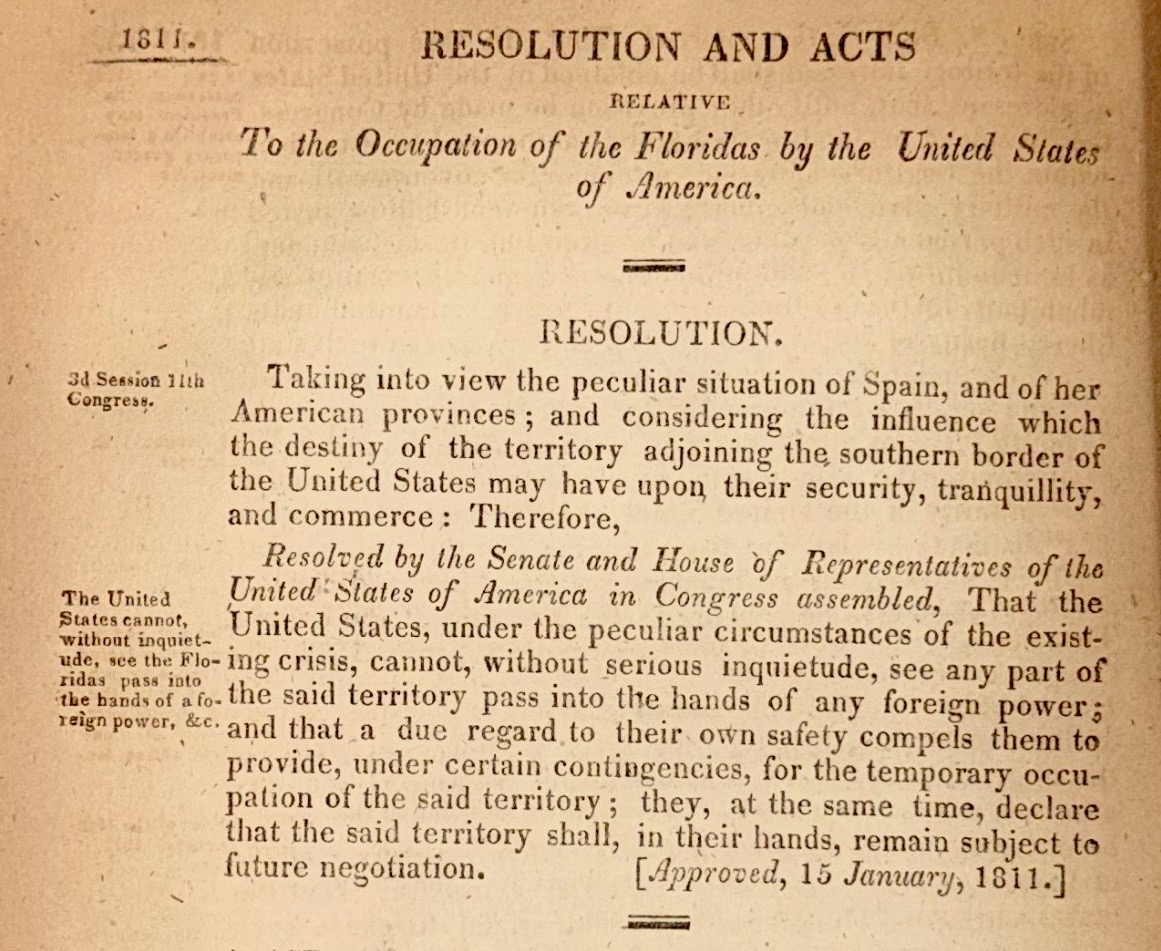
| Acts and Joint Resolutions relative to the Occupation of the Floridas, 11th Congress, vol. 6, The Laws of the United States of America, published by Davis & Force | Washington City, 1811 |
In a secret session held on January 15, 1811, Congress adopted a resolution declaring that the United States:
[U]nder the peculiar circumstances of the existing crisis, cannot, without serious inquietude, see any part of the said territory pass into the hands of any foreign power; and that a due regard to their own safety compels them to provide, under certain contingencies, for the temporary occupation of the said territory; they, at the same time, declare that the said territory shall, in their hands, remain subject to future negotiation.
Congress then proceeded to adopt the “Act to enable the President of the United States, under certain contingencies, to take possession of the country lying east of the river Perdido, and south of the state of Georgia and the Mississippi territory, and for other purposes.”
This occurred in connection with the so-called “Patriot War,” an aborted attempt to foment rebellion and annex portions of Spanish East Florida. Madison feared that Spain’s colonies would be taken over by France or seized by Britain. Florida would eventually be purchased in 1819 with the Adam-Onis Treaty. The Act for the Establishment of a Territorial Government in Florida was adopted in 1822, which governed the Florida Territory until Florida was admitted as the 27th state on March 3, 1845.
| Civil Rights Act of 1866 (first federal civil rights law), First Session, 39th Congress, Chapter 31, vol. 14, Statutes at Large edited by George P. Sanger, 1868 | Washington, D.C., 1866 |
The first federal civil rights law, “An Act to protect all Persons in the United States in their Civil Rights, and furnish the Means of their Vindication,” was adopted on April 9, 1866 over the veto of President Johnson. According to Johnson, former slaves were not qualified for United States citizenship and that the bill would “operate in favor of the colored and against the white race.” Radical Republicans overrode the veto two weeks later by a vote of 122 to 41. Significantly, this was the first time Congress overrode a presidential veto of major legislation. (The first ever veto override occurred in 1845 when the 28th Congress overrode lame-duck President John Tyler’s veto of an appropriation bill).
Radical Republicans believed that the Act was the next logical step after the 13th Amendment abolished slavery in December of 1865. According to Representative Henry Raymond of New York the Act was “one of the most important bills ever presented to this House for its action.”
Yet, President Johnson disagreed with the extraordinary use of federal power to intervene to enforce the Act, describing the legislation in his veto message as “another step, or rather a stride, toward centralization and the concentration of all legislative power in the national Government.” Yet, President Johnson refused to enforce the law.

| 14th Amendment, First Session, 39th Congress, Joint Resolution No. 48 proposing the 14th Amendment, June 16, 1866, vol. 14, Statutes at Large edited by George P. Sanger, 1868 | Washington, D.C., 1868 |
The 14th Amendment is now widely recognized as not only one of the most significant Civil War era amendments, but one of the most important provisions in the entire Constitution.
Section 1 begins by declaring that all persons born or naturalized in the U.S. are citizens of the U.S. and of the state of their residence. This is the first, official, national definition of citizenship, which is now being litigated.
The broadly written civil rights provisions in the Due Process and Equal Protection clauses provide that no state can abridge the rights of citizens of the United States or “deprive any person of life, liberty or property without due process of law nor deny to any person within its jurisdiction the equal protection of the laws.” The less important and often overlooked Privileges and Immunities clause further provides that no state “shall make or enforce any law which shall abridge the privileges or immunities of citizens of the United States.”
Northern Republicans understood the irony of the Civil War – that the South stood to gain additional representation in Congress if the original 3/5th Compromise was repealed. Section 2 thus grew out of an understandable effort to avoid rewarding the South unless it fairly shared the franchise with the newly freed slaves. Section 2 offered the South a choice.
Section 2 provides that if a state denied the right to vote to any of its adult “male inhabitants” its representation in the House and the electoral college would be proportionately reduced. The clause has never been invoked. Interestingly, Section 2 is the first time that the Constitution makes reference to gender. By dealing with voting rights for former slaves but ignoring voting rights for women, the 14th Amendment provoked a strong reaction from the women’s right movement.
Section 3 is now an obsolete provision disqualifying any person from elected office who had aided the Confederacy during the Civil War, unless and until Congress voted by a 2/3 margin to remove the disability. Section 4 provided that:
Confederate war debt was null and void, along with claims for emancipated slaves. In Section 5 Congress delegated enforcement powers to Congress. Southern states recognized that they would not be admitted into the union – and reconstruction would not end – until they ratified the 14th Amendment. Nevertheless, ten southern states initially and overwhelmingly refused to ratify because of the “controversial” nature and stigma of Section 3. President Johnson specifically advised the Southern States to defeat the 14th Amendment. Tennessee was the only exception, gaining quicker re-admittance. This refusal to ratify led to the adoption of the Reconstruction Acts, which among other things required the Southern states to adopt the 14th Amendment to regain representation in Congress.

Notorious laws
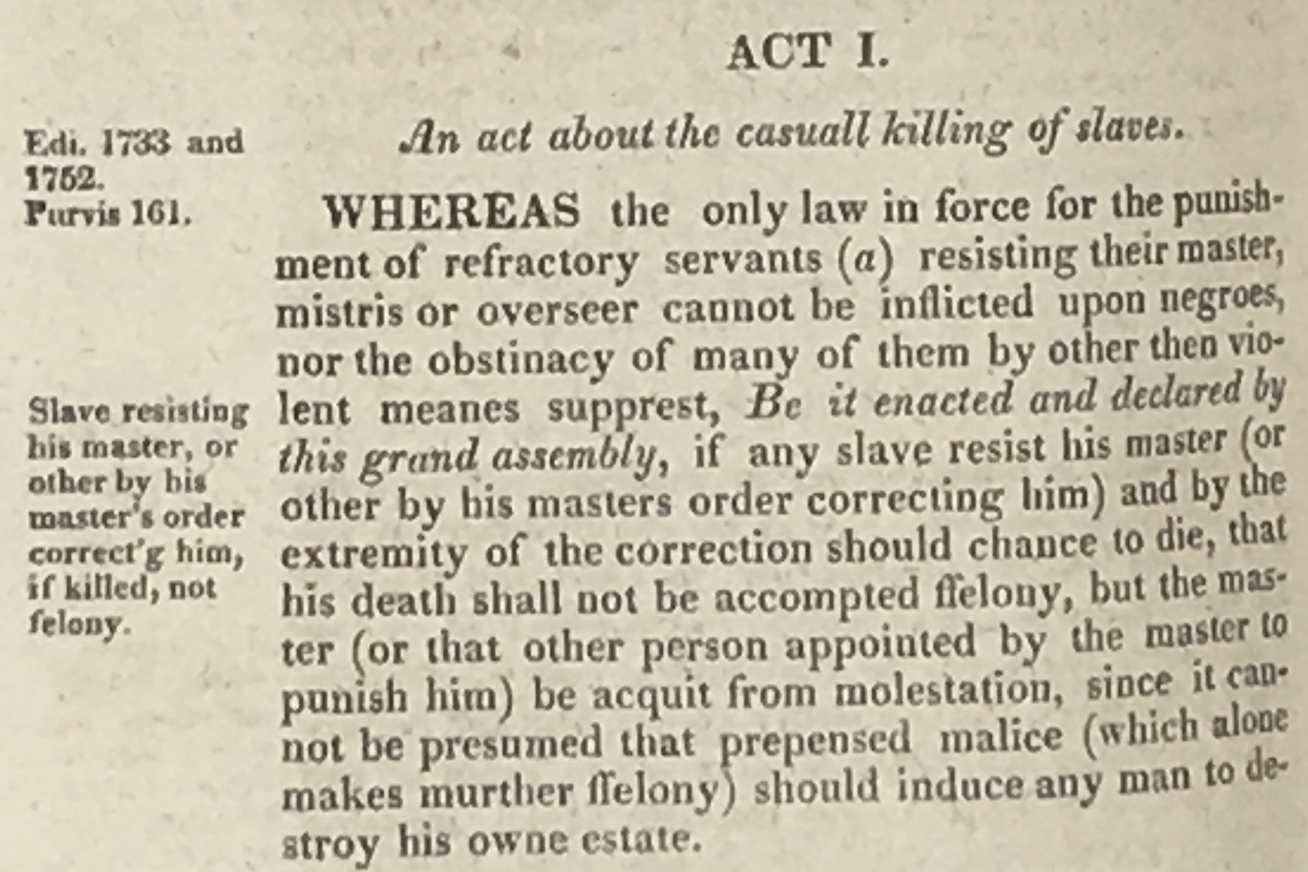
| Virginia Act for the Casual Killing of Slaves, vol. II, Statutes at Large, Being a Collection of the Laws of Virginia (published by William Waller Henning in 1823) | James Citte, Virginia, October 1669 |
In 1669, Virginia amended its slave code to adopt “An act about the casual killing of slaves,” which declared that masters who killed enslaved persons deemed to be resisting were exempt from criminal charges. The law declared that “prepensed malice” for murder could not be presumed as an enslaver would not intentionally “destory his owne estate.” The law was but one example of the horrific slave codes.
The odious act provided as follows:
WHEREAS the only law in force for the punishment of refractory servants resisting their master, mistris or overseer cannot be inflicted upon negroes, nor the obstinacy of many of them by other then violent meanes supprest, Be it enacted and declared by this grand assembly, if any slave resist his master (or other by his masters order correcting him) and by the extremity of the correction should chance to die, that his death shall not be accompted ffelony, but the master (or that other person appointed by the master to punish him) be acquit from molestation, since it cannot be presumed that prepensed malice (which alone makes murther ffelony) should induce any man to destroy his owne estate.
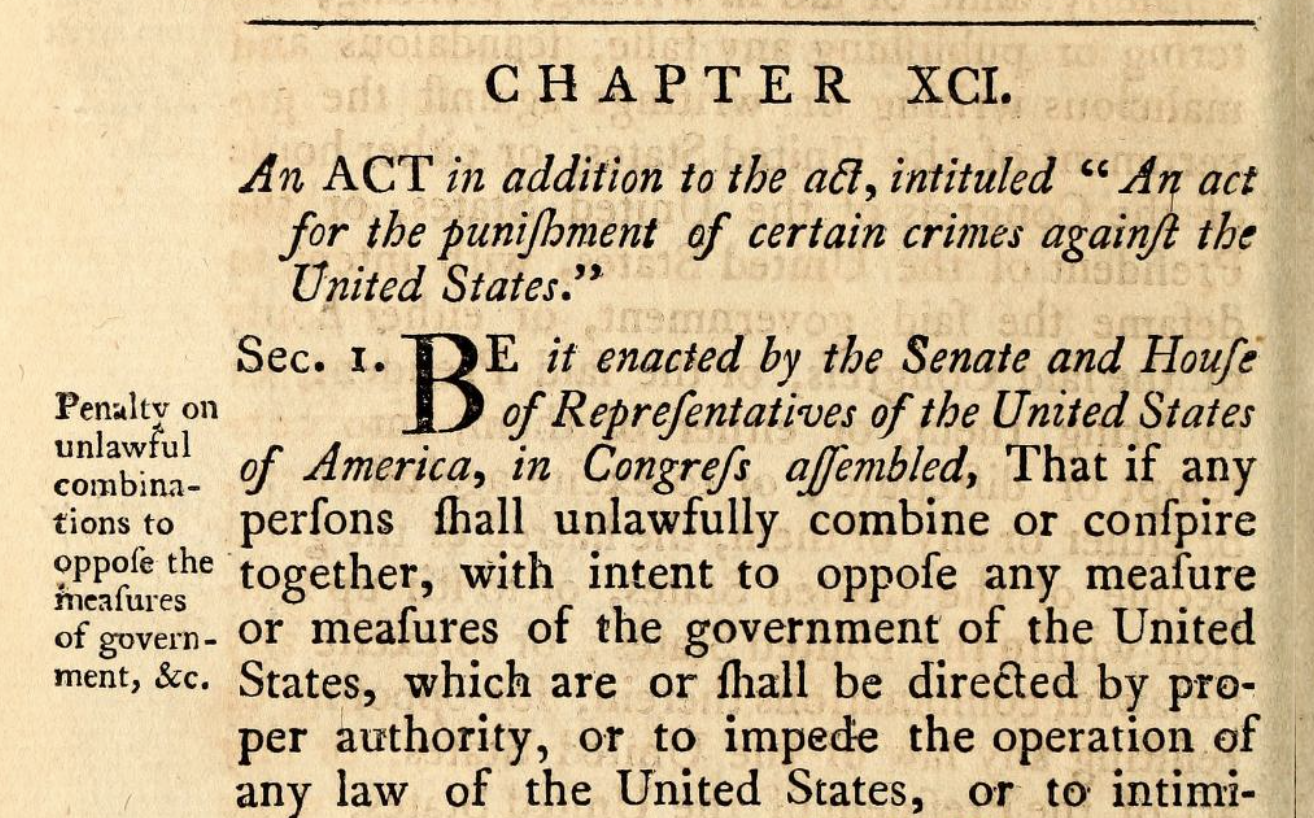
| Alien & Sedition Acts, Acts of the Fifth Congress, Second Session (published by William Ross, 1798) | Philadelphia, 1798 |
One of the most problematic assaults on the First Amendment in U.S. history, the Alien and Sedition Acts consisted of four laws passed by the Federalist-controlled Congress as the nation braced for possible war with France. Although the acts sought to weaken growing Democratic-Republican Party, the resulting blowback helped contribute to Jefferson’s election in 1800.
The Sedition Act provided for up to two years imprisonment and a fine not to exceed $2,000 for printing or uttering “any false, scandalous and malicious writing or writings against the government of the United States, or either house of the Congress of the United States, or the President of the United States, with intent to defame the said government, or either house of the said Congress, or the said President, or to bring them, or either of them, into contempt or disrepute; or to excite against them, or either or any of them, the hatred of the good people of the United States, or to stir up sedition within the United States, or to excite any unlawful combinations therein, for opposing or resisting any law of the United States, or any act of the President of the United States, done in pursuance of any such law, or of the powers in him vested by the constitution of the United States, or to resist, oppose, or defeat any such law or act, or to aid, encourage or abet any hostile designs of any foreign nation against the United States, their people or government, then such person, being thereof convicted before any court of the United States having jurisdiction thereof…”
The Alien Acts were motivated by a desire to limit the influx of Irish immigrants, who were felt to be pro-French. Federalists were also concerned about a perceived unpatriotic press at a time of growing hostilities with France. Thomas Jefferson described the Sedition Act as a “monster” that would “forever disgrace its parents.”
It is difficult to reconcile the four Alien and Sedition Acts with the ten year old Bill of Rights. Under common law, however, freedom of the press only prevented prior restraints on publication, not criminalization of speech. Ultimately, opposition to the Sedition Act strengthened the First Amendment. The Sedition Act was never challenged in the Supreme Court and expired in 1801. Two years later in 1803 the doctrine of judicial review was established by Chief Justice Marshall in Marbury v. Madison.
Click here for a discussion of the Alien and Sedition Acts.
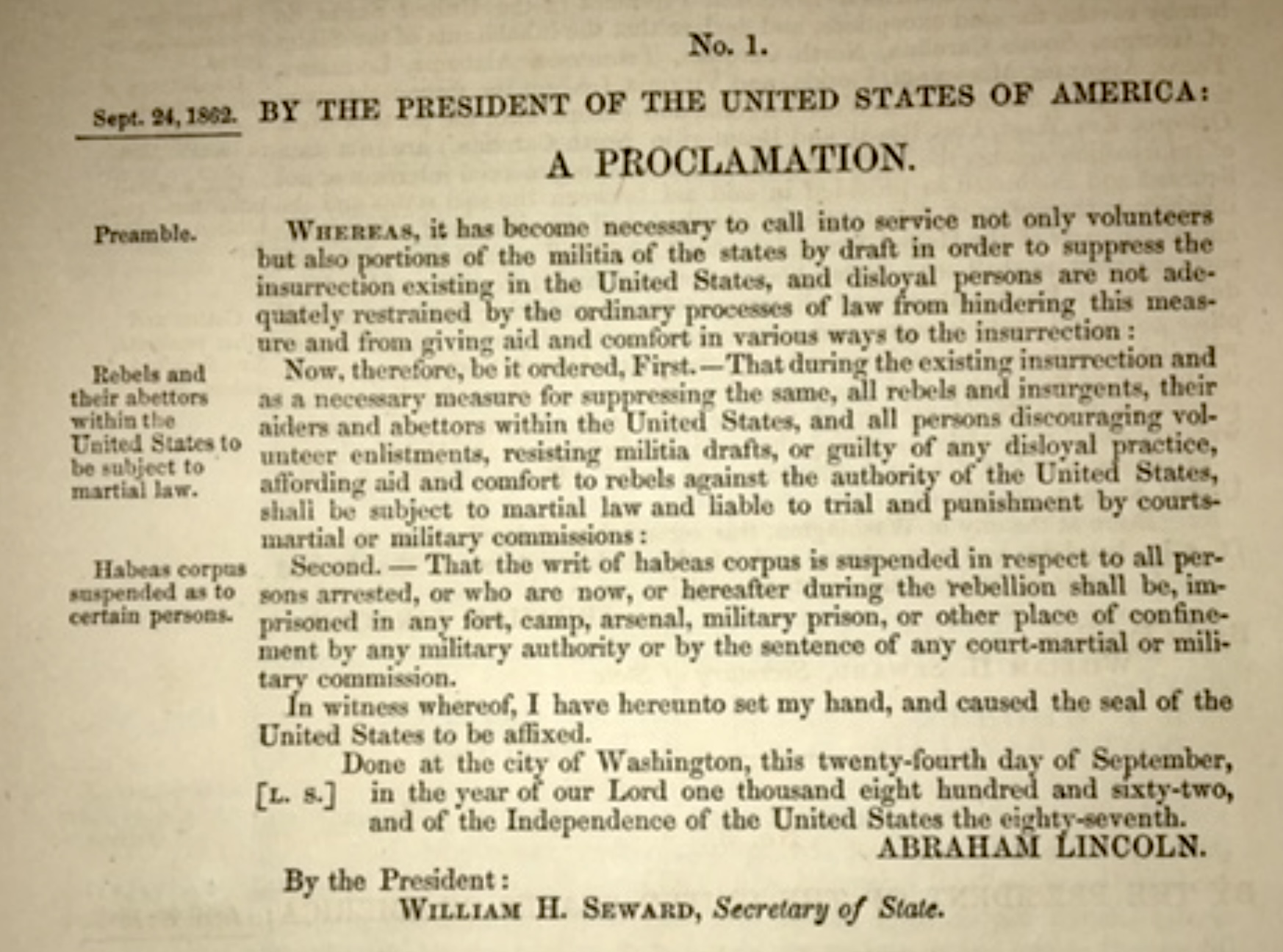
| Lincoln’s Proclamation Suspending Habeas Corpus and the Habeas Corpus Suspension Act of 1863, 12 Stat. 755, Statutes at Large edited by George P. Sanger, 1866 | Washington, D.C., 1862 and 1863 |
During the Civil War, President Lincoln took the unprecedented – and highly controversial – step of unilaterally suspending the writ of Habeas Corpus between Washington, D.C. and Philadelphia. We can understand why. When the Civil War broke out in April of 1861, the nation’s capital was largely undefended. Congress was not in session. Riots in Baltimore were threatening to spread.
When a special session of Congress was called on July 4, 1861, Lincoln defended his decision as necessary and constitutional. It wasn’t until March of 1863 that Congress finally adopted the Habeas Corpus Suspension Act.
Pictured below is the Proclamation of 1862 which suspended Habeas Corpus across the country and applied martial law to anyone charged with interfering with the draft, discouraging enlistments, disloyal practices or affording aid and comfort to the Confederacy.
Early legal publications for use by lawyers / judges / justices of the peace
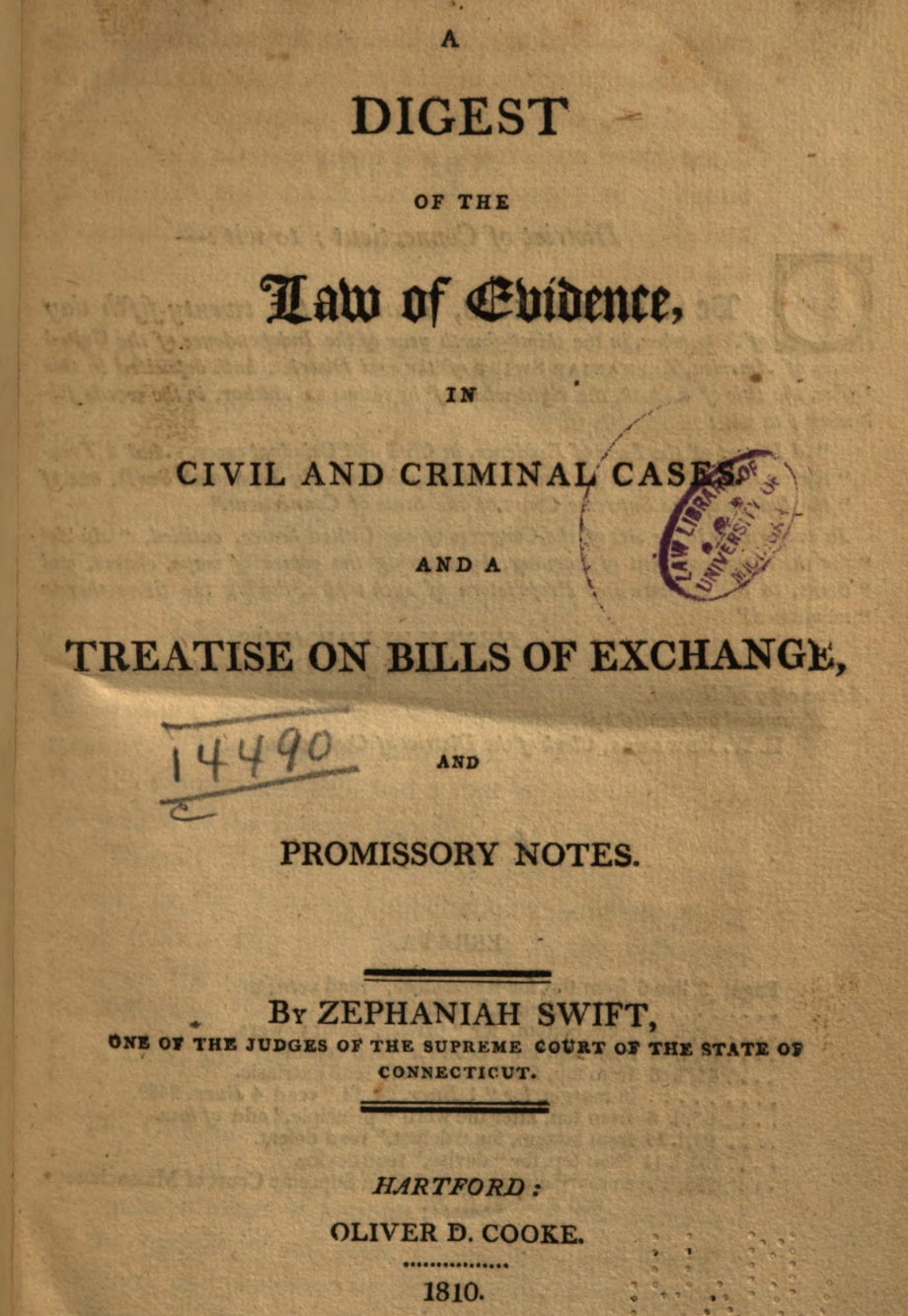
| A Digest of the Law of Evidence, in Civil and Criminal Cases, and a Treatise on Bills of Exchange and Promissory Notes, Zephaniah Swift (Hartford, 1810) | Hartford, 1810 |
One of the great early American jurists, Zephaniah Swift, was a long serving Chief Justice of the Connecticut Supreme Court. Justice Swift first gained national attention after he wrote the first American legal text/treatise, A System of the Laws of the State of Connecticut. Swift also wrote A Digest of the Laws of the State of Connecticut which was published in 1820 and the first American treatise on the laws of evidence, A Digest of the Law of Evidence, in Civil and Criminal Cases, and a Treatise on Bills of Exchange and Promissory Notes. It is said that a country law office was well furnished “if it had a three legged stool and Swift’s Digest.” Based on the success of his influential legal publications – which were widely distributed around the country – Swift has been referred to as America’s Blackstone.
According to Swift, the best method to diffuse this knowledge was to “simplify” and “fyftematize” (systematize) the laws. In the introduction to his Digest of the Law of Evidence Swift wrote that “No object is more important in society, than a code of laws founded on principles of justice, and promulgated with such perspicuity, and precision, that they may be easily understood, and uniformly administered.” He further explained that doing so “furnishes to the people more effective security for their liberty, than mere forms of government” and “checks their tendency to despotism, and restrains the baneful influence of party spirit.” Earlier in his career he served as the Speaker of the General Assembly of Connecticut. He was elected to the Third and Fourth U.S. Congress as a Federalist from 1787 to 1793.
Click here to read about Swift’s treatise on evidence.
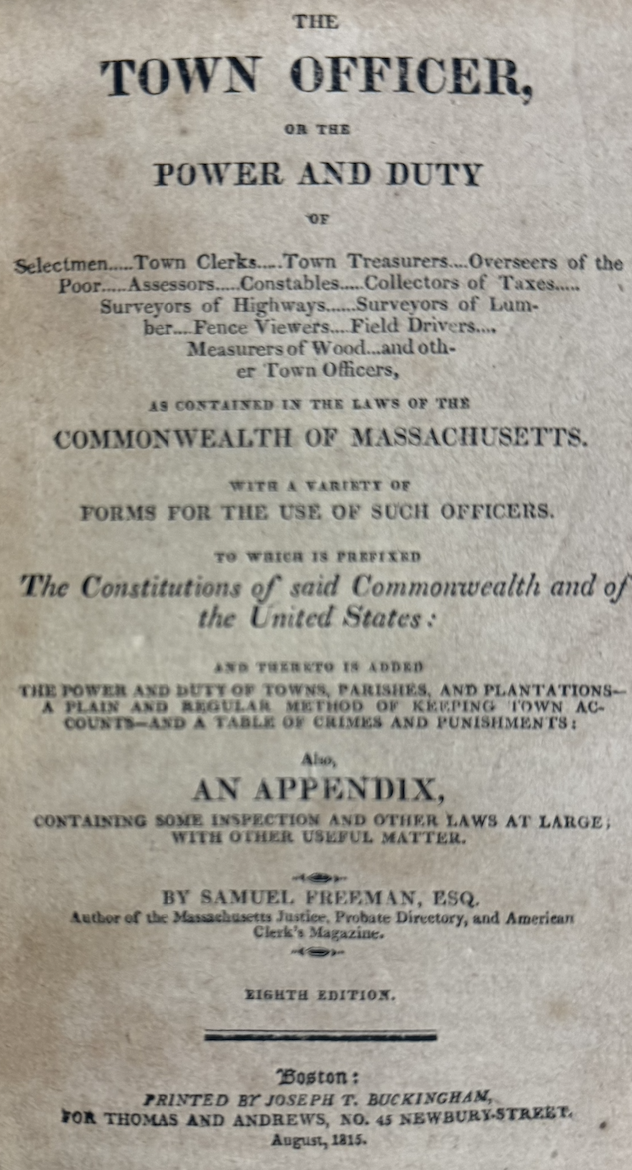
| Justice of the Peace Manuals: The Town Officer by Samuel Freeman, 8th ed. (1815); The Connecticut Civil Officer in Three Parts by John M. Niles (1823) | Hartford 1815 |
The position of justice of the peace dates back to 1360 with the adoption of the Justice of the Peace Act (34 Ed. III, ch. 1). Some historians refer to the reign of Richard the Lion-Hearted in 1189, when knights across the kingdom preserved the king’s peace. The Justice of the Peace Act of 1360 empowered justices of the peace to try and imprison “offenders, rioters, and all other barators” (a barator was a brawler). In England, a justice of the peace’s jurisdiction gradually expanded as political power moved from lords of the manor to the landed gentry. By the 1600s local governmental functions were firmly rooted in justices of the peace (also known as “magistrates” or “commissioners”).
The English tradition of local control overseen by the county justice of the peace was transplanted to America. For example, in 1662 Virginia adopted Act XXXI (II Hening 69) which empowered justices of the peace to act according to the laws of England and “doe all such things as by the laws of England are to be done by justices of the peace there.” The 1662 Act further provided that justices of the peace should be “of the most able, honest and judicious persons in the county.” The County Court in each county consisted of eight justices of the peace, any four of which would constitute a quorum to hold court.
Justices of the peace were responsible for maintaining order in the community as the arresting and arraigning magistrate. They also watched over the morals of the community (ranging from drunkenness, gaming, and adultery to property crimes). In their administrative role they also authenticated deeds and affidavits, were empowered to officiate marriage ceremonies, and raised the “hue and cry” against escaped prisoners.
Justices of the peace manuals were among the earliest “American” works to be published in the colonies. After the Revolutionary War a void was created for updated American manuals for justices of the peace, town officers and public officials. As a practical matter, the new federal government was far removed from the lives of average Americans – who were far more likely to interact with their local government than with federal officials.
Local justices of the peace played an important role in both government administration and the adjudication of legal disputes. From 1760-1774 George Washington served as a justice of the peace in Fairfax County, Virginia. Washington followed in the footsteps of his father, grandfather, and great grandfather who were also justices of the peace. Likewise, both Thomas Jefferson and his father served as justices of the peace. As many justices of the peace lacked formal legal training, manuals for non-lawyer justices of the peace were necessary tools of the trade. One of the most famous cases in American history, Marbury v. Madison, involves a dispute over the appointment of a justice of the peace, William Marbury.
Click here to read about Justice of the Peace Manuals, law in a saddle bag.

Colonial and Early American Newspapers
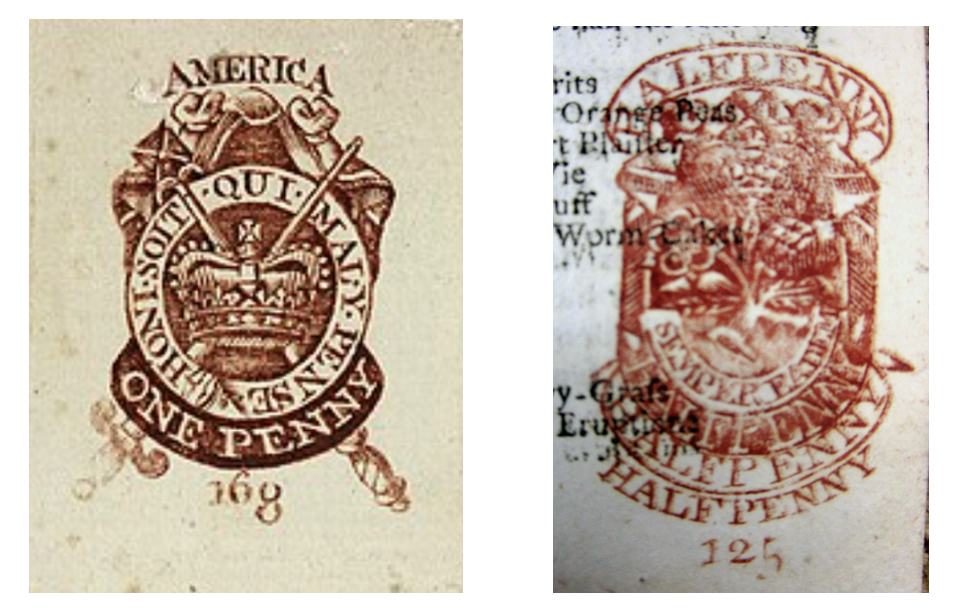
Sample royal tax stamp:
Pictured below (on the left) is a sample royal tax stamp that would have been required by the Stamp Act of 1765. Due to the rarity of “American” stamp taxes, the example on display (on the right) is a ubiquitous stamp used in England applied to a British newspaper, the London Chronicle.
Alexander Hamilton as Pacificus:

During the summer of 1793, Hamilton wrote seven essays defending Washington’s controversial Proclamation of Neutrality. Covering a wide range of topics, the Pacificus essays argued that America was not obligated by treaty to support France and should avoid involvement in European conflicts. James Madison replied in five essays under the pseudonym Helvidius.
Alexander Hamilton as Camillus:

Between July of 1795 and January of 1796 Hamilton anonymously published twenty-eight essays as Camillus defending Jay’s Treaty. Hamilton edited another ten Camillus essays written by Federalist Senator Rufus King. Hamilton wrote an additional four essays as Philo Camillus, bringing the total to forty-two essays, which ultimately contributed to ratification of the unpopular treaty. For Ron Chernow, the essays support the claim that Hamilton was the “foremost political pamphleteer in American history,” churning out almost 100,000 words in seven months while maintaining a full-time law practice.
Alexander Hamilton as Lucius Crassius:

Using the pseudonym Lucius Crassus, Hamilton wrote eighteen essays criticizing Jefferson’s first message to Congress and defending Federalist policies. Contemporary accounts compared Hamilton’s The Examination essays to his earlier Camillus essays. According to John Quincy Adams, Hamilton’s work found “great approbation among the federalists and among all those who consider themselves as the profound thinkers of the nation.”
Noah Webster as Curtius:
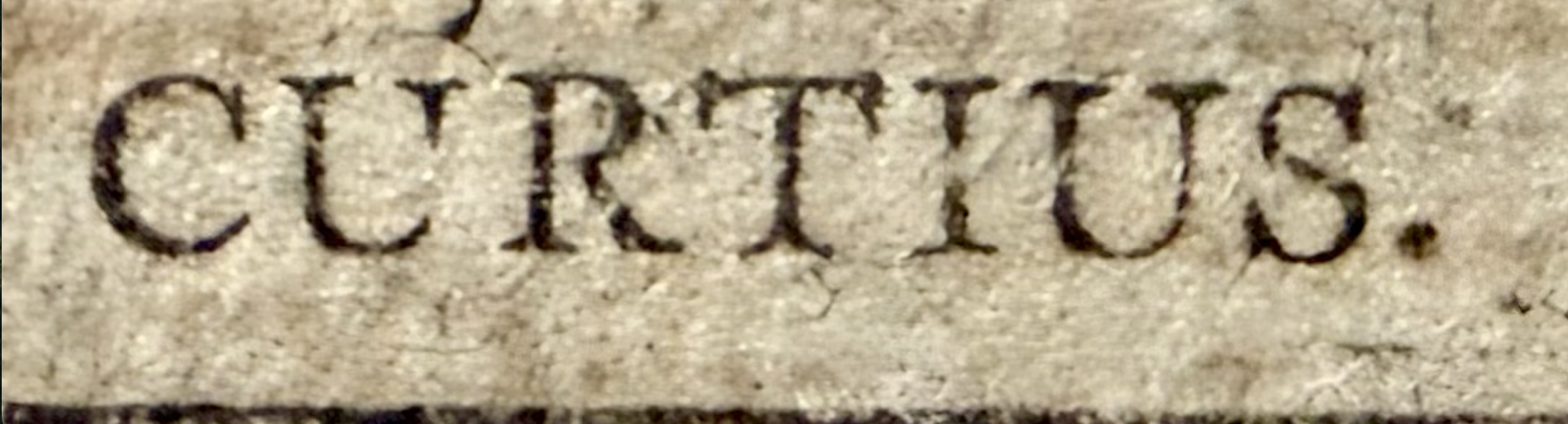
Noah Webster wasn’t just a lexicographer. In addition to his dictionaries and spellers, he authored a dozen articles defending Jay’s Treaty under the pseudonym Curtius. Another eloquent and thoughtful defense was offered under the pseudonym Macellus, who was likely John Quincy Adams. In 1793, Alexander Hamilton recruited Webster to move to New York to edit a Federalist newspaper. He subsequently founded New York’s first daily newspaper, the American Minerva, later renamed the Commercial Advertiser.
New York Evening Post founded by Hamilton
Founded by Alexander Hamilton, The New York Evening Post is the oldest daily newspaper continually published in the U.S. As the leader of the Federalist party, Hamilton started the paper on November 16, 1801 after his beloved Federalist party suffered electoral defeats at the hands of Jefferson and the Democratic-Republicans. It was also hoped that the paper could provide leadership for other Federalist newspapers. Sadly, Hamilton died on July 11, 1804 and never saw this December 21, 1804 edition. The first issue of the paper contained the following summary of the paper’s mission:
The design of this paper is to diffuse among the people correct information on all interesting subjects, to inculcate just principles in religion, morals, and politics; and to cultivate a taste for sound literature.
