Gouverneur Morris and Mary Dalley’s Boarding House (the “Constitution House”)
Exhibit at the Historical Society of Pennsylvania (HSP), April 18, 2026
Introduction

Leading members of the founding generation boarded with Miss Dalley during and after the Revolutionary War. Regrettably, history has largely forgotten Mary Dalley’s enormously important boarding house. Unlike the well-known “Declaration House” where Thomas Jefferson resided during the summer of 1776, until this week there are no historical markers commemorating Miss Dalley or her boarding house. This is unfortunate as the location where Gouverneur Morris resided in 1787 is likely the site where he “drafted” the Preamble and the September 12th draft of the Constitution.[1]
Gouverneur Morris is widely regarded as the “Penman” of the U.S. Constitution. After an exhaustive review of archival records, it can be safely concluded that Gouverneur Morris boarded with Miss Mary Dalley in the same boarding house where Alexander Hamilton and Elbridge Gerry boarded during the Constitutional Convention.
Beginning in 1778 Miss Dalley’s name begins appearing in the correspondence and diaries of Massachusetts delegates to the Continental Congress. Her name is repeatedly mentioned in Elbridge Gerry’s correspondence with his wife Ann during the summer of 1787. Newspaper ads and street directories indicated that Miss Dalley was also an entrepreneurial businesswoman and tailor. In addition to running a boarding house, in the late 1780s she also sold several varieties of imported tea from China.
During the course of her hospitality career, Mary Dalley provided meals and/or lodging for at least 15 signers of the Declaration of Independence and 12 signers of the Constitution. Her customers and guests included George Washington, John Adams, James Madison, John Jay, Robert Morris, Roger Sherman, Henry Laurens, John Trumbull, Henry Knox, Baron von Steuben, the Marquis de Lafayette, Gouverneur Morris, Alexander Hamilton (Publius) and Elbridge Gerry (the Antifederalist Federal Farmer).
As far as can be determined, we don’t have any letters written by Mary Dalley. Nevertheless, the following manuscripts located at the Historical Society of Pennsylvania help paint a wonderful picture of the issues that her boarders were confronting during and after the war.
HSP manuscripts on display
| 1. James Duane to George Clinton | 5 August 1777 |
In 1784 James Duane became the first Mayor of New York City post-independence. In 1777 Duane was a delegate to the Continental Congress from New York who boarded with Miss Dalley. In 1777 George Clinton became the first Governor of the state of New York. Clinton would later be elected as the fourth Vice President of the United States during Thomas Jefferson’s second term.
Duane and his fellow New York delegates to Congress (Philip Livingston and William Duer) regularly provided updates to Governor Clinton. In this letter Duane reports that General Washington declined to appoint a successor for General Philip Schuyler. Thereafter, Congress appointed General Horatio Gates, who would go on to win the crucial battle of Saratoga. The letter was potentially drafted at Miss Dalley’s boarding house. Click here for transcription.
| 2. William Whipple to Josiah Bartlett | Philadelphia, 14 April 1779 |
William Whipple was a New Hampshire shipper and merchant who saw action at the Battle of Saratoga. When he wasn’t commanding troops, Whipple served in the Continental Congress from 1776 to 1779, becoming a signatory to the Declaration of Independence. In April of 1779 Whipple once again resided at Miss Dalley’s boarding house while serving in Congress. Josiah Bartlett was a New Hampshire physician, politician and signatory to the Declaration of Independence and Articles of Confederation. Bartlett would later serve as a judge and governor of New Hampshire.
Whipple’s letter to Bartlett discusses a possible alliance with Spain. In their correspondence both Whipple and Bartlett express frustration with the length of the war. Whipple explains that he is “much more sick to think that the Glory of America” should be tarnished by the artifice of rascals who were endeavoring to frustrate the war effort. The letter was potentially drafted at Miss Dalley’s boarding house. Click here for transcription.
| 3. Nathaniel Peabody to Josiah Bartlett | Philadelphia, 13 July 1779 |
Nathaniel Peabody was a medical doctor and delegate to Congress from New Hampshire who boarded with Miss Dalley in 1779 – 1780. Peabody became an Adjutant General of the New Hampshire militia and served in the state assembly. Peabody replaced Josiah Bartlett as a delegate to Congress from New Hampshire after Bartlett’s resignation. In 1782 Peabody was the chair of the committee that drafted New Hampshire’s second Constitution.
In the July 1779 letter Peabody updates Bartlett about developments in Congress. Peabody mentions New Hampshire land grants and grievances before Congress. According to Peabody, Col. Ethan Allen has been in Philadelphia seeking admission before Congress on behalf of Vermont. Congress tabled the matter due to opposition by New York. Peabody was happy to learn that New Hampshire complied with a Congressional requisition to raise funds “at this critical situation of our finances.” The letter was potentially drafted at Miss Dalley’s boarding house. Click here for transcription.
| 4. George Partridge to Samuel Adams | March 1780 |
George Partridge was a delegate to the Second Continental Congress and Confederation Congress from Massachusetts variously serving from 1779 – 1785. When Congress resided in Philadelphia Partridge boarded with Miss Dalley. Partridge also served in the first Federal Congress. As long serving Massachusetts politicians, Partridge and Samuel Adams would have closely worked together as colleagues, as is evident in the March 1780 letter.
Partridge was reaching out to Adams, after learning of Adams’ reappointment as a delegate to Congress. Partridge enclosed intelligence regarding General Benjamin Lincoln’s operations and military plans. Partridge attempts to coordinate travel plans as he would be returning to Boston as Adams was travelling to Philadelphia. The March 1780 letter from Partridge to Adams was potentially drafted at Miss Dalley’s boarding house. Click here for transcription.
| 5. Matthew Clarkson to General Benjamin Lincoln | Philadelphia, 17 July 1780 |

Matthew Clarkson was an aide de camp for General Benjamin Lincoln and was present for Burgoyne’s surrender after the Battle of Saratoga. As a member of the New York legislature in 1785, he introduced the bill for the gradual elimination of slavery in New York. Clarkson was a member of both the New York Manumission Society (NYMS) and the Pennsylvania Abolition Society (PAS). He was elected as the third President of the NYMS in February of 1791. Clarkson helped found the Free African School in New York City and served on its first board of directors. In 1780 Clarkson resided at Miss Dalley’s boarding house. After the war he served as President of the Bank of New York.
In May of 1780 the British seized Charleston, one of the most decisive American losses during the war. Clarkson and Lincoln were captured along with 5,000 American troops. The letter was written after Clarkson and Lincoln were paroled and mentions the controversy over their release as part of a prisoner exchange for captured British officers. When Lincoln returned to Philadelphia he requested a court of inquiry to investigate his actions in Charleston. Validating his conduct, no charges were brought against Lincoln who returned to service as one of Washington’s most trusted generals.
| 6. Samuel Osgood to Samuel Holten | Philadelphia, 15 April 1782 |

Samuel Osgood was a Congressional delegate from Massachusetts who likely lived with Miss Dalley beginning in 1782. At the beginning of the war he led a company of minutemen at the Battle of Lexington and Concord in 1775. He subsequently became an aide to General Artemas Ward, who also boarded with Miss Dalley. In 1785 Congress appointed Osgood as one of three members of Confederation’s Board of Treasury. This letter was potentially written at Miss Dalley’s boarding house when Osgood boarded with Miss Dalley. Osgood forwards a letter from Mr. Lovell, another Massachusetts delegate who had also boarded with Miss Dalley.
One of the defects with the Articles of Confederation was the inability of the Confederation Congress to secure a quorum. This is evident in Osgood’s letter to his former colleague which mentions the “surprising” news that James Lovell had left Congress “to return no more.” Osgood opined that Lovell’s motives were justifiable considering his unspecified family situation. Further illustrating the difficulty of maintaining the Massachusetts delegation to Congress, Mr. Partridge, another Massachusetts delegate, intended to return home in May. Osgood himself hoped to “leave this place in June.”
| 7. Gouverneur Morris to George Washington | Philadelphia, 2 July 1782 |
Gouverneur Morris was a Congressional delegate from New York and Constitutional Convention delegate from Pennsylvania. Morris spoke 173 times at the Constitutional Convention, more than any other delegate. Appointed to the Committee on Style and Arrangement on 8 September, Morris was selected to craft the Preamble and the final draft of the Constitution. Morris was a close confidant of Washington, as evidenced by the 109 letters from Morris to Washington in the Washington Papers.
In this 2 July 1782 letter to George Washington, Morris encloses a packet of newspapers for Major General William Dalrymple, the Quartermaster of the British army. As the war was winding down the Americans and British had reached “an agreement” in Elizabethtown, which included the exchange of newspapers. Washington regularly subscribed to a wide variety of newspapers and was well read, despite his lack of a formal education. This July 1782 letter was potentially written from Miss Dalley’s boarding house. Click here for transcription.
| 8. Elbridge Gerry to Mr. Whipple | 30 August 1782 |

Elbridge Gerry was a signer of the Declaration of Independence and the Articles of Confederation. He became the 5thVice President of the United States under President James Madison. He served in the Second Continental Congress from 1776 to 1780. He agreed to return to Congress in 1783. At various times Gerry and William Whipple boarded with Miss Dalley and other Congressional delegates from Massachusetts. Whipple and his brother were New Hampshire shippers and merchants. Whipple served in the Continental Congress from 1776 to 1779 and was a signatory to the Declaration of Independence. Whipple was a hero at the Battle of Saratoga.
Illustrating Gerry’s deep connections to revolutionary era leaders and members of Congress, Gerry provides a letter of introduction for James Warren’s son who was traveling to New Hampshire. Gerry mentions that Warren was a gentleman who “has been frequently mentioned in the most respectable terms at our social interviews in Philadelphia.” It is likely that these discussions (social interviews) took place at Miss Dalley’s boarding house. The letter ends with Gerry sending his best respect to Whipple’s wife, “your lady & all friends.” During the ratification debate, Gerry and Warren became leading Antifederalists.
| 9. Gouverneur Morris to George Washington | Philadelphia, 9 October 1782 |
In 1782 Gouverneur Morris was living with Miss Dalley and working as the Assistant Superintendent of Finance under Robert Morris. In this 9 October 1782 letter Morris recommends that George Washington discuss a “very interesting” matter with Mr. Ogden. During the war Samuel Ogden was colonel in the New Jersey militia. He operated an iron works and was a successful businessman. Ogden married Gouverneur Morris’ half-sister, Euphemia. Ogden had proposed an effort to rescue some American prisoners of war who were being housed in private dwellings in New Jersey. Washington rejected the plan that might not be entirely successful and would have jeopardized the lenient agreement that Americans had with the British in housing prisoners humanely. Is this the “very interesting” matter referred to in Morris’s letter? Click here for transcription.
| 10. Alexander Hamilton to General John Cadwalader | Philadelphia, 14 March 1783 |
In March of 1783 while serving as a delegate to Congress Hamilton was potentially living at Miss Dalley’s boarding house. Generals John Cadwalader and Joseph Reed were bitter rivals in Pennsylvania politics. Hamilton was asked by Cadwalader to confirm a disputed account of a conversation between Cadwalader and Reed. Both Reed and Cadwalader collected letters and affidavits about the conversation in which Reed had allegedly considered abandoning the American cause in December of 1776 when the American army retreated across the Delaware.
Hamilton replied that it was “disagreeable to appear in any manner in a personal dispute, yet I cannot in justice to you refuse to comply with the request….” As best as Hamilton could remember, Reed “intimated that he thought it time for Gentlemen to take care of themselves and that it was unwise any longer to follow the fortunes of a ruined cause, or something of a similar import.” Click here for transcription.
| 11. Mercy Otis Warren to Elbridge Gerry | 17 May 1783 |

Mercy Otis Warren is one of the most famous and outspoken founding mothers. A playwright, poet, satirist and historian, Mercy was an ardent Massachusetts patriot. She was highly critical of British policies and supported the Boston Tea Party and anti-British boycotts. After the war she became a vocal Antifederalist, writing under the pseudonym A Columbian Patriot. Married to Massachusetts politician James Warren, the Warren home served as a hub of political and intellectual debate. Not surprisingly, Mercy regularly communicated with John and Abigail Adams among other revolutionary era leaders. For many years the authorship of Mercy’s Columbian Patriot pamphlet was wrongly attributed to Elbridge Gerry, an ally and friend of the Warren family.
Mercy and Elbridge discuss possible travel plans for a “young gentleman,” the son of Mercy and James Warren, who was planning on visiting England, France, Barcelona or Lisbon. Mercy asks Gerry to confer with Robert Morris who might be influential in this regard. The friendship between the Warrens and Elbridge Gerry is evident in the letter.
| 12. Bartholomew Wistar – Oath of Allegiance | 12 October 1784 |
Bartholomew Wistar was a Quaker from a prominent Philadelphia family. Wistar owned the building where Miss Dalley operated her boarding house. As a Quaker, Wistar would have been neutral during the war. This may explain why he was required to sign the oath of allegiance. Wistar joined the Pennsylvania Abolition Society in April of 1787, the same month that Benjamin Franklin, Thomas Paine and John Jay joined. The Constitutional Convention convened in Philadelphia the following month, May of 1787.
| 13. Gouverneur Morris to Jeremiah Wadsworth | 10 March 1786 |

Gouverneur Morris began boarding with Miss Dalley in 1780. Tax rolls indicate that he also boarded with Miss Dalley in 1786. Morris served as the Assistant Superintendent of Finance under Robert Morris from 1781 to 1784. As a co-founder of the Bank of North America, Morris worked closely with Robert Morris after they left public office. Jeremiah Wadsworth was a delegate to the Confederation Congress from Connecticut in 1788. He would also serve as a Federalist in the First Federal Congress. The 10 March 1786 letter was likely written at Miss Dalley’s boarding house in Morris’s office.
From 1785-1786 Wadsworth was the second President of the Bank of New York. Morris’s cryptic letter discusses financial transactions relating to Robert Morris and the Board of Treasury. The first sentence of the letter mentions that an earlier letter appeared to have been opened, which may explain why the letter speaks at a high level. By 1786, Robert Morris was no longer the Superintendent of Finance of the Confederation and the letter likely reflects the friction between Morris and the three-member Board of Treasury (Arthur Lee, Walter Livingston and Samuel Osgood) which replaced him.
| 14. Marquis de Chastellux to Gouverneur Morris | 16 January 1787 |

François-Jean de Beauvoir, the Marquis de Chastellux, served as a major general on Comte de Rochambeau’s staff. He came to America in 1780 and served in the Yorktown campaign. He returned to France in 1783 and published his Travels in North America in the Years 1780, 1781, and 1782. Morris would become the American minster to France after Thomas Jefferson. The 16 January 1787 letter is remarkable as it illustrates Morris’s transatlantic connections and communications in the months leading up to the Constitutional Convention.
Composed in Paris, Chaustellux’s letter was written in French. Although the letter has not yet been translated, it demonstrates that Morris was conversant in French, as was Alexander Hamilton.
| 15. Henry Knox to Gouverneur Morris | 25 January 1787 |

Before the war, Henry Knox was a Boston book seller who became a leader in the Sons of Liberty. During the war he became one of George Washington’s most trusted advisors and chief artillery officer of the Continental Army. He played an instrumental role in redeploying cannons from Fort Ticonderoga which forced the British to abandon Boston. He served as Secretary at War under the Confederation Congress and President Washington’s first Secretary of War.
This dramatic letter was written during the height of Shays’s Rebellion as “action was expected.” Knox describes the pending defense of the “magazine at Springfield” on January 25 by General William Shepard. Interestingly, Knox shares the evolving and likely sensitive plan to confront Shays’s 1,500 insurgents with forces from Boston/Weston and Worcester. The sensitive details contained in the letter include the massing of Shepard’s 1,000 men “in favor of government,” along with General Lincoln’s 2,000 troops which were enroute to protect the court of common pleas. According to Knox, the federal troops were prepared to pursue the insurgents to Hampshire County, but ultimately did not need to do so after Shepard’s successful defense of the Springfield arsenal. Upon reviewing this letter, Professor Kaminski reflected on the similarities between Shays’s rebellion and the British attempt to arrest Massachusetts rebels, Samuel Adams and John Hancock, at Lexington and Concord in 1775. A decade later Massachusetts was hunting its own insurgents.
| 16. Dr. John Jones to the Supreme Executive Council of PA | 2 November 1787 |
Although originally from New York, Dr. John Jones was a long-term boarder with Mary Dalley. He was a surgeon during the French and Indian War and became a professor of medicine at King’s College in New York. After the British captured New York City, Jones joined the Continental Army as a surgeon. Jones’ surgical field manual was the first medical textbook published in America and was used at battlefields throughout the war. Jones served as the personal physician for George Washington and Bejamin Franklin.
The President of the Supreme Executive Council of the Commonwealth of Pennsylvania served as Governor, who along with the Lt. Governor and other councilors collectively formed the executive branch of Pennsylvania’s government. In 1787 Benjamin Franklin was the President of the Council and lived approximately one block away from Miss Dalley’s on Market Street.
Jones’ petition seeks reappointment as Health Officer for Pennsylvania. Jones observes that “although an office of this kind is difficult in its nature and will or may necessarily involve in it self some groundless complaints” yet Jones “exertions can be well attested by a number of respectable citizens.” The second page of the letter signed by approximately 30 subscribers, including Robert Morris, expressing the opinion that Jones executed his office with “ability and diligence.”
| 17. Elbridge Gerry to John Wendell | Cambridge, Mass. 16 November 1787 |
Elbridge Gerry was a Congressional and Convention delegate from Massachusetts. He is one of only three Convention delegates who refused to sign the Constitution on 17 September 1787. The two pamphlets signed by Federal Farmer are widely regarded as two of most important Antifederalist essays, which debated pseudonymously with Publius in 1787 – 1788. Originally believed to have been written by Richard Henry Lee, new research demonstrates that Gerry was the Federal Farmer.
Gerry’s letter dated 16 November 1787 was written approximately two months after he left Philadelphia following the Constitutional Convention. The letter is particularly significant as Gerry explains that if the Constitution were to be adopted it would be his duty to support it despite his opposition:
If the new Constitution should be adopted, I shall think it my duty to support it, but as it now stands I think it neither consistent with the principles of the Revolution, or of the Constitutions of the several States, & it is condemned by the best Writers on free Governments, indeed the eastern States will soon rebel against it, for it is not a Government adapted to their Genius, Habits, or aversion to arbitrary power, but if they are of a different opinion, I have no objection to their trying on the fœderal Chains, for such I am persuaded they will find the bonds of this constitution eventually to be. this entrè nous.
Drafts of the Constitution and Federal Farmer pamphlet
| 18. Federal Farmer pamphlets | November 1787 and May 1788 |
Arguably the two most fascinating items in the entire HSP collection are James Wilson’s August draft of the Constitution from the Committee of Detail and the penultimate draft prepared by Gouverneur Morris on behalf of the Committee of Style and Arrangement in September.
Gouverneur Morris is widely regarded as the “Penman of the Constitution” for his work on the September draft. Comparing the two versions illustrates the evolution of the Constitution into its final form. Both the Committee of Detail and the Committee of Style had five members, including a representative from Pennsylvania. Wilson and Morris are believed to have worked closely together during the Convention and shared many common objectives during the ratification debate as Federalist supporters of an energetic Federal government. By contrast, Antifederalist Elbridge Gerry, the sixth most frequent speaker in the Convention, was one of only three delegates who refused to sign the Constitution on 17 September 1787.
The Federal Farmer was one of the most important Antifederalists. For many years historians assumed that Richard Henry Lee was the Federal Farmer until Gordon S. Wood convincingly discredited the Lee attribution in 1974. Two decades later, John Kaminski floated the thesis that Elbridge Gerry was the Federal Farmer. Recently uncovered evidence has confirmed Kaminski’s thesis. As a result, it is increasingly clear that both Publius (Alexander Hamilton) and Federal Farmer (Elbridge Gerry) boarded with Miss Dalley at various times in 1787. Oh, to have been a fly on the wall at Miss Dalley’s boarding house!
The eighteen letters of the Federal Farmer were printed in two consecutively numbered pamphlets in November of 1787 and May of 1788. In many respects, the Federalist Papers are a debate between Publius and the Federal Farmer. Another well respected Antifederalist author was Brutus, who is believed to have been Melancton Smith. While there are many similarities between Federal Farmer and Brutus, the Federal Farmer was more moderate, which is consistent with Gerry’s public positions. A detailed discussion of Miss Dalley’s boarding house and the Federal Farmer and Brutus is available at the free history website, Statutesandstories.com.
|
19. Observations on the American Revolution |
1779 |

While largely forgotten today, in 1779 Congress called upon Gouverneur Morris to draft an official history of the American Revolution. Published mid-way through the war, Morris’s Observations on the American Revolution(“Observations”) was an effort to combat British propaganda, solidify support for the war effort, and allow the American public to “look over the ground they had trodden.” Morris appears to have been the first author to use the phrase “the American Revolution” in print.
The first history of the American Revolution is generally understood to be David Ramsay’s History of the Revolution in South Carolina published in 1785 and his History of the American Revolution published in 1787. Mercy Otis Warren, another early historian of the American Revolution, published her three-volume History of the Rise, Progress, and Termination of the American Revolution in 1805. Published in 1779, Gouverneur Morris’s Observations arguably qualifies as the first history of the Revolutionary War. In hindsight it should not be a surprise that Morris was selected for this task by his peers as his was “the pen most trusted” by Congress.
Morris’s Observations was written as momentum was shifting to the Americans following the French decision to join the war after the Battle of Saratoga. To be sure, Morris was not attempting to write an impartial historical account of the war. Nevertheless, Morris’s Observations reached back into colonial history to provide an overview of the underlying colonial grievances which gave rise to the war. While Thomas Paine’s Common Sense is better known, Morris’s Observationsarguably had a comparable impact with British audiences when it was reprinted in 1780.
Remarkably, Gouverneur Morris wrote Observations while serving as an active member of the Continental Congress. In fact, a cash strapped Congress voted to pay for the publication of Morris’s Observations, making it nothing less than the only “official” history of the war. Morris’s Observations is not only noteworthy for its early timing but also its official pedigree, having been written “according to a resolution of Congress.” Congress was willing to dedicate scarce wartime funds for this project based on the recognition that America was waging both a defensive campaign against the British military and a public relations war with the British Carlisle Commission.
|
20. Photocopy of page 107 of the Constable Return for the City of Philadelphia |
1780 |

Details about Miss Dalley’s boarding house appears on page 107 of the Constable Return to the Tax Assessors of Philadelphia (the “Constable Return”) for the year 1780. In its day, the Constable Return effectively served as a quasi-census for the tax collectors of the State of Pennsylvania. Philadelphia’s Constable Returns were extremely detailed, containing more data than the subsequent federal census which began in 1790.
The following information about Miss Dalley and Henry about jumps off the page:
- Miss Dalley’s maternal name, Gifford, appears in the first column (“householders”).
- The second column (“trades or occupation”) confirms that Miss Dalley “keeps lodgers” for the property owner, Thomas Mifflin.
- The third column indicates that there were no children under age 21 on the premises.
- The fourth column (“freemen & inmates”) elaborates that “Six members of Congress from Massachusetts and New Hampshire lodge with her.”
- The fifth column (“hired servants and sojourners”) contains an exciting new discovery about Henry, a “free Negro servant,” who was employed by Miss Dalley. The “Regarding Free Henry Hypothesis” theorizes that Henry was Henry Stewart, a colleague of Richard Allen and Absalom Jones.
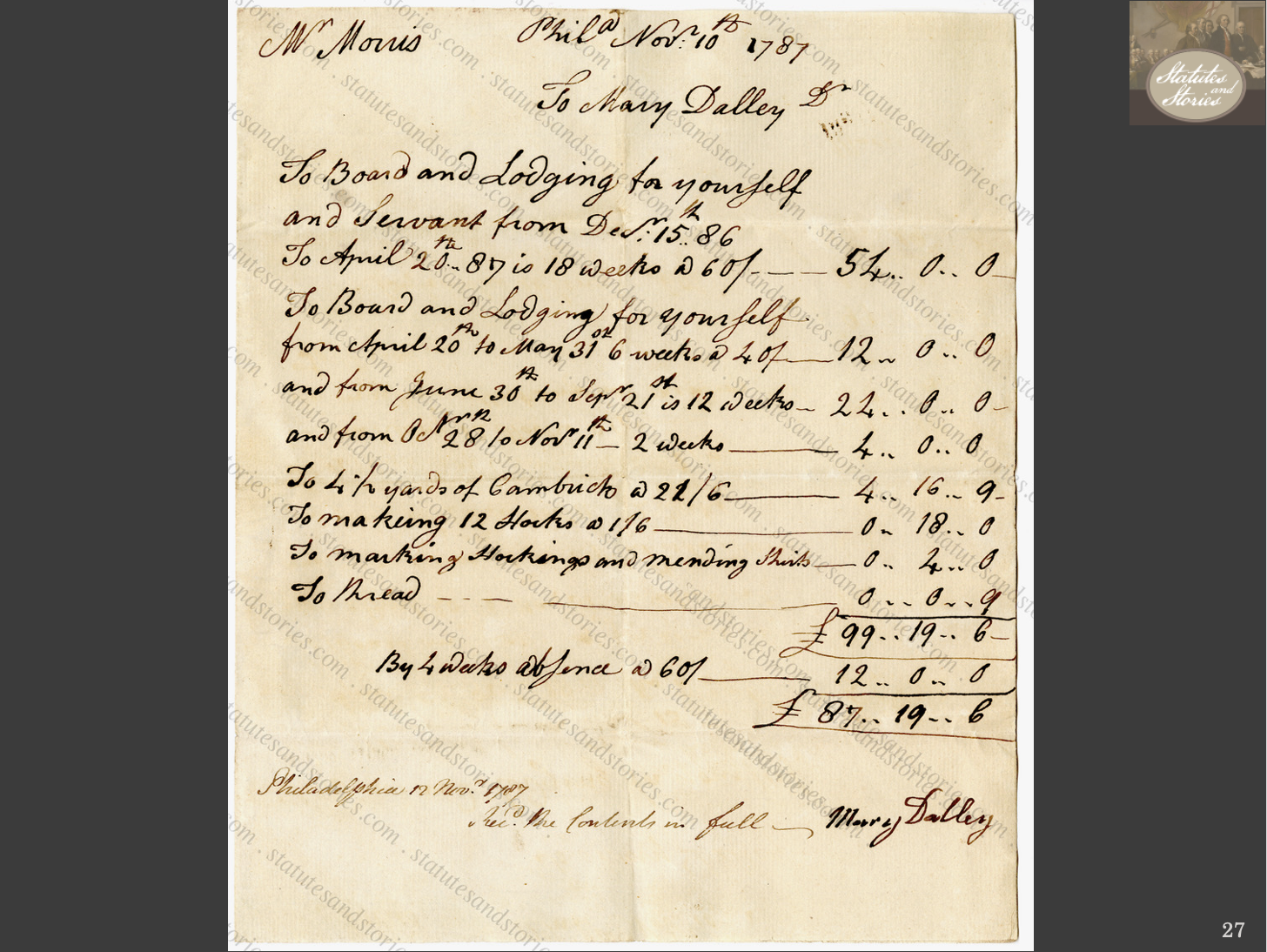
| 21. Photocopy of Gouverneur Morris’s boarding house receipt from Mary Dalley | Summer of 1787 |
While the Constitutional Convention adjourned on 17 September 1787, Gouverneur Morris continued boarding with Miss Dalley through 11 November 1787. He would subsequently travel to Virginia with Robert Morris on business. Thereafter he moved into his newly acquired estate in Morrisania, which he purchased from his half-brother.
This remarkable receipt, which is held in the collections at the American Philosophical Society, provides definitive proof that Gouverneur Morris resided at Miss Dalley’s boarding house during the Constitutional Convention. The receipt is signed by Miss Dalley and reflects other services that she provided including “making stockings and mending shirts” for Gouverneur.