Regarding Free Henry Hypothesis – Continued
Mary Dalley Eight in 1780 – Part 3

In April of 2026, a historic marker was installed in Philadelphia to honor Miss Dalley’s boarding house, otherwise known as the “Constitution House.” Gouverneur Morris (the “Penman of the Constitution”), Alexander Hamilton (“Publius”) and Elbridge Gerry (the “Federal Farmer”) boarded with Miss Dalley while attending the Constitutional Convention in 1787. But who else resided with Miss Dalley during the time spanning from the Revolutionary War through the First Federal Congress? What else can we learn about Miss Dalley’s ecosystem during some of the most important periods in American history?
In 2024 Statutesandstories.com identified eight members of the founding generation who boarded with Mary Dalley in 1780 (“the Mary Dalley Eight in 1780”). Miss Dalley’s boarders included Samuel Adams, Gouverneur Morris, Doctor John Jones[1] and General Alexander McDougall. Six of Miss Dalley’s guests in 1780 were Congressional delegates from Massachusetts and New Hampshire. Several boarders would become members and/or leaders of the Pennsylvania Abolition Society and the New York Manumission Society. Arguably the most tantalizing evidence uncovered in Philadelphia’s tax records[2] is the revelation that Miss Dalley employed a “free Negro servant” named Henry.
In 2025, Statutesandstories.com posited the (“Regarding Free Henry Hypothesis”) which focused on Henry, a “hired servant” employed by Miss Dalley. It is clear that Henry lived and worked in close proximity to Samuel Adams, Gouverneur Morris and other members of Congress during the Revolutionary War. The prospect that Henry might have been present at Miss Dalley’s boarding house seven years later – during the Constitutional Convention – remains an open question.
Part 1 launched the “What about Henry?” investigation to better understand the “Mary Dalley Eight in 1780” and their interactions with Henry. In an effort to shine a spotlight on Henry, Statutesandstories.com invited researchers and scholars to assist with this ongoing investigation. Part 2, the Regarding Free Henry Hypothesis, proposed that the Henry who worked for Miss Dalley in 1780 was Henry Stewart.
Henry Stewart was a colleague of Absalom Jones and Richard Allen and a co-founder and trustee of St. Thomas’ African Episcopal Church of Philadelphia, the first African American Episcopal church in the United States. In the later part of the 18th century, Henry Stewart would become a leader of the “African Free Society” (FAS), one of the first organizations of its kind in American history.[3] As an emissary of the free African American community in Philadelphia, Henry Stewart traveled to Boston in 1789 to meet with Prince Hall, “the first Grand Master of Colored Masons in the United States.”[4]
Part 2 began by introducing Henry Stewart and summarizing the limited information about his background. Admittedly, the hypothesis that the “Henry” who lived with Miss Dalley in 1780 was Henry Stewart is purely circumstantial. Nevertheless, the Henry Stewart hypothesis offers what is believed to be the strongest case for Henry’s identity based on an admittedly imperfect historical record.
Part 3 provides an update following two years of ongoing research which further reinforces the Henry Stewart hypothesis. As explained below, new details have emerged about Henry Stewart’s life, connections and family. For example, Henry’s oldest son, David Stewart, lived on the same block as John Beckley, the Clerk of the House of Representatives.
Although David Stewart is a common name, the Philadelphia Street Directory for 1795 specifies that the David Stewart who lived alongside John Beckley was an “African.” It is clear that Beckley had access to “contingent funds” for miscellaneous Congressional expenses. Part 3 posits that Beckley and his colleague, Gifford Dalley, the House Doorkeeper, may have periodically employed David Stewart as a laborer for Congress. Or, it may have been a mere coincidence that Henry’s son and John Beckley were neighbors on south Eighth Street between Walnut and Spruce streets.
Another discovery summarized below involves Henry’s Stewart’s diplomatic role as the representative for Philadelphia’s African American community. After traveling to Massachusetts and Rhode Island in 1789, Henry attempted to remain in contact with his New England colleagues. The minutes of the Newport Free African Union Society demonstrate that in 1791 Henry Stewart of Philadelphia, an “African Gentleman,” sent a book to his Rhode Island friends for their consideration. While the Newport minutes do not identify the title of the book, Part 3 proposes that the author was Philadelphia abolitionist Anthony Benezet. As previously described in Part 2, Henry Stewart, Absalom Jones, Richard Allen and other subscribers helped fund the publication of abolitionist literature and Phyliss Wheatley’s poetry. Accordingly, this blog post will argue that in 1791 Henry Stewart was at the forefront of what can be described as “book diplomacy.”
In addition to surveying emerging evidence and discoveries about Henry Stewart, his activities and family, Part 3 poses unanswered questions and a roadmap for future scholarly research. The goal is to leave no stone unturned in a collaborative effort to learn more about Henry and prove, refine, or disprove the Henry Stewart hypothesis. By no means has the final chapter of Henry’s story been written.
Henry Stewart and Philadelphia’s Free African Society

As described in Part 2, Henry Stewart became a leading member of Philadelphia’s African American community in the late 18th century. Philadelphia’s Free African Society (FAS) was established by Absalom Jones and Richard Allen in April of 1787, the month before the Constitutional Convention met in Philadelphia. The FAS was the first African American mutual benevolent society and fraternal organization in Philadelphia, the nation’s largest city at the time. The FAS was also historically significant as the forerunner of Philadelphia’s first independent African American churches, including Absalom Jones’s African Episcopal Church.[5] As described by historian Julie Winch, Jones and Allen had far-reaching plans for the FAS, which they hoped would become a “fully-fledged interdenominational church for Philadelphia’s African-American population.”[6]
Henry’s name first appears in the ledgers of the FAS beginning in 1788.[7] Many of the records of the FAS and St. Thomas’ Episcopal Church were subsequently transcribed as the Annals of the First African Church (“Annals”).[8] Stewart’s name appears over a dozen times in the Annals and can be found in over one hundred newspaper notices and church announcements.[9]
In June of 1789 Richard Allen parted company with Absalom Jones and the FAS, involving a respectful doctrinal disagreement. Allen would subsequently establish Philadelphia’s African Methodist Church and become its first bishop. Despite their religious differences, the “warm friendship” and collegial relationship between Absalom Jones and Richard Allen continued during their lifetime.[10] As Stewart remained at the FAS and became a leader at St. Thomas’s Church, one can infer that he was more closely aligned with Jones than Allen.
In 1790 Henry Stewart was one of eight petitioners, along with Absalom Jones, to the Mayor and City of Philadelphia seeking to lease Potter’s Field as a burial ground for African Americans.[11] Prominent Philadelphians, including Dr. Benjamin Rush and Tench Coxe, recommended the project.[12] Similarly, in 1791, Henry was one of eight signatories to the “Articles of Faith and Practice” for St. Thomas’ Church, which were widely published in the newspapers.[13] Henry’s name also regularly appeared in church fundraising appeals that were not only published in Philadelphia but also in surrounding states.[14] The “ringing broadside”[15] envisioned erecting a church, instructing their youth and taking care of their poor. The bold fundraising appeal also imagined laying a “foundation for similar churches” for Africans and their descendants in other states, as well as extending the Gospel of Jesus Christ to their brethren in Africa.
In February of 1792, Henry Stewart was one of six representatives listed on the deed to purchase land for the church.[16] Along with Absalom Jones, in 1794 Henry was one of the seven founders and trustees of St. Thomas’ African Episocpal Church.[17] He was one of four signatories to the petition supporting Jones’ ordination.[18] In March of 1796, Henry was one of five incorporators listed on the Act of Incorporation of St. Thomas’ church.[19] In 1796, Henry was elected vestryman as the “very first church officers of any congregation of persons of African descent in the United States.”[20] Importantly, Henry Stewart is the only “Henry” who’s name appears as a founder, trustee, vestryman or signatory to any of these early documents.
Interestingly, Henry is not listed on the December 1799 “Petition of Absalom Jones and Others, People of Color, and Freemen Against the Slave Trade to the Coast of Guinea” to the President and Congress.[21] As seventy names are listed on the Petition, one can only speculate as to why Henry Stewart didn’t sign.[22] Among the possibilities is that Henry was traveling[23] or otherwise indisposed. There should be no doubt that Henry Stewart would have agreed with the merits of the historic petition, which was introduced in Congress on January 2, 1800.
Henry Stewart and book diplomacy
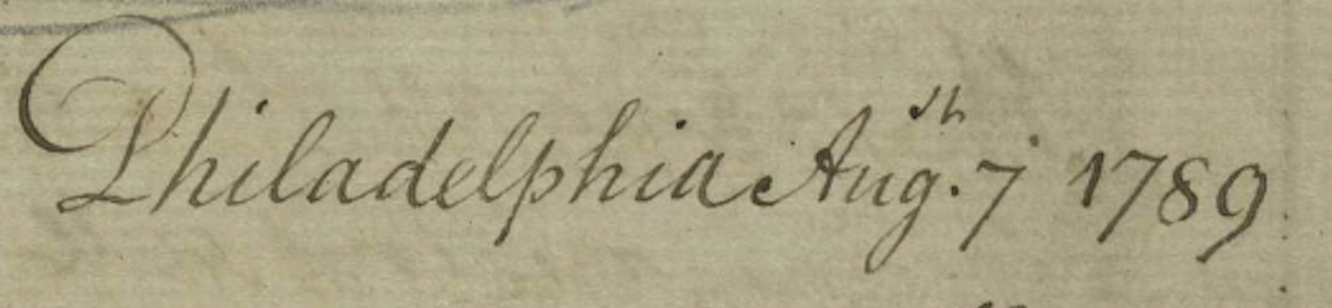
In the early days of the FAS Henry Stewart was selected to visit with similar societies in New England during the late summer and fall of 1789. While traveling to Boston, Stewart met with leaders of the Free African Union Society (FAUS) of Newport, Rhode Island.[24] In Boston, Stewart consulted with Prince Hall, the first African American Grand Master Mason in the United States. Letters from Newport and Boston detailing Stewart’s trip are transcribed in the FAS Annals and the Newport FAUS minutes. Stewart was described as a “truly worthy member” by his Newport colleagues, who prepared a “Certificate to H. Stewart” which likely facilitated his travel to Boston.
The correspondence delivered by Stewart in 1789 between colleagues in Boston, Newport and Philadelphia evidences heartfelt efforts to build bonds between their respective communities. For example, Prince Hall’s letter delivered by “your recommended brother, Mr. Henry Stewart” indicated that “We shall be glad therefore to hear of your proceedings, by letters of correspondence with us.”[25] Prince Hall signed the 16 September 1789 letter as “Your loving brother.” The response from the FAS in Philadelphia acknowledged differences of opinion about resettlement in Africa but emphasized that they were united in laboring in the same vineyard for the benefit of mankind.
While records are fragmentary, it is clear that Henry attempted to stay connected with his new Northeastern contacts. Importantly, the minutes of the Newport FAUS in March of 1791 indicate that Henry sent a book to Newport, approximately a year and half after his visit in 1789. As far as can be determined, no scholar – until now – has attempted to identify the book sent by Henry Stewart to Newport. Yet, insights can be gained by investigating what might be described as purposeful “book diplomacy” by Henry Stewart and his colleagues.
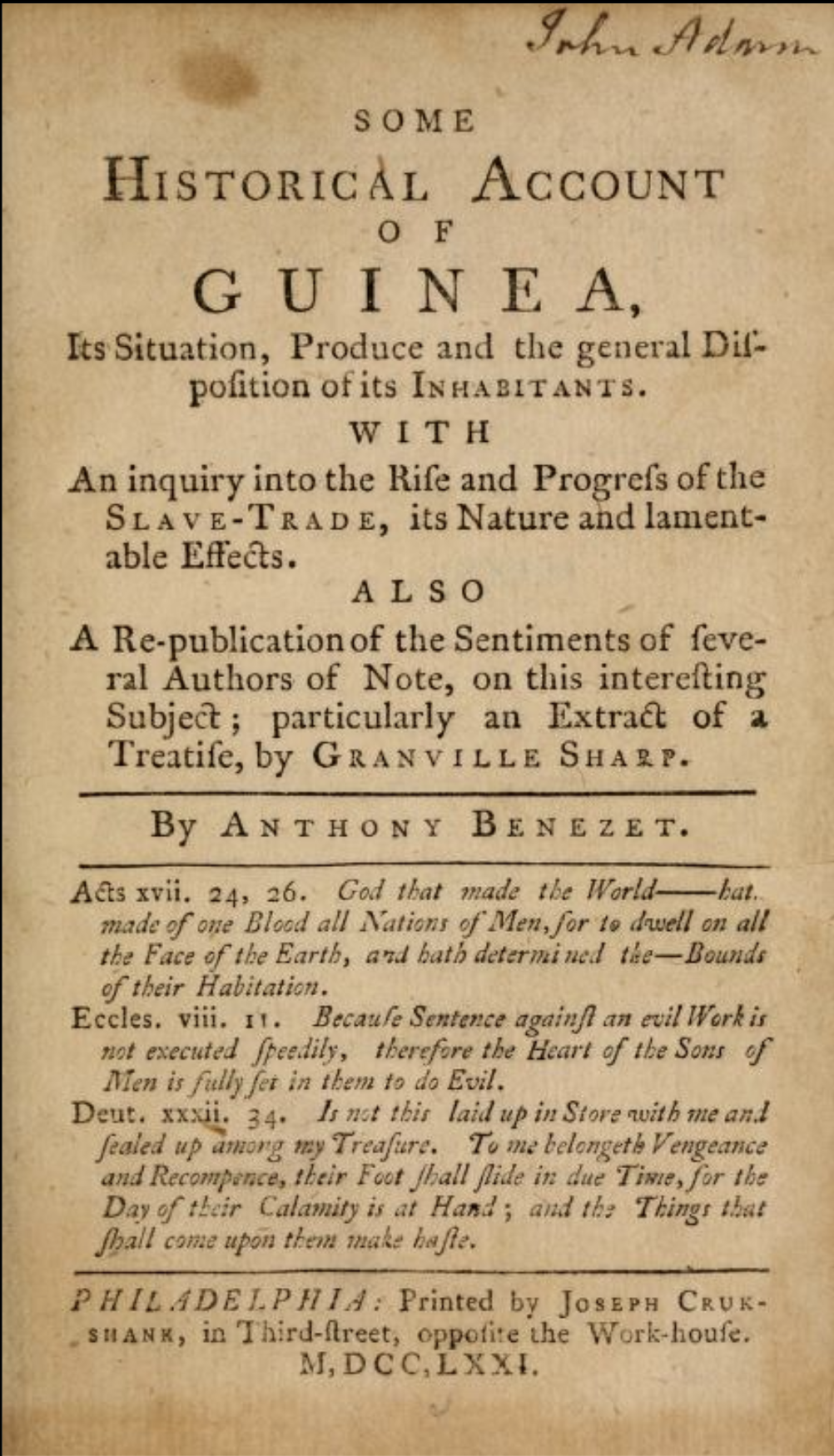
Pictured below is John Adams’ copy of the book, Some Historical Account of Guinea, Its Situation Produce and the General Disposition of Its Inhabitants, with an Inquiry into the Rise and Progress of the Slave-Trade, Its Nature and Lamentable Effects (Benezet’s “Account of Guinea”). Written by noted Philadelphia abolitionist Anthony Benezet, the seminal work went through several printings on both sides of the Atlantic. Based on the clues in the Newport minutes, it is reasonable to conclude that this was the book that Henry Stewart sent to his Rhode Island friends in 1791.
The Newport minutes are remarkably well preserved. It is likely that the members of the FAUS understood that they were making history which likely contributed to their diligent record keeping. The March 1791 minutes indicate that committee member Lymas Kieth presented a remarkable book for discussion. The unidentified book was enclosed under cover from Philadelphia and appeared to be a “present” from “Henry P. Stewart,” who had previously visited Newport. Here are clues as to why this book was likely Benezet’s Account of Guinea:
- according to the March 1791 minutes[26] the book was nearly 125 pages
- it was described as “respecting Africans in general”
- the book generated considerable interest by the membership and provoked “some unhappy disputes”
- according to the September 1790 minutes the FAUS already had another book respecting the settlement of Sierra Leone[27] (see minutes at page 68).
Admittedly, Benezet’s Account of Guinea was not the only book about Africa in 1790. Nevertheless, the following evidence supports the conclusion that this was in fact the book sent by Henry Stewart to Newport in 1791:
- The 1788 edition of Benezet’s Account of Guinea was 132 pages, whereas other books about Africa were generally larger. For example, Francois Valliant’s Travels into the Interior Parts of Africa was 376 pages. John Matthews’ Voyage to the River Sierra Leone was 183 pages.
- Another particularly popular book regarding Africa was The Interesting Narrative of the Life of Olaudah Equiano. The American edition of this biography was not published until September of 1791, after the March meeting in Newport.[28] An earlier edition was published in 1789 in London, but was over 250 pages.
- Henry Smeathman’s Plan of a Settlement to be Made Near Sierra Leone was another popular book at this time. Nevertheless, according to its minutes the Newport FAUS already had a copy of this book.
- Benezet’s Account of Guinea was originally published in 1771 in Philadelphia by Quaker printer Joseph Crukshank. The first edition printed by Crukshank was 197 pages, which exceeds the 125-page description. Importantly, the London reprinting of the book in 1788 was 132 pages, perfectly aligning with the Newport minutes’ description of “nearly 125 pages.” Accordingly, StatutesandStories has a high degree of confidence that the 1788 edition of Benezet’s Account of Guinea was the book sent by Henry Stewart to Newport.
- The title of Chapter 1 of Benezet’s book is “A general account of Guinea….” Likewise, the book’s subtitle contains the word “general disposition…” This nicely aligns with the minutes which describe the book as respecting Africans “in general.”
- The use of the name “Guinea” in the title of Benezet’s book also aligns with a famous antislavery Petition sent by Absalom Jones and his Philadelphia colleagues to Congress in December of 1799.[29] While the name is less commonly used today, it is clear that Guinea was synonymous with west Africa in late 18th century Philadelphia.
- Philadelphia publisher, Joseph Crukshank, was a dedicated abolitionist. After Benezet’s book was republished in 1788 Crukshank may have been willing to share extra copies of with kindred spirits.
- Perhaps most importantly, Henry and some of his older colleagues likely knew Anthony Benezet, a long-time resident of Philadelphia. As a philanthropist and educator, Benezet was beloved in Philadelphia before he passed away in 1784. In fact, it is believed that Henry Stewart, Absalom Jones, Richard Allen and James Forten may have attended the school established by Benezet for African American students.[30]

As described by historian Julie Winch, Anthony Benezet’s credentials as an abolitionist were “impeccable.”[31] Benezet wrote several books railing against the immorality of slavery. Benezet warned slave holders that they would be required to “account to God” for their actions. Speaking with unambiguous moral clarity, Benezet indicted the “barbarous treatment,” “intolerable hardships” and “insupportable tyranny” of slavery.[32] Benezet’s Account of Guinea was not merely an abolitionist tract:
At a time when much of Africa was unknown to Europeans, and when a great deal of what was known about Africa was erroneous and colored by European ethnocentrism, Benezet set out to collect reliable, first-hand accounts of West Africa and the conduct of the slave trade there. Influenced by his own encounters with Africans in Philadelphia and by insights gained from his knowledge of other Africans whose stories of their enslavement were reported to him, he was eager to correct many misrepresentations of West Africa that were used to defend the slave trade, and to present as accurately as he could the rich cultural diversity in the region known to Europeans as Guinea.[33]
Accordingly, mounting evidence supports the conclusion that Henry Stewart was very familiar with Benezet’s book when he sent a copy to Newport in early 1791. One can only imagine the reaction of the Black community in Philadelphia, Boston and Newport when they had access to Benezet’s vivid accounts of Africa’s Ivory and Gold coasts. Might Benezet’s descriptions of the Senegal and Gambia rivers have evoked childhood memories for Henry or his colleagues?
It is also reasonable to imagine that Stewart took pride in sharing the book, whose author may well have taught Henry to read. One can also infer that Henry and other Benezet school alumni might have attended Benezet’s funeral in 1784. As described by contemporary accounts, Benezet’s funeral was attended by “persons of all religious denominations” including “many hundred negroes.”[34] Perhaps one day an inscribed copy of Benezet’s book will be found with Henry’s notes or other provenance.
David Stewart and House Clerk, John Beckley
A second potentially significant discovery about Henry involves his oldest son, David Stewart. As explained in Henry’s will, David was the only surviving child of Henry’s first marriage to Margaret Carty. While David Stewart is a common name, the Philadelphia street directory for 1795 is very helpful as it identifies the race and occupation of city residents. Unlike alphabetical directories published in other years, the 1795 Directory organizes Philadelphia residents by street. As pictured below, the 1795 Directory indicates that David Stewart was an “African” laborer, who resided on the west side of South Eighth Street between Walnut and Spruce streets. Moreover, the 1795 Directory only lists one “David Stewart.”

Beginning in 1789, John Beckley became the first Clerk of the U.S. House of Representatives. In 1790 Beckley moved to Philadelphia when Congress relocated from New York. Only eight residents, including David Stewart and John Beckley, are listed in the 1795 Directory as residing on the west side of South Eighth Street between Chestnut and Walnut streets. Ephraim Miller, another African laborer, is listed immediately alongside David Stewart’s name. Accordingly, it is reasonable to ask whether Stewart and Miller might have worked as laborers for Beckley when Congress resided in Philadelphia from 1790 to 1800?
Admittedly, there are no records of payments from Beckley to David Stewart. Nonetheless, in his official capacity as House Clerk, Beckley “managed the House’s finances and payroll until the Sergeant-at-Arms, and later, the Chief Administrative Officer assumed those duties.”[35] Moreover, Beckley was authorized to expend “contingent funds” for miscellaneous and incidental Congressional expenses including “day-to-day operations of the chamber and the general upkeep of the facilities and ground.”[36]
As discussed in Part 2, Henry was employed by, and resided at, Miss Dalley’s boarding house in 1780, along with several members of Congress.[37] As discussed here, Miss Dalley’s brother, Gifford Dalley[38] was the official Doorkeeper for Congress. Pictured below are the names of Congressional staff, including John Beckley and Gifford Dalley, along with the House Chaplain and Sergeant-at-Arms. One can reasonably posit that Henry Stewart used his connections with Miss Dalley and her brother, Gifford Dalley, to secure David Stewart’s employment with Beckley and the House of Representatives.

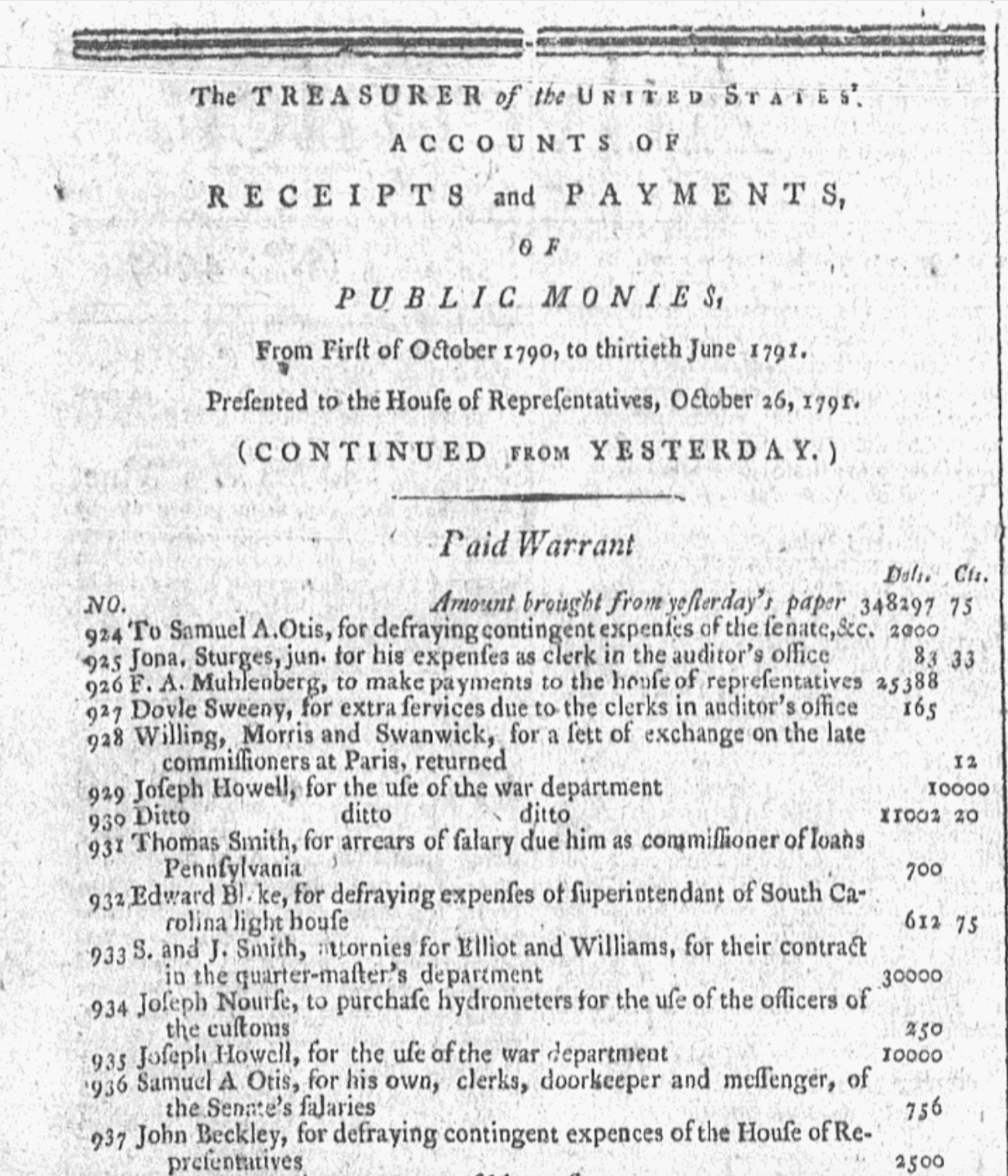
By way of example, in 1793, contingent expenses of the House of Representatives exceeded $4,000.[39] This sum was appropriated to the Office of the Clerk of the House of Representatives, John Beckley. The amounts spent by Beckley grew over time. Warrants paid to Beckley in 1791 were $2,500. By 1797, the total budgeted for the expense of fire-wood, stationary, printing, and all other contingent expenses for the House and Senate were $12,000.[40] Unfortunately, the individual payments to laborers and their identities are not specifically broken out. “The Clerk’s control of the contingent fund was unquestioned prior to March 1, 1823,” when Congress adopted joint resolutions requiring annual statements detailing expenses.[41] Nevertheless Congressional expenses would have included fuel, furniture, and “the hiring of carpenters, painters, bricklayers, blacksmiths, chimney sweeps, and general laborers, as well as the purchase of materials for general physical plant upkeep.”[42] It is thus reasonable to propose that David Stewart may well have periodically worked for John Beckley or Gifford Dalley, in their official capacities with the House of Representatives.[43]
The 1796 Philadelphia Directory provides a specific street address for both Beckley and David Stewart confirming that they were neighbors. As pictured below, Beckley’s address was “99 South Eighth Street.” Stewart lived “near 99, South Eighth Street.” It is thus possible that Beckley and Stewart lived in the same building or the same lot, with David Stewart and Ephraim Miller living in the basement or nearby outbuilding.[44] It cannot be doubted, however, that Henry Stewart’s son, David Stewart, knew his neighbor John Beckley. Consistent with the Regarding Free Henry Hypothesis, StatutesandStories.com does not believe that it was a coincidence that David Stewart shared the same street address as the Clerk of the House of Representatives.[45]


Henry Stewart’s name appears three times in the Philadelphia Directory as follows:
- 1793: Henry C. Stuart, nailor, South Fourth near Gaskell Street
- 1798: Henry Steward, blacksmith, near fifth, in Lombard Street
- 1799: Henry Steward, blacksmith, 164 Lombard Street
Henry Stewart’s family and will
Henry Stewart’s will[46] provides clues about his identity. Among other things, the will confirms his address in March of 1800 and identifies his wife, three children, friends and property as follows:
- Henry’s will and probate notice describes his occupation as nailer.
- Henry identified his “beloved wife” as Elizabeth Stewart.
- He bequeathed to Elizabeth a life estate in the house and land located on the south side of Lumber/Lombard Street between 4th and 5th streets, measuring 30 feet x 70 feet.[47]
- Upon Elizabeth’s death the property and “tenements thereon” were to be equally divided between his three children, Rebecca, John and David.
- The will explains that Rebecca and John were children of Elizabeth, whereas Margaret Carty was the mother of Henry’s oldest son David.
- Other property owned by Henry included a silver watch, silver shoe buckles, a desk, shop tools, feather bed, household goods and kitchen furniture of every kind.
- Henry appointed “his trusty and well beloved friends” William White and Cyrus Porter executors with Elizabeth as executrix.
- The will was witnessed by none other than Absalom Jones and Rachel Spelman.


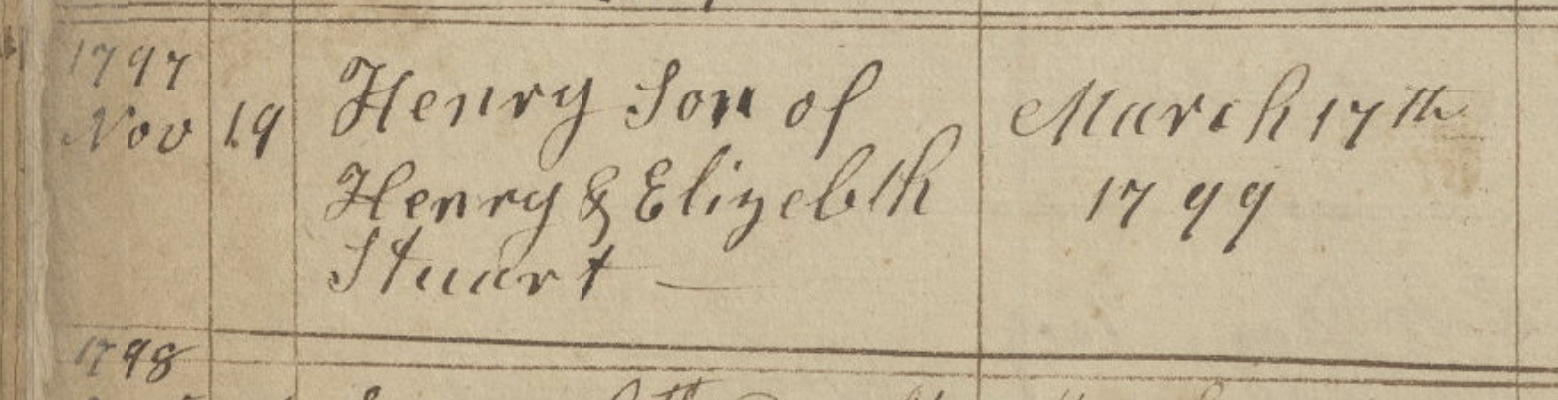
Church records confirm that Henry Stewart and Elizabeth Foreman (described as “blacks”) married on 22 January 1793.[48] Henry and Elizabeth appear to have given birth to other children who did not survive to adulthood. Pierce Gray Stewart, the son of Henry and Elizabeth, was born on 11 January 1796 and baptized on 29 March 1796 by Absalom Jones. Henry, the son of Henry and Elizabeth Stewart, was born on 19 November 1797 and was baptized on 17 March 1799. Henry and Elizabeth’s two surviving children, Rebecca (age 6) and John (age 5), enrolled as “scholars” in Absalom Jones’ school.[49]


The probate notice for Henry’s estate is copied below. Interestingly, the notice was published in September of 1804, suggesting that Henry died four years after his March 1800 will was executed. Alternatively, the probate of Henry’s estate might have been delayed if he passed prior to 1804. The probate notice identifies Henry Stewart as a nailer and lists his executors as Cyrus Porter and William White, as appointed by his will.
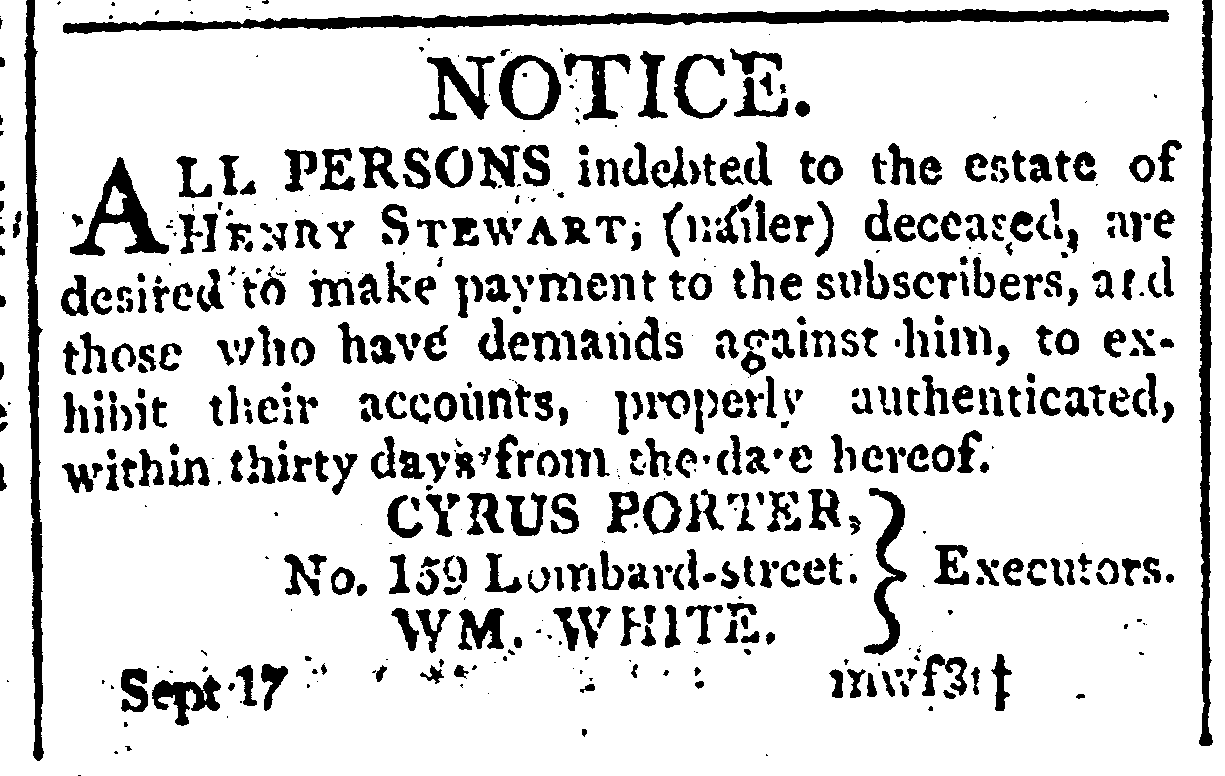
Henry Stewart, “nail manufactory,” and indenture of Thomas Holliday
Consistent with his will and several street directories, Henry Stewart operated a nail manufactory in the late 18th century. This should not be a surprise as beginning in 1794 Richard Allen, Absalom Jones and Cezar Wetherington also ran a nail manufactory. As no newspaper advertisements have been found for Henry Stewart’s nail-making business, one can expect that Stewart’s operation was similar to his colleagues’, assuming that they weren’t working together. According to the newspaper advertisement pictured below, the Allen/Jones/Wetherington’s manufactory was located on Fourth Street, adjoining St. Peter’s Church. The advertisement by Allen, Jones and Wetherington sought “a number of Africans or their descendants” for work as journeyman and apprentices.[50]

In 1795 Henry Stewart, nailer, executed an indenture with his apprentice, Thomas Holiday. The two-year apprenticeship obligated Henry to instruct Holiday in the trade of nail-making. Confirming that he was literate, Henry signed his name on the indenture above Thomas, who marked his name with an “x.” The indenture was executed on 19 May 1795, and was witnessed by Gunning Bedford, Alderman of the City of Philadelphia.[51] Images of the apprenticeship indenture between Henry Stewart and Thomas Holiday are copied below.


In 18th century Philadelphia, the indenturing of servants was not uncommon. For example, Absalom Jones had several indentured servants “bound by the consent of” their parents in 1793.[52] In the mid-18th century, indentured servants constituted a quarter of Philadelphia’s labor force. As described by historians Gary Nash and Jean Soderlund, in 1790 “half of the city’s free blacks lived in white households and ten years later census takers counted 56% of the black population working and residing with white families.”[53] Indenturing thus became the “intermediate station that thousands of blacks on the road to freedom occupied…”[54]
Miss Dalley and Maria
In 1793, Mary Dalley, Henry Stewart’s prior employer, executed an indenture agreement with a “negro girl named Maria, aged about nine years and three months.” As a condition of Maria’s apprenticeship, Mary Dalley agreed to teach Maria “housewifery and to read the bible and New Testament.” The indenture explains that Maria was manumitted and “set from slavery” by her prior enslaver, Richard Bassett of Kent County, Delaware.[55]
The fact that Maria was indentured to Mary Dalley by Richard Bassett is noteworthy. As described by historian William H. Williams, “no Methodist was more important in the fight against human bondage in Delaware than Richard Bassett.” Bassett was the first chief justice of the Delaware Court of Common Pleas, a state legislator, U.S. Senator, and Governor of Delaware. In 1787, Bassett was a delegate from Delaware to the Constitutional Convention in Philadelphia, where he may have met Henry Stewart and/or Mary Dalley. As a founding member of Delaware’s abolition society in 1788, Bassett advanced the cause of abolition in the Delaware legislature by sponsoring the state’s first manumission law in 1787. The preamble of his bill declared that the slavery was “contrary to the principles of humanity and justice and derogatory to the honor of this state.”[56] Bassett co-founded the Delaware abolition society with Quaker Warner Mifflin.[57] Bassett’s antislavery allies included John Dickinson, the author of a gradual abolition bill in 1786, which was supported by a petition signed by more than 200 Quakers.[58]
While Henry was not a Quaker, it is clear that he associated with Quakers. In 1780, Quaker Thomas Mifflin was the owner of Miss Dalley’s building. Seven years later Thomas Mifflin would become a delegate to the Constitutional Convention a year after his cousin Warren Mifflin co-founded the Delaware Abolition Society with Richard Bassett. Matthew Clarkson, another Miss Dalley boarder in 1780, introduced the law gradually abolishing slavery in New York. As described in Part 2, several boarders who lived with Miss Dalley and Henry in 1780 became prominent abolitionists and leaders of the Pennsylvania Abolition Society and New York Manumission Society, including Clarkson. Miss Dalley’s long term boarder, Gouverneur Morris, is universally recognized as the most outspoken opponent of slavery at the Constitutional Convention. What else can be learned about this ecosystem, which might be called Henry’s circle?
Roadmap for future researchers
Did Henry Stewart attend classes at Anthony Benezet’s school? When? Who else was in his class(es)?
Might a survey of antiquarian book collections locate an inscribed copy of Benezet’s Account of Guinea with marginalia or inscriptions from Henry, Philadelphia’s African Free Society, or the Newport Free African Union?
Is it possible that Henry might have been the author of the anti-slavery Cato letter and petition which was published in Freeman’s Journal on 21 September 1781? Note that Absalom Jones and Richard Allen were still enslaved in 1781 and the famous Cato letter has not been attributed to them. FAS members circa 1794 included: Cato Collins, Cato Freeman, Cato Jackson, Cato Robinson, Cato Williams and Simon Cato.
Was Henry freed by Pennsylvania’s 1780 Act? Or was Henry free prior to 1780?
Where was Henry born? What happened to his first wife, Margaret Carty, assuming that they were married?
According to the 1780 Constable Return, the same building which housed Miss Dalley’s boarding house also housed “Mifflin & Butler’s store.” In addition to working for Miss Dalley, did Henry also assist with this store? What was the relationship between Henry and Thomas Mifflin, Miss Dalley’s landlord in 1780?
When did Henry start working with Miss Dalley? When did he stop?
Did Henry have a relationship with Bartholomew Wistar, Miss Dalley’s landlord beginning in 1782 when she relocated her boarding house to Market and Third streets. Note that Bartholomew Wistar and his brother Dr. Caspar Wistar were prominent Quakers. https://archives.upenn.edu/exhibits/penn-people/biography/caspar-wistar/
Did Henry have a relationship with Dr. John Jones, a long-term boarder at Miss Dalley’s boarding house. Note that Dr. Jones was boarding with Miss Dalley and Henry as early as 1780.
Is it possible that David Stewart made or repaired chairs for Congress? In the 1797 Philadelphia Directory David Stewart was listed as a “windsor chair maker.”
Alexander Hamilton was a delegate to Congress in Philadelphia in 1782-1783. Might Hamilton have boarded with Miss Dalley? Was Henry still working with Miss Dalley in 1782?
Did Henry or any of his children move to Washington DC in 1800 with Miss Dalley?
Was Henry a hired servant working for Gouverneur Morris or other boarders / members of Congress?
Did Henry assist Gouverneur Morris when he lost his leg in 1780?
Is it possible that Henry might be mentioned in the letters/papers of Miss Dalley’s boarders?
What was Henry’s background? Was Stewart his given name or did Henry choose his last name? Was Stewart selected because a steward was charged with taking care of property? Was Henry his first or last name?
Did Henry travel with members of Congress or merchants to Boston and/or Newport?
The papers of the Pennsylvania Abolition Society, Series 5.27, indicate that Henry Stewart and Rudolph Boys were defendants in a lawsuit brought by James Holland in March of 1796. What was the case about?
Was Henry in fact a member of Absalom Jones’ Masonic lodge? The minutes are inconclusive.
Was Rachel Spelman, one of the witnesses on Henry’s will, related to Laura Spelman Rockefeller?
In addition to Henry Stewart, the Free African Society had several other members named Henry in 1794: John/Johnathan Henry, Henry Duff, Henry Wilshire, and Henry Wilson. Annals at 107. Might these other Henrys have been the Henry who lived with Miss Dalley in 1780?
The subscriber list to the 1801 printing of The Negro Equalled by Few Europeans with Wheatley poetry contains nine Henrys including Henry Stewart: Henry Baker, Henry Hubley, Henry Miller, Henry Richards, Henry Scott, Henry Sharp, Henry Thompson and Henry Warren. Yet none of these Henrys appear to have been associated with the Free African Society, as was Henry Stewart.
As described by the Library Company, “Philadelphia’s free black population grew from about 240 in 1780 to 1,849 in 1790, over 6,000 in 1800, and 8,942 by 1810; an increase from 2.1% of the total population in 1780 to 10% by 1810.” Accordingly there were a limited number of free Henrys in 1780. https://www.librarycompany.org/blackfounders/section6.htm
What cooperation/collaboration can be ferreted out between Henry (or the FAS in Philadelphia) and the African Free Union Society (FAUS) in Newport or Prince Hall’s African Lodge in Boston? For example, in 1793 the FAUS sent $6 to Philadelphia to aid in the construction of Absalom Jones’ church. Collection of the Newport Historical Society, Vol.1674B, p. 186. https://newporthistory.org/your-brethren-in-affliction-the-free-african-union-society-and-18th-century-black-networks-of-communication/
Phillis Wheatley’s poems were added to the 1801 publication of The Negro Equaled by Few Europeans based on “the solicitation and recommendation of a number of Gentleman.” Philadelphia Gazette and Daily Advertiser, 13 January 1801. Is it possible that Henry or his colleagues played a role in this decision by the book’s publisher, W. Woodward of Philadelphia?
Absalom Jones’ 1799 anti-slavery petition was signed by Henry William and Henry Peters (both of whom marked their name with an “x”). Might these other Henrys have been the Henry who lived with Miss Dalley in 1780, rather than Henry Stewart?
Endnotes
[1] Doctor Jones would become the physician for Benjamin Franklin and George Washington.
[2] The 1780 Constable Return for the Walnut Ward in Philadelphia, at 107. https://openn.library.upenn.edu/Data/0055/html/tx10.html#a107r
[3] Gary B. Nash, Forging Freedom: The Formation of Philadelphia’s Black Community, 1720-1840 (Cambridge: Harvard University Press, 1988), 98; Ira V. Brown, The Negro in Pennsylvania History (The Pennsylvania Historical Association, 1970), 11.
[4] Rev. George F. Bragg, Jr., The First Negro Organization: the Free African Society, established on April 12th, 1787 (Baltimore: 1924).
[5] Julie Winch, Philadelphia’s Black Elite: Activism, Accommodation, and the Struggle for Autonomy, 1787-1848 (Philadelphia: Temple University Press, 1988), 5; Leslie M. Harris, “Free African Society,” Paul Finkelman, Editor, Encyclopedia of African American History: 1619-1895, vol. 2 (Oxford University Press, 2006), 57.
[6] Winch, A Gentleman of Color at 139.
[7] African Episcopal Church of St. Thomas, Free African Society Receipts and Expenditures, digitized by Philadelphiacongregations.org.
[8] William Douglass, Annals of the First African Church in the United States of America, now styled The African Episcopal Church of St. Thomas (Philadelphia, King & Baird, 1862).
[9] In two cases, Henry’s Stewart’s last name is spelled “Steward.” Annals at 36 and 104. This alternative spelling of Henry’s last name also appears in Philadelphia street directories and other contemporaneous records. For example, the General Advertiser spelled his name as “Henry Stuart” when publishing the African Church’s “Articles of Faith and Practice” on 2 September 1791.
[10] Annals at 22-23.
[11] A prior petition had been submitted in February of 1786, but the minutes of the City’s Supreme Executive Council did not record the names of the petitioners. Winch, A Gentleman of Color at 139.
[12] Annals at 34-35. Despite the favorable endorsement, the proposal was not approved in 1790. As the 1790 petition was not successful, subsequent attempts to secure cemetery space continued in 1793, as summarized by the Bethel Burying Ground Project: https://bethelburyinggroundproject.com/2015/02/01/the-hallowed-ground-before-bethel-burying-ground/ See also https://www.creativephl.org/wp-content/uploads/2020/12/Pt-Two-Appendix.pdf
[13] Independent Gazetteer, 10 September 1791.
[14] Benjamin Franklin Bache’s newspaper, the General Advertiser, ran fundraising advertisements for the church from August 30, 1791 to March 19, 1792. Bache was Benjamin Franklin’s grandson. Other newspapers which reprinted the fundraising appeal included the Federal Gazette (29 August 1791), Dunlap’s American Daily Advertiser (30 August 1791), and the Providence Gazette (17 September 1791).
[15] Nash, Forging Freedom at 113.
[16] According to the deed, title vested in the trustees including Absalom Jones and Henry Stewart. The First Negro Organization, 12; Annals, 43.
[17] Annals at 95.
[18] Annals at 102.
[19] Annals at 85 and 90.
[20] George F. Bragg, History of the Afro-American Group of the Episcopal Church (Baltimore; Church Advocate Press, 1922), 68. https://archive.org/details/historyofafroame0000brag/page/68/mode/2up
[21] https://www.nps.gov/articles/000/inde-1799-12-30-petition-ajones-abolition-guinea.htm
[22] The petition is signed by a Henry Peters and Henry Williams, who in theory might have been the free negro named Henry who was employed by Miss Dalley in 1780. With that said, both Henry Peters and Henry Williams marked their name with an “x,” suggesting that they were unable to sign their names. By contrast, based on this prominent role and activities with the FAS, it is believed that Henry Stewart was literate.
[23] For example, Henry Stewart might have been traveling 1) to obtain subscribers for the publication of the book, Negro Equaled by Few Europeans, published along with Phillis Wheatley’s poetry, 2) on church and/or Masonic business, or 3) for personal and/or other business reasons. It is also noteworthy that the name “Herny Stewart” appears in the “list of letters” waiting to be picked up at the Philadelphia post office in May of 1799. Philadelphia Gazette, 6 May 1799.
[24] Annals, 25; Winch, Philadelphia’s Black Elite at 7; Julie Winch, A Gentleman of Color: The Life of James Forten (Oxford University Press, 2002), 145; Nash, Forging Freedom at 103.
[25] Annals at 30-31.
[26] FAUS minutes at 80.
[27] FAUS minutes at 68. By1790 several books had been published about colonization / resettlement in Sierra Leone. As indicated by Professor William H. Robinson, the Sierra Leone book mentioned in September of 1790 was likely Henry Smeathman’s book, Plan of a Settlement to be Made Near Sierra Leone (London, 1786). FAUS minutes at 69.
[28] New-York Journal, 24 September 1791.
[29] https://www.nps.gov/articles/000/inde-1799-12-30-petition-ajones-abolition-guinea.htm
[30] Benezet was teaching free African American students by 1750. He also taught children of slaves at night from his home. David Hackett Fischer, African Founders: How Enslaved People Expanded American Ideals (Simon & Schuster, 2022), 234; Nancy Slocum Hornick, “Anthony Benezet and the Africans’ School: Toward a Theory of Full Equality,” The Pennsylvania Magazine of History and Biography, vol. 99, no. 4. (Oct. 1975), 415-416. https://www.jstor.org/stable/20091000?googleloggedin=true&seq=1
[31] Winch, A Gentleman of Color at 15. According to Benezet’s biographer, during his lifetime he became “the leading crusader and theorist” against slavery in in the Western world. Maurice Jackson, Let This Voice be Heard (University of Pennsylvania Press: 2009), 32; Fischer, 247-248.
[32] Benezet, Some Historical Account, 1771 edition at 94.
[33] Randy J. Sparks, “‘This Precious Book’: Africa and Africans in Anthony Benezet’s Account of Guinea” in Marie-Jeanne Rossignol & Bertrand Van Ruymbeke, eds., The Atlantic World of Anthony Benezet: 1713-1784 (Bill: 2017).
[34] Freeman’s Journal, 30 November 1791; Pennsylvania Gazette, 12 May 1784.
[35] https://history.house.gov/Institution/Origins-Development/Other-Officers-of-the-House/
[36] Jeffrey A. Jenkins & Charles Stewart III, More than Just a Mouthpiece: The House Clerk as Party Operative, 1789-1870 (paper presented at the annual meeting of the American Political Science Association, 2004), 5. https://dspace.mit.edu/entities/publication/c200190f-a996-46e6-b0e5-60fbbbb31338
[37] It remains an open question how many years Henry worked for and/or lived at Miss Dalley’s boarding house. The 1793 Directory lists a Henry C. Stewart, “nailor,” living at South Fourth Street near Gaskell Street.
[38] The last names for both Mary Dalley and her brother Gifford Dalley were commonly and inter-changeably spelled Dalley or Dally. Their mother was Sarah Gifford who married Hendrick Dalley in November of 1739. Thus, Gifford Dalley’s first name was his mother’s maiden name. https://www.statutesandstories.com/blog_html/samuel-fraunces-family-of-tavernkeers/
[39] American State Papers, Documents, Legislative and Executive of the Congress of the United States, from the 1st Session of the First to the 2nd Session of the 10th Congress (Gales & Seaton, 1834), 59. https://founders.archives.gov/documents/Hamilton/01-17-02-0471-0007
[40] An Act making appropriations for the support of Government, for the year 1797, Debates and Proceedings in the Congress of the United States, Fourth Congress, Second Session, (Gales & Seaton, 1849), 2944. https://babel.hathitrust.org/cgi/pt?id=uc1.a0013393905&seq=724&q1=fire-wood
[41] Jenkins & Stewart at 5, n. 6.
[42] Id. at 5.
[43] It has long been known that both enslaved and free African American laborers, including carpenters and brickmakers, were employed building the White House and Capitol in Washington, DC. https://www.archives.gov/press/press-releases/2009/nr09-28-images
[44] It is also possible that David Stewart was employed by Jedediah Snowden, a gentleman who also lived at 99 South Eight Street. Of course, it is also possible that Stewart worked for both Beckley and Snowden.
[45] The 1797 Philadelphia Directory identifies David Stewart as a windsor chair maker, living on Eighth Street between Walnut and Spruce streets. John Beckley’s address was also Eighth Street between Walnut and Spruce. It is likely that David worked with John Chapman, who is described as a winsor chair maker in the 1796 Directory.
[46] The will spells the family name as Stuard, but there can be no confusion that Henry Stewart and Henry Stuard were one and the same. Book Y, page 307. The probate notice spells his name Henry Stewart.
[47] In 1806, James Forten would subsequently purchase a three-story house on Lombard Street between Third and Fourth. Winch, A Gentleman of Color at 101. The African Lodge of Masons in Philadelphia met at 155 Lombard Street. William H. Grimshaw, Official History of Freemasonry Among the Colored People in North America (Broadway Publishing Co., 1903), 113. Grimshaw lists Henry Stewart on the roster of members of Philadelphia’s Free and Accepted Masons from 1797-1808, which included Absalom Jones, Richard Allen and James Forten.
[48] The Register-Book of Marriages belonging to the United Churches of Christ Church and St. Peter’s, commencing January 1763.
[49] Pennsylvania Abolition Society Papers, Series 5.2, 5-172.
[50] Aaron Goodwin, “Richard Allen: First Bishop of the African Methodist Episcopal Church,” Pennsylvania Genealogical Magazine, vol 46, 207 (2010); Philadelphia Gazette, 20 February 1794.
[51] Indenture Book of the Pennsylvania Abolition Society, Book D, page 75. Philadelphia Alderman Gunning Bedford is easily confused with the Delaware delegate and Constitution signer who shared the same name.
[52] PAS Papers Series 4.3, Indenture Books, image 91 of 395.
[53] Gary B. Nash & Jean R. Soderlund, Freedom by Degrees: Emancipation in Pennsylvania and its Aftermath (Oxford University Press, 1991), 173-174.
[54] Id. at 173.
[55] PAS Papers Series 4.2, Manumission Books E-G, 126 of 683. Indenture Book E, page 62 suggests that Maria’s indenture was voluntary, but nonetheless ended on December 28, 1804.
[56] Patience Essah, A House Divided: Slavery and Emancipation in Delaware (University Press of Virginia, 1996). 82; John A. Munroe, Federalist Delaware: 1775-1815 (Rutgers University Press, 1954), 158.
[57] During the Revolutionary War, Mary Dalley operated her boarding house out of a building owned by Thomas Mifflin on the corner of Front and Walnut streets in the Walnut ward. In 1782, she moved her boarding house to another building owned by Bartholomew Wistar on Market and Third streets.
[58] John A. Munroe, Colonial Delaware: A History (KTO Press, 1978), 189-190.